Scottish Justice Committee examines performance of Crown prosecutors in wildlife crime cases

copfs-logoThe Scottish Parliament’s Justice Committee is in the middle of an inquiry into the role and purpose of the Crown Office and Procurator Fiscal Service (COPFS).

This is a broad inquiry focusing on the core role of the COPFS and examining its effectiveness and efficiency, how well it works with stakeholders and the support it provides to witnesses and victims of crime.

As part of the inquiry, interested organisations were invited to submit written evidence. A full list of these submissions can be found here and we were pleased to see submissions from Scottish Badgers, RSPB Scotland and Scottish Environment LINK, all discussing their concerns about how wildlife crimes are handled. These three submissions can be read here:

written-submission-from-scottish-badgers

written-submission-from-rspb-scotland

written-submission-from-scottish-environment-link

All are well worth a read. The evidence from Scottish Badgers is particularly shocking. Here’s an example:

Our recent analyses of evidence averages 60 reports of badger incidents per quarter – of which 40 are confirmed badger crimes. This is in stark contrast to the 7 badger crimes recorded in police statistics in the year 2013/14, none of which were brought to prosecution‘.

Once again this calls in to question the veracity of the Scottish Government’s annual Wildlife Crime Report, which we’ve already criticised for its exclusion of a number of confirmed raptor persecution crimes (see here). The disparity between the annual crime figures recorded by Scottish Badgers and those recorded by Police Scotland is enormous, and again undermines any confidence that is to be had from the Government’s annual Wildlife Crime Report.

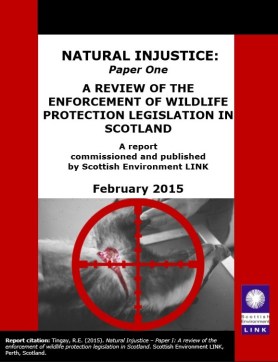
Natural Injustice 1 Feb 2015 cover - CopyAll three submissions to the Justice Committee share a common theme – there is repeated criticism of the chronic lack of communication and engagement from the Crown Office with organisations that have played key roles in wildlife crime investigations. This topic was further discussed during an oral evidence session to the Justice Committee on 29 November 2016. Ian Thomson (Head of Investigations at RSPB Scotland) was invited to speak to the Committee on behalf of Scottish Environment LINK. The video of this evidence session can be viewed here (starts at 11.15 mins) and the transcript of the evidence session can be read here (starts at page 6).

During this oral session, Ian talked at length about the Crown Office’s refusal to communicate, and the subsequent frustration and missed opportunities to learn that this silence engenders. Some members of the Justice Committee seemed pretty shocked by this, and the irony wasn’t lost on them when they were told the (former) Lord Advocate had steadfastly refused to meet with LINK members to discuss a 2015 report (‘Natural Injustice‘) that had flagged up the same communication failures.

Complaints about a lack of communication from the COPFS isn’t just limited to those groups involved with the investigation of wildlife crime. A number of other submissions from completely different sectors, including those involved with rape victims, restorative justice, victim support, and even the covener of a car rally, had also all raised the same point.

Let’s hope that the Justice Committee’s inquiry results in some recommendations to improve this on-going problem, and let’s also hope that the recommendation, if it comes, is not ignored like it was when it was previously made (in relation to the investigation of wildlife crime) in 2008 (see here).

Minutes of meeting between Cairngorms National Park Authority & Scottish Gamekeepers’ Association

ALMDLast month we blogged about a comment that had been made during an official meeting between the Cairngorms National Park Authority (CNPA) and the SGA. The comment came from a CNPA Board member (Eleanor Mackintosh) who was advising the gamekeepers to ‘cover up’ dead mountain hares so that photographs of the corpses couldn’t be published on social media (see here).

That meeting between the CNPA and the SGA was triggered by the SGA’s anger over a blog that had been written by Will Boyd Wallis (CNPA’s Head of Land Management & Conservation) in August, where Mr Boyd Wallis had raised legitimate concerns about some aspects of intensive grouse moor management (see here).

The SGA was furious about that CNPA blog, for a number of reasons (see below). The SGA asked for a meeting with the CNPA to discuss these concerns and the meeting was arranged, apparently after the ‘intervention‘ of Fergus Ewing MSP, who is Cabinet Secretary for the Rural Economy & Connectivity, but whose remit does not cover the National Parks (Cabinet Secretary Roseanna Cunningham has responsibility for the National Parks).

Chairman of the SGA, Alex Hogg, wrote to the CNPA requesting a meeting. We got a copy of his letter via an FoI request and here it is: sga-letter-requesting-mtg-with-cnpa-sept-2016

It’s an entertaining read. In it, Alex claims there’s no need for concern about the potential environmental harm of dumping tonnes of medicated grit on to the grouse moors because there’s no scientific evidence to show any damage. He also suggests that if the CNPA was concerned about potential environmental damage then the CNPA would be looking at the issue of dogs and livestock (which have also been wormed) defecating all over the Park. Hmm. If dogs and livestock had been wormed every day with a drug that was 10-20 x the strength permitted for use in the UK, and those piles of faeces were placed at every 100 metres across the grouse moor, for up to eight months of the year, as are piles of medicated grit put out for red grouse, then he might have had a valid point. Unfortunately for Alex, there is growing scientific evidence that the drug used in medicated grit (Flubendazole) is actually highly toxic to some aquatic organisms (e.g. see here) and, given the extent of its use on intensively managed grouse moors, this is exactly why Leeds University is offering a PhD scholarship to examine this issue in more detail (see here).

Anyway, on to the actual meeting itself. This took place on 29 September 2016 at Glenlochy in the National Park (an interesting choice of venue given the raptor persecution crimes that have been recorded in the area). In attendance were several representatives of the CNPA, several from the SGA, including Bert Burnett, some gamekeepers, and local SNP councillor Geva Blackett, who used to work as the SGA’s Parliamentary Officer many moons ago and who is married to Simon Blackett, the (now retired) Estate Factor at Invercauld Estate.

The minutes can be downloaded here: minutes-cnpa-sga-mtg-29-sept-2016

These minutes are well worth a read, not just because they expose the buffoonery of the SGA, but also because they provide an insight to the astonishing display of deference from the CNPA officials towards the SGA.

The meeting covered many topics and we won’t go in to all of them here because you can read them for yourselves and have a good giggle (whatever you do, don’t diss red grouse by calling them willow grouse!). The main thing we want to focus on is the discussion about gamekeepers getting licences to monitor and ring raptors and waders within the National Park.

Geva Blackett is pushing the CNPA to support this idea, and according to Bert Burnett, “no training is needed”. He really doesn’t have a clue, does he?!  The CNPA seems equally as ignorant, claiming that they’d like to support this initiative because they’d like to know about raptor numbers within the Park. Er, have they not heard of the award-winning Scottish Raptor Monitoring Scheme? A multi-partner scheme that holds all the raptor monitoring data collected across Scotland? Apparently not.

What’s even funnier about the SGA’s demands to get licences is that just this week, Bert Burnett and a couple of his cronies (including a convicted falcon thief) have launched a social media campaign designed to portray raptor fieldworkers in a negative light. They’ve trawled the internet and come up with some old photographs of raptor tagging activities (one photo is at least 13 years old!) and have made wholly unsubstantiated allegations about the behaviour of those featured in the photographs (unbeknownst to Bert, one of the photographs is actually from a project in North America, not from Scotland!). Apparently, these nest visits cause birds to desert. Hmm. And the evidence for that is where, exactly?

Bert has also claimed that raptor monitoring, ringing and tagging is “completely unregulated and those doing it are totally non accountable for their actions”. This exposes Bert’s lack of knowledge about the training and qualifications needed for this work, and also his ignorance about the high level of reporting required by the licensing authorities.

Strange, isn’t it, that if Bert thinks all this monitoring and ringing is ‘bad’, that at this meeting with the CNPA he is pushing for gamekeepers to be issued with licences to do the same work!

And if Bert/the SGA and co are so upset about satellite-tagging, why are they not kicking off about the GWCT’s woodcock satellite-tagging project?

And if Bert/the SGA and co are so upset about the ‘welfare’ of satellite-tagged golden eagles, why do we never see them kicking off about eagles that have been found poisoned, shot or trapped on driven grouse moors?

What is obviously going on here is a desperate little smear campaign designed to coincide with the forthcoming review of raptor satellite tag data, as requested by Cabinet Secretary Roseanna Cunningham (see here). This review, due out in the spring, is expected to be damning. We already know that many satellite-tagged raptors ‘disappear’ on grouse moors, and we also know that many satellite-tagged raptors have turned up either poisoned, shot or trapped on grouse moors. This review will pull all of those data together and it is predicted to be a shocking read.

The SGA knows this, hence these latest tactics to try and discredit the raptor workers.

Now, what was it that Tim (Kim) Baynes of the Scottish Moorland Group told that parliamentary committee last week? Ah yes, it was this:

We would very much like to see greater cooperation between ourselves, the Raptor Study Groups and the RSPB“.

It’s pretty clear the SGA has not received this message, or if it has, it’s chosen to ignore it.

But you carry on, Bert, because what you’re doing is political suicide. By asking your cronies to send (no doubt illiterate, baseless rants) to Roseanna Cunningham, complaining about Scottish Raptor Study Group members, she will see that the SGA is trying to undermine her review of the satellite tag data, and she’ll also recognise that the SGA’s claims of ‘partnership working’ with other members of the PAW Raptor Group are nothing more than lip service. PAW partners? Piss-poor partners, more like.

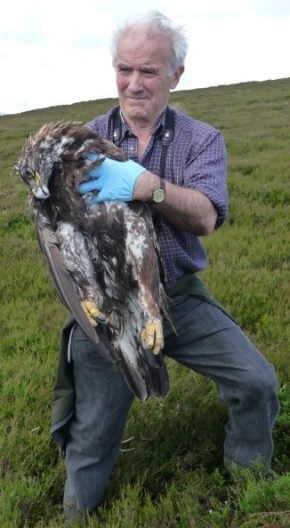
Photograph: dead golden eagle ‘Alma’, found poisoned on a grouse moor on Millden Estate in the Angus Glens. Her corpse was only found because she was wearing a satellite tag, fitted by Scottish Raptor Study Group member and internationally-recognised expert Roy Dennis. It’s no surprise then, that the SGA wants to put a stop to satellite-tagging.

East Arkengarthdale Estate: some questions for the grouse shooting industry

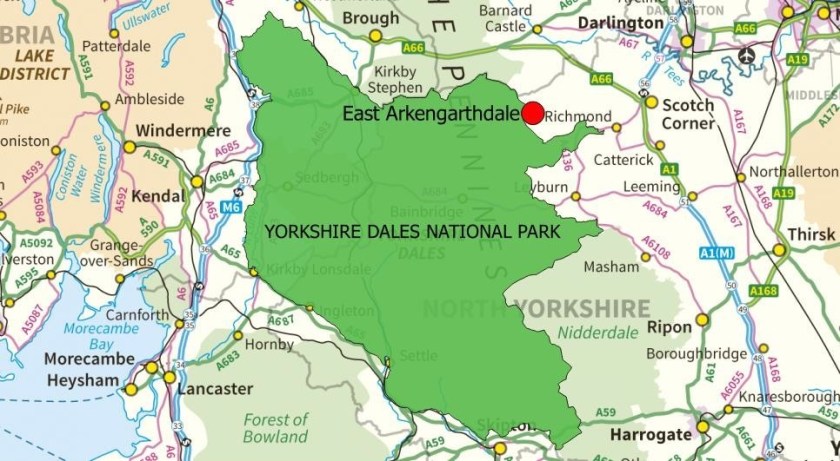
Following on from today’s earlier news that in December 2014 a poisons cache had been uncovered on a driven grouse moor at East Arkengarthdale Estate in Yorkshire, and that a gamekeeper had admitted that he was responsible for placing poisons in the cache, but he avoided prosecution and had his firearms certificates reinstated (see here), we’ve got some questions for the grouse-shooting industry.

arken

Let’s start with questions for the Moorland Association. Email: amanda@moorlandassociation.org

  1. Is East Arkengarthdale Estate a member of the Moorland Association?
  2. When were you first aware of the discovery of this poisons cache, that was found two years ago?
  3. Were you aware of it when you gave evidence at Westminster on the petition to ban driven grouse shooting?
  4. If East Arkengarthdale Estate is a member, will you be expelling them from your organisation?
  5. If not, why not?
  6. Will you be publishing a statement about the discovery of a poisons cache on a driven grouse moor in Yorkshire?
  7. If not, why not?
  8. Will you be praising the superb work of the RSPB Investigations Team for uncovering this poisons cache on a driven grouse moor?
  9. Can you confirm whether Adrian Thornton-Berry, a Moorland Association official, was the sporting agent (via Dalesport Sporting Agency) at East Arkengarthdale Estate in December 2014 when the poisons cache was discovered?
  10. Did Amanda see the poisons cache through her kitchen window?

Questions for the National Gamekeepers’ Organisation. Email: info@nationalgamekeepers.org.uk 

  1. Is this (unnamed) gamekeeper a member of the National Gamekeepers’ Organisation?
  2. If yes, do you intend to expel him from your organisation?
  3. If not, why not?
  4. Could you explain why this gamekeeper had an electronic calling device (typically used to attract predators) with a series of raptor calls stored in it?
  5. Could you explain why this gamekeeper was visiting a poisons cache on a driven grouse moor?
  6. Could you explain why those poisons had been hidden in a bucket, underground?

Questions for the Game & Wildlife Conservation Trust. Email: info@gwct.org.uk

  1. When did you first become aware of the discovery of a poisons cache at East Arkengarthdale Estate?
  2. Were you aware of it when one of your 2014 auction prizes (some driven grouse shooting on 4 Yorkshire grouse moors, including East Arkengarthdale Estate) was fulfilled in October 2015?
  3. Have you received funding/donations from East Arkengarthdale Estate?
  4. Will you be accepting any further funding/donations from East Arkengarthdale Estate in light of today’s news?

Questions for BASC. Email: click here

  1. Why did your senior staff member, Dr Colin Shedden, tell a Scottish parliamentary committee that “any hint of illegal activity can lead to the right to hold a [shotgun] certificate, and the ability to shoot, being withdrawn“, when on the very same day, the BASC Chairman was defending the right of a gamekeeper to keep his shotgun certificate despite him admitting to placing poisons in a secret cache?

Poisons cache found on Yorkshire grouse moor – no prosecution

This just beggars belief.

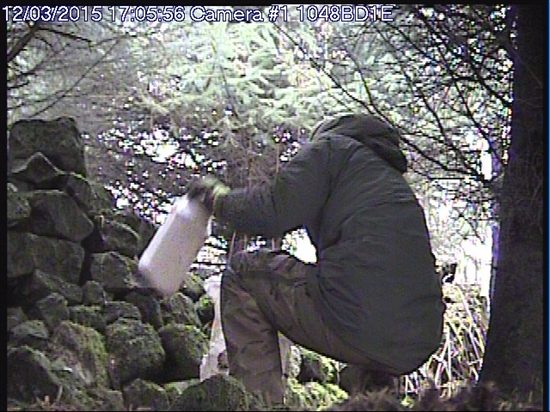
Have a read of this blog (here) written by Senior RSPB Investigations Officer, Guy Shorrock. It tells the story of how he and a colleague discovered a cache of poisons hidden underground in a small forestry plantation on Hurst Moor, a driven grouse moor which forms part of the East Arkengarthdale Estate, just outside the Yorkshire Dales National Park. A suspect was identified from camera footage obtained by the RSPB and North Yorkshire police paid him a visit.

east-arkengarthdale

arken

During that police visit, a number of items were seized including an electronic calling device that contained a series of raptor calls.

Despite the best efforts and intentions of the RSPB investigators, North Yorkshire Police and Natural England, working in some pretty harsh conditions, the Crown Prosecution Service didn’t want to proceed with a prosecution due to some procedural concerns. Nevertheless, North Yorkshire Police seized the gamekeeper’s firearms and revoked his firearms and shotgun certificates. That seemed perfectly reasonable, especially in light of Dr Colin Shedden’s evidence yesterday to a Scottish parliamentary committee that “any hint of illegal activity can lead to the right to hold a [shotgun] certificate, and the ability to shoot, being withdrawn” (see here).

However, the gamekeeper at East Arkengarthdale Estate decided to appeal this decision and get his firearms returned. This was a remarkable move because undoubtedly, the evidence that the police had based their decision upon would now be heard in open court! And indeed, that is what happened yesterday.

According to Guy’s blog, it was apparently accepted in court that this gamekeeper had placed the poisons in that underground stash on that grouse moor. Nevertheless, the judge decided that this gamekeeper could have his firearms returned and his firearms certificates reinstated.

Incredible!

Let’s remind ourselves again of Dr Colin Shedden’s evidence to a parliamentary committee yesterday:

“Shotgun certificate holders are among the most law-abiding sector of society and any hint of illegal activity can lead to the right to hold a certificate, and the ability to shoot, being withdrawn“.

Sorry, Dr Shedden, but the result of yesterday’s court hearing blows the credibility of your evidence right out of the water.

In an ironic twist, Dr Shedden works for BASC. The Arkengarthdale Estate gamekeeper’s defence barrister, Peter Glenser, is also associated with BASC – he’s the current Chairman, having recently been elected following a bit of a fracas at a BASC staff meeting where the police were called in. It struck us as amusing that on the day Dr Shedden is telling a parliamentary committee that shotgun certificate holders are already stringently regulated and their certificates can be revoked “at any hint of illegal activity” (and thus there’s no need for further regulation such as the licensing of gamebird hunting), at the very same time on the very same day, his colleague, Peter Glenser, is defending a gamekeeper’s right to keep his shotgun certificate even after admitting to hiding poisons in a secret cache!

You couldn’t make it up.

Gift of grouse: their propaganda exposed

The Gift of Grouse – a campaign run by the Scottish grouse-shooting industry to promote the so-called ‘benefits’ of driven grouse shooting, have been well and truly caught with their pants down.

(Gift of Grouse for you anagram fans: to fog figures]

Some of you may remember a story from last year, where the Gift of Grouse made great claims about the number of bird species that had been recorded on three driven grouse moors – Invermark & Glenogil (both in the Angus Glens) and Glenturret in Perthshire. We blogged about these claims (here) and have since made repeated requests to see the actual data/reports (as have others – e.g. Andy Wightman here), but all to no avail. The Gift of Grouse refused to publish the reports and instead pointed everyone to a summary, written by The Gift of Grouse and not by the ecological consultants who had conducted the surveys.

Pay attention to some of the specific claims made in that Gift of Grouse summary about the survey undertaken on Invermark Estate:

The consultants “used a variety of techniques to record birds, butterflies, mammals and other species across 80 sq km of upland habitats which are specifically managed for grouse“.

And

“…..with an overall total of 81 bird species recorded as either breeding on the site or using the area as a valuable feeding resource“.

The clear intention from these statements was for people to believe that these three driven grouse moors support a wide range of avian biodiversity.

Indeed, on the back of these apparent survey results, the Gift of Grouse even held a prestigious Parliamentary reception at Holyrood, hosted by Graeme Dey MSP on 23 November 2015,  with wide media coverage, to “celebrate diversity through grouse moor management“.

The Gift of Grouse have been pumping out this so-called success for a year now, and only the other day they referred to these survey results in another press release (here) when they claimed that ‘raptors are thriving on Scottish grouse moors’ – a press release that was dismissed by RSPB Scotland as “a pile of risible, make-believe tosh” (see here).

Well guess what? It turns out that the Gift of Grouse had good reason not to release the actual survey report from Invermark Estate because if they had, their misinterpretation (we’re being kind) of the data would have been exposed.

Unfortunately for the Gift of Grouse, a new summary report, written by the ecological consultants (Taylor Wildlife) has now been published and it makes for very interesting reading indeed.

Download it here: invermark-wildlife-audit-2015-and-2016

According to the Taylor Wildlife report, there were NOT81 bird species recorded as either breeding on the site or using the area as a valuable feeding resource” in 2015 as the Gift of Grouse had claimed. There were actually only “52 species considered to be breeding on site, 19 additional species noted during surveys as flying over and 10 species documented as incidental sightings“. How on earth can birds recorded as “flying over” a site be listed as “either breeding on the site or using the area as a valuable feeding resource“?!

Furthermore, the survey was not conducted “across 80 sq km of upland habitats which are specifically managed for grouse” as the Gift of Grouse had claimed. According to the Taylor Wildlife report, the habitats surveyed included “blanket bog, bracken, broadleaved and mixed woodland, coniferous woodland, dwarf shrub heath, improved grassland, inland rock and montane heath“. Since when has broadleaved and mixed woodland, coniferous woodland, improved grassland and inland rock been “managed specifically for grouse“?!

That RSPB Scotland quote, “a pile of risible, make-believe tosh” springs to mind.

It looks very much like the Gift of Grouse have misled everyone, including Graeme Dey MSP, doesn’t it? You can make up your own minds whether this misinterpretation of the Invermark survey results was a deliberate and cynical ploy to portray driven grouse shooting in a favourable environmental light, or whether it was just an honest inability to grasp the simple interpretation of bird survey data.

As an aside, it’s also interesting to note that these surveys were conducted as a requirement of the estate claiming Basic Payments. Funny that. Didn’t the grouse shooting industry claim that no public subsidies were used to support driven grouse shooting?

We should make it clear here that we are not having a go at Taylor Wildlife. On the contrary, we thank them for publishing this summary report. This morning, Andrew Whitelee, one of the ecological consultants involved in the survey, wrote a comment on one of our earlier blogs. We’re reproducing it here:

Hello everyone,

I work for Taylor Wildlife, who have been subject to a lot of speculation on this website recently. As with any other ecological consultancy, client confidentiality would normally prevent us from discussing specific surveys and data. However, in this instance the client (Invermark) have made the data public which means I can take this opportunity to clarify a few points. The Taylor Wildlife summary report can be found on this link.

Over the past two field seasons (2015 and 2016) Taylor Wildlife staff have been surveying on the Invermark Estate as part of the Basic Payment Scheme Farm Environment Surveys. This Government scheme requires us to undertake bird surveys using a modified version of the Brown and Shepherd methodology. This methodology is usually used for recording upland waders but for the purposes of the scheme we are required to record all species we encounter on surveys. We are not required to disturb the nests of Schedule 1 birds and our surveyors work completely within the law. The SGRPID/SNH guidelines we (and any other consultancy undertaking surveys) are bound by for the scheme are on the link below (page down to Annex A).

https://www.ruralpayments.org/publicsite/futures/topics/all-schemes/basic-payment-scheme/basic-payment-scheme-full-guidance/eligible-hectares-and-minimum-activity—bps/

As I am sure you will all appreciate, we have no control over how our data is interpreted by others once it is published, so I would ask you to take a look and make up your own mind. At the end of each survey season we are required to submit our data and report to SNH/SGRPID for review. We also give our data to the relevant organisations such as Butterfly Conservation, The Mammal Society or Birdtrack (via the bulk upload option).

There seems to be a misconception that Taylor Wildlife provided the majority of the data used in the Gift of Grouse statement. However, we only collected data on Invermark so that is the only part I can pass comment on. Two years of Invermark data starts to give us a baseline, more data collected in the coming years may help us to identify trends and hopefully provide useful data for informed land management decisions in the future. In my opinion the more data collected in upland environments the better.

If anyone wants to contact me to discuss the above, then please feel free to do so, my email address is andrew@taylorwildlife.co.uk

Andrew Whitelee
Senior Ecologist
Taylor Wildlife

Today’s evidence session on licensing of gamebird hunting: Scottish Moorland Group & BASC

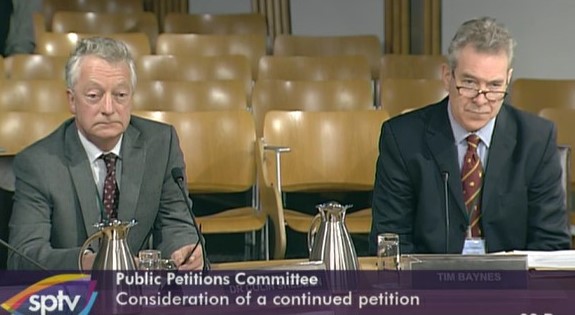
This morning the Scottish Parliament’s Public Petitions Committee took evidence from the Scottish Moorland Group and BASC on the petition to introduce gamebird hunting licencing (see here for background to this petition).

The two witnesses today were Dr Colin Shedden (BASC) and Tim (Kim) Baynes (Scottish Moorland Group, part of Scottish Land & Estates).

kim-colin

The evidence session can be watched on Holyrood TV here and the formal transcript can be read here.

The hearing went pretty much as anticipated, with the main gist being that the two witnesses didn’t think that gamebird hunting licensing was necessary. The ‘evidence’ they used to back up their claim was also predictable.

Dr Shedden asserted that all those who shoot game are already regulated via their shotgun certificates, and that “shotgun certificate holders are among the most law-abiding sector of society and any hint of illegal activity can lead to the right to hold a certificate, and the ability to shoot, being withdrawn“. If only that was true! If Police Scotland did revoke shotgun certificates based on “any hint of illegal activity“, there would be a lot of gamekeepers out of a job!

Tim (Kim) Baynes cherry-picked his way through his ‘supporting evidence’, citing the recent increase in the national golden eagle population (but omitting to mention the consistently low occupancy rate of breeding golden eagles on driven grouse moors in the eastern Highlands – see here) and citing the raptor persecution figures in the Government’s latest wildlife crime report (but omitting to mention that the raptor persecution figures in this report are incomplete as some have been deliberately withheld, rendering any trend analysis a pointless waste of time – see here).

He also claimed that raptor persecution on driven grouse moors was not endemic, as the petitioners had claimed, and he cited the evidence of Assistant Chief Constable Malcolm Graham, who had stated at another parliamentary hearing that wildlife crime reporting levels were NOT the tip-of the iceberg and that Police Scotland was “catching a significant amount of it” [wildlife crime]. What Tim (Kim) forgot to mention was that the quality of ACC Graham’s evidence has been called in to question several times (see here, here and here). He also ‘forgot’ to mention the string of recent scientific publications showing that illegal persecution on driven grouse moors is so rife it is having population-level impacts on a number of species including hen harriers, red kites, peregrines and golden eagles.

He also mentioned several so-called ‘partnership-working initiatives’ in an attempt to paint a picture of productive cooperation – we’ve previously discussed these ‘initiatives’ in detail and not one of them stands up to scrutiny. E.g. Wildlife Estates Scotland (it’s a sham, see our critique here), Heads up for Hen Harriers (it’s a sham, see our critique here), the South Scotland Golden Eagle Project (it’s a sham, see our critique here) and the Eastern Cairngorms Moorland Partnership (it’s a sham, see our critique here).

Tim (Kim) then introduced his ‘four point plan’ which, he said, could “deal with this issue once and for all” (presumably the ‘issue’ he’s referring to is the issue of raptor persecution associated with gamebird hunting). Here’s his plan:

Point 1:We very much support the continued enforcement of wildlife crime” [legislation], ‘including the proposed increase in wildlife crime penalties‘.

We’d agree with him on Point 1, in principle, although we want to see increased efforts in wildlife crime enforcement because the current levels of enforcement are simply not good enough.

Point 2:We would ask for support and development of the Wildlife Estates initiative and the other collaborative schemes and projects going on“.

We don’t support Point 2 because it will not address the problem of raptor persecution on game-shooting estates, especially when some members of this scheme have wildlife crime convictions to their name. This ‘initiative’ is, in our opinion, nothing more than a window-dressing opportunity to disguise the on-going persecution of raptors.

Point 3:The Understanding Predation Project“……”looking at predation and how that can be managed“….”We think that is a very important way of everybody moving forward together“.

We don’t support Point 3, because the Understanding Predation Project is nothing more than an exercise in legitimising the killing of predators for the benefit of game shooting.

Point 4:We would very much like to see greater cooperation between ourselves, the Raptor Study Groups and the RSPB“.

Point 4 is hilarious – especially when you hear the story behind a group of dedicated raptor workers who have recently been ‘thrown off’ their 30-year study site because they dared to question some of the management practices they’d seen on that Scottish grouse moor (which also just happens to be an accredited member of the Wildlife Estates initiative!). Watch for a scientific publication due out in March 2017 that explains all!

Point 4 is also hilarious when you consider that the new ‘partnership-working’ protocols that Tim (Kim) had referred to later in this evidence session in relation to national bird surveys, actually comprised of landowners wanting to exert control on raptor fieldworkers by making sure they sought landowner permission before visiting survey sites. That type of control is never going to be welcomed by raptor fieldworkers who have huge and legitimate concerns about subsequent disturbance (i.e. persecution) at the nest sites of sensitive Schedule 1 species on some of these estates.

MSPs put a number of questions to the two witnesses, asking for clarification on a few points. Of particular note are the well-informed questions posed by the increasingly impressive Alison Johnstone MSP (Scottish Greens).

Her questions included asking Tim (Kim) to explain the reason behind the low occupancy rate of breeding golden eagles on driven grouse moors in the eastern Highlands in contrast with the very high occupancy rate in western Scotland. His answer was evasive, to say the least, although he did confirm that this low occupancy rate had been the same for decades, despite productivity there (when it happens) being the highest in Scotland….thus (probably unintentionally) confirming that illegal persecution has been going on there, for, er, decades! He also said, “It’s a really complicated picture“. Is it? Seems pretty straightforward to us. We’ll come back to this in a later blog as we’ve got some interesting maps to share.

Alison also asked Tim (Kim) whether the recent report demonstrating the persistence of red kite persecution in the north of Scotland flew in the face of his assertion that raptor persecution was in decline? His response was to avoid answering the specific question and instead he waffled on about condemning wildlife crime.

The Petitions Committee then discussed what to do with the petition now that evidence from both ‘sides’ had been heard, and it was agreed that it would now be passed on to the Environment, Climate Change and Land Reform (ECCLR) Committee for further consideration. We don’t know the timescale for that but it is more than likely to feature in the New Year when the ECCLR Committee scrutinises the Government’s most recent report on wildlife crime.

Watch this space.

Vicarious liability prosecution: Andrew Duncan (Newlands Estate), part 12

Criminal proceedings continued yesterday (6 December 2016) against landowner Andrew Walter Bryce Duncan, who is alleged to be vicariously liable for the crimes committed by gamekeeper William (Billy) Dick in April 2014.

Gamekeeper Dick was convicted in August 2015 of killing a buzzard on the Newlands Estate, Dumfriesshire by striking it with rocks and repeatedly stamping on it (see here). Mr Dick was sentenced in September 2015 and was given a £2000 fine (see here). Mr Dick attempted to appeal his conviction but this was refused on 15 July 2016 (see here).

Here’s a quick review of the proceedings against Andrew Duncan so far:

Hearing #1 (18th August 2015): Trial date set for 23rd Nov 2015, with an intermediate diet scheduled for 20th Oct 2015.

Hearing #2 (20th October 2015): Case adjourned. November trial date dumped. Notional diet hearing (where a trial date may be set) scheduled for 18th January 2016.

Hearing #3 (18th January 2016): Case adjourned. Another notional diet & debate scheduled for 11th March 2016.

Hearing #4 (11th March 2016): Case adjourned, pending the result of gamekeeper Billy Dick’s appeal. Another notional diet scheduled for 4th April 2016.

Hearing #5 (4th April 2016): Case adjourned, pending the result of gamekeeper Billy Dick’s appeal. Another notional diet scheduled for 3rd June 2016.

Hearing #6 (3rd June 2016): Case adjourned, pending the result of gamekeeper Billy Dick’s appeal. Another notional diet scheduled for 17th June 2016.

Hearing #7 (17th June 2016): Case adjourned, pending the result of gamekeeper Billy Dick’s appeal. Another notional diet scheduled for 15th July 2016.

Hearing #8 (15 July 2016): Case adjourned. Another notional diet scheduled for 2 August 2016.

Hearing #9 (2 August 2016): Proceedings moved to trial. Intermediate diet scheduled for 15 November 2016 and provisional trial date set for 7/8 December 2016.

Hearing #10 (15 November 2016): The case was adjourned for another intermediate diet scheduled for 22 November 2016. Trial date of 7/8 December 2016 is dumped.

Hearing #11 (22 November 2016): The case was adjourned for yet another intermediate diet, scheduled for 6 December 2016.

Hearing #12 (6 December 2016): The case was adjourned for yet another intermediate diet, scheduled for 24 January 2017. A provisional trial date (this will be the third time a trial date has been assigned) is scheduled for 24 April 2017.

Vicarious liability in relation to the persecution of raptors in Scotland (where one person may potentially be legally responsible for the criminal actions of another person working under their supervision) came in to force nearly five years ago on 1st January 2012. To date there have been two successful prosecutions/convictions: one in December 2014 (see here) and one in December 2015 (see here).  One further case did not reach the prosecution stage due, we believe, to the difficulties associated with identifying the management structure on the estate where the crimes were committed (see here).

Further delay in case against Angus Glens gamekeeper accused of pole trapping offences

Criminal proceedings continued on Monday (5 December 2016) against Scottish gamekeeper Craig Graham.

Mr Graham, 51, is accused of setting and re-setting a pole trap, baited with a pheasant carcass, on the Brewlands Estate between 9-17 July 2015. He has denied the charges.

This case was first called on 31 March 2016. A provisional trial date was set for 9th September 2016. This date was later dumped and another provisional trial date was set for 5th December 2016.

On Monday, the case was adjourned, again. An intermediate diet is scheduled for 28 March 2017 and another provisional trial date has been scheduled for 15 May 2017. This is the third time a provisional trial date has been set for this case.

Previous blogs on this case here and here

‘Giant buzzards’ eating dogs, warns Tipperary newspaper

The following article was headline news last week in the Tipperary Star, a local rag in the Irish Republic:
ATTACKING BUZZARDS TARGET TERRIERS

By Noel Dundon

A call to have the protection orders on buzzards lifted has been made following a number of incidents in which the birds of prey have taken terriers and other animals in deadly swoops through mid Tipperary.

Buzzards are causing major problems in the mid-Tipperary area at the present time with a number of terriers having been taken, leading to a call for protection orders to be lifted.

Two families have been left in distress after their dogs were preyed upon and killed by giant buzzards in the Templetuochy area where hares, rabbits, cats and other small animals have also been taken.

However, it has also been revealed that are birds of prey circling overhead Deputy Michael Lowry in Glenreigh, Holycross, while Moyaliffe, Drombane, Inch, Clonmore and Castleiney are also areas where buzzards have been spotted on the attack.

There is one report of a Yorkshire terrier having been attacked, but survived and was patched up by a veterinary surgeon, only to be attacked again and killed a short time later – all by the same buzzard which can have a wingspan of up to three feet with very powerful and strong claws used to take prey.

Forested areas which afford cover are the best hunting ground for buzzards and dog and cat owners are being advised to be on the watch out for their pets which could be taken at the blink of an eye.

There are also concerns that with the increase in buzzards, the spring lambing season after Christmas could be an ideal hunting ground for them – but a very costly one for sheep owners.

ENDS

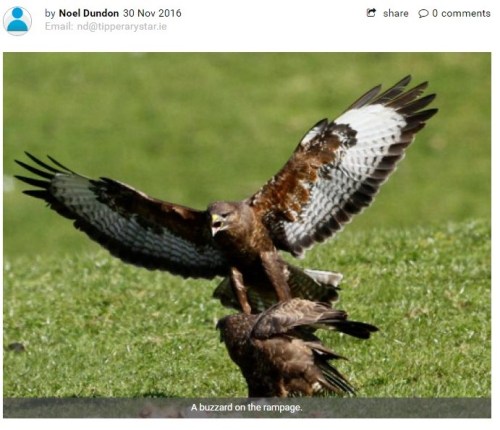
The online version of the article was illustrated with this photograph, entitled ‘A buzzard on the rampage’.

Is this ‘journalist’ having a laugh? Since when did ‘giant buzzards’ (or even normal-sized buzzards) start killing dogs, and since when did the sight of soaring buzzards above a politician’s head become a cause for alarm?

This type of sensationalist, ignorant, scare-mongering would be funny if it didn’t have consequences. Unfortunately, this baseless demonisation of birds of prey does have consequences, and serious ones at that. As we see all too often, there are still people clinging on to 19th Century attitudes who think that raptors are ‘vermin’ and should be destroyed. Articles like this one above will only fuel their prejudice and lead to the illegal persecution of these birds.

Tipperary is no stranger to raptor persecution – in the last few years the following crimes have been recorded:

July 2015: shot buzzard

May 2014: poisoned peregrine

January 2014: shot white-tailed eagle

July 2013: shot peregrine

June 2013: shot peregrine

June 2013: shot peregrine

Raptor persecution is a serious issue in Ireland, and the latest official report shows the trend is pointing upwards with 35 confirmed persecution incidents in 2015 – the highest number since recording began in 2011 (see here).

We’d encourage strong (but polite) words of complaint to the Tipperary Star:

Email journalist Noel Dundon: nd@tipperarystar.ie

Email editor Anne O’Grady: aog@tipperarystar.ie

UPDATE 6/12/2016: BirdWatch Ireland has issued a strong statement in response to the Tipperary Star (see here).

Shot buzzard rehabilitated & returned to the wild in North Yorkshire

At the end of October we blogged about a buzzard that had been found with shotgun injuries in Thirsk, North Yorkshire (see here).

The bird’s broken femur was expertly pinned by Mark Naguib of Battle Flatts Veterinary Clinic and the buzzard then underwent a period of care and rehabilitation with the wonderful Jean Thorpe of Ryedale Wildlife Rehabilitation.

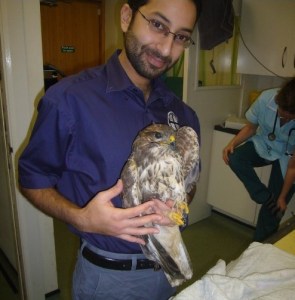
Yesterday this buzzard was released back to the wild (pictured here with vet Mark Maguib – photo by Jean Thorpe)

We’ve said this before but we’ll say it again – Jean’s work is entirely voluntary. If you want to support her efforts, please consider making a donation here.