Reward for information after baited pole trap discovered on east Devon farmland
The RSPB and Devon & Cornwall Police are appealing for witnesses after a trap designed to kill birds of prey was found on farmland, next to a pheasant release pen.
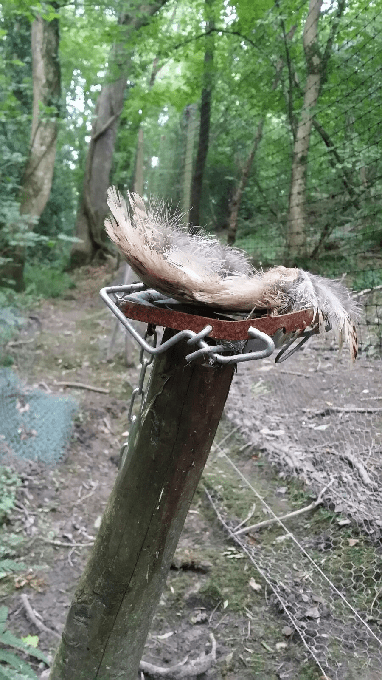
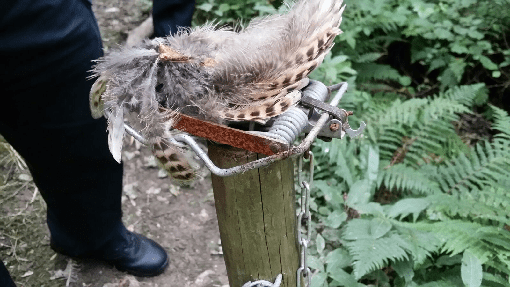
Police attended a location near Dunkeswell, in the Blackdown Hills, East Devon, following a tip off recently, where they discovered a live, baited pole trap.
Police officers photographed the trap, which was set and ready to use, but left it in situ. When police returned the next day the trap had been removed. Further visits accompanied by the RSPB’s Investigations unit have yielded no more information.
Pole traps have been outlawed for more than 100 years and work by smashing the bird’s legs when it lands on the trigger plate.
Mark Thomas, a senior investigations officer at the RSPB, said: “There is a reason why these traps have been illegal for so long, they are barbaric and they are designed to kill protected birds of prey“.
Inspector Martin Taylor, wildlife crime coordinator for Devon & Cornwall Police, said: “Despite it being illegal for over a century, we are still getting reports of spring traps being placed on poles or perches set to kill birds of prey. We will prosecute anyone setting these indiscriminate and lethal traps“.
Birds of prey habitually use posts as lookouts when hunting and in this case the trap had been baited using meat to encourage a bird to land.
The trap’s presence was reported on August 11 2016 and police first visited the following day. The RSPB is offering a reward of £1,000 for information that leads to a successful prosecution.
Anybody with information should contact Devon & Cornwall Police by phoning 101 or emailing 101@dc.police.uk quoting crime reference CR/56051/16.
Last week we blogged (here) about the results from this year’s Heads up for Hen Harriers project, a so-called ‘partnership-working’ initiative aimed at better understanding the threats faced by hen harriers in Scotland.
We were pretty scathing about this project. Everyone knows, thanks to years, in fact decades, of scientific evidence, that the main threat comes from illegal persecution on driven grouse moors so let’s not pretend this is still a big mystery needing to be solved. But we want to re-visit the project again just to drive home some salient points.
Have another look at the press release put out by SNH (here). We learned that this year the number of ‘participating’ estates had risen from five to 13.
Now, according to the SNH press release, “The thirteen estates participating in the project have cameras installed on their land to monitor hen harrier nests“.
This same claim was made in a press release from the Scottish Countryside Alliance (here). They said:
“Thirteen participating estates, many of them managed for grouse shooting, installed cameras to capture what exactly was happening on and around hen harrier nests to improve our understanding of why nests fail“.
So, from these two claims, you could be forgiven for thinking that all 13 ‘participating’ estates had hen harrier breeding attempts this year, and that each of the 13 estates had nest cameras installed. That’s what these propagandists would like you to believe, but it isn’t actually what happened.
The term ‘participating’ needs some clarification. Yes, 13 estates had agreed to ‘participate’ in the project – that just means that 13 estates (8 of which were managed as driven grouse moors) had agreed to host a project nest camera should there be a hen harrier breeding attempt on that estate this year.
What it doesn’t mean is that those 13 estates (including those eight driven grouse moors) all had hen harrier breeding attempts and all had nest cameras installed. They didn’t. Hen harriers attempted to breed on three of the 13 estates, and guess what? None of those breeding attempts was on a driven grouse moor.
So what the SNH press release should have said is something like: ‘Three of the thirteen participating estates had hen harrier breeding attempts this year, and those three estates each hosted a nest camera. None of these three estates is managed as a driven grouse moor‘.
By putting out misleading information suggesting that all 13 estates had hen harrier breeding attempts and that each estate hosted a nest camera, SNH is able to repeat the myth that ‘landowners and conservationists are working together to help the hen harrier’, and this allows other organisations like Scottish Countryside Alliance and Scottish Land & Estates to repeat the same myth and present a wholly inaccurate picture of ‘partnership working’. This perpetual myth then allows the Scottish Government to also pretend that progress is being made and therefore further measures to stamp down on the raptor killers isn’t deemed to be necessary.
It’s a total sham, facilitated by SNH, the Government’s statutory conservation agency, no less.
We also wanted to revisit the BBC’s Landward programme that covered this year’s Heads up for Hen Harriers project. The programme is still available on iPlayer for a limited period but to avoid losing it, we’ve uploaded a clip to YouTube. (NB: the visual quality of the clip is quite poor, thanks to rural broadband, and isn’t a reflection on the BBC, but the sound quality is good, and it’s what was said on that programme that is of interest here).
First to be interviewed was Brian Etheridge of the RSPB who stated that the relationship between failing hen harrier nests and land managed as a driven grouse moor was ‘striking’.
Next came Tim (Kim) Baynes, speaking on behalf of Scottish Land & Estates. The first question he was asked by the presenter was: “How frustrating is it for you that you always seem to be painted as the bad guys?“.
Ah yes, the poor, victimised grouse moor owners, it must be soooooo frustrating for them to be portrayed in such bad light. Let’s just ignore all the wildlife crime statistics from grouse moors, all the poisoned baits that have been found, all the poisoned raptors, all the illegal traps, all the shot raptors, all the burnt out raptor nests, all the trampled chicks, all the disappearing satellite-tagged raptors, all the consistently vacant raptor breeding territories, all the gas guns, all the banger ropes, all the inflating screeching scarecrows….those poor, poor victimised grouse moor owners.
Tim (Kim) played the victim card with the usual aplomb, agreeing that it was “really, really frustrating‘ to be portrayed in such poor light, especially when “one estate has got 81 bird species, you know, including birds of prey“.
Ah yes, of course, the old 81 species claim again. We’ve blogged about this before (here) but it’s worth reiterating. This is the ‘study’ that was undertaken on Invermark Estate (Angus Glens) in 2015 that claimed there were 81 species of birds ‘either breeding or feeding‘ on the grouse moor. The findings of this ‘study’ were used at a parliamentary reception at Holyrood (see here) to celebrate the so-called conservation value of driven grouse moors. Unfortunately, the study report has never been made public, despite repeated requests to see it, which is a shame because we’d really like to know how a study undertaken at Invermark between June and August could possibly measure the breeding status of many bird species when the usual (proper scientific) survey technique is to conduct a study from March to June…you know, during the actual breeding season. Perhaps the surveyors saw some random birds flying overhead and decided to include them on the list of ‘breeding’ or ‘feeding’ species to boost the numbers. That would be a bit like Bristol claiming that the management of the Severn Bridge was so good it supports Bearded Vultures (here), or the ground keepers at Regent’s Park claiming that their management was so good that the Park supports Cory’s Shearwaters (here).
It’s amazing, isn’t it, how so-called ‘studies’ that apparently show driven grouse moors in a positive light are allowed to be kept secret so nobody can scrutinise the methods or results but can be celebrated by MSPs at a parliamentary reception, and yet studies that are commissioned to assess the illegal persecution of raptors on driven grouse moors are required to include a “robust statistical analysis of all the data to support any conclusion” (see here).


 Raptor Persecution UK