Royal grouse shoot in the Cairngorms National Park: a military operation?

The tabloids have been making much of the fact that the Queen was photographed driving Kate Middleton to a picnic on Balmoral Estate last week, joining Prince William who had apparently been grouse shooting (Daily Mail here; Daily Mirror here; Daily Record here).

Whilst the tabloids focused on the important things like patterned scarves and casual sleeveless jackets, our attention was drawn to something else:

At the butts behind imposing Creag Bhiorach, dozens of soldiers were waiting to do the beating and drive the grouse towards the waiting guns“.

Eh? Soldiers working as beaters on a royal grouse shoot in the Cairngorms National Park? Shurely shome mishtake?

Surely a case of mistaken identity? Surely anybody camo-ed up to work as beaters weren’t professional soldiers paid for by our taxes? Surely they were simply local men and women from the rural community, reliant on the oh-so-important beater’s wage (average £55 per day) so ‘vital’ to the local economy? Isn’t that what we’re so frequently told?

But maybe it’s not a mistake. Maybe soldiers are being used to work as beaters on the royal grouse shoot. Have a look at this (here), a report detailing the royal duties of the (now former) 1st Battalion The Argyll and Sutherland Highlanders in 1962:

“(b) Beating.

There were seventeen days of grouse driving on the two moors, Micras and Gairnshiel, which lie side by side to the North of the River Dee. The Balmoral ground was not driven at all, there being too few birds to merit it. On all shooting days one officer and forty ORs turned out as beaters to the Royal shooting party. This duty required a high standard of fitness, alertness and a definite restraint on language: it was not universally a popular duty despite the extra-duty pay (!), but the standard of beating achieved was good enough to please Gillan, the head-keeper, and to provide a total bag for the guns of over 2,200 brace which was considerably higher than anticipated at the beginning of the season”.

Has this been going on since 1962? Great to see our taxes being put to such good public use, and inside a National Park, too.

Illegal raptor killing has to stop, says Angela Smith MP

Here’s another transcript from last week’s Sheffield conference on raptors. This time we feature the deeply personal yet unflinchingly resolute presentation given by Angela Smith MP (Labour, Penistone and Stocksbridge).

Angela is no stranger to the subject of illegal raptor killing on grouse moors. You may remember, way back in 2011, she tabled a Parliamentary question asking whether it was time for England to follow Scotland’s lead and introduce vicarious liability to deal with criminal gamekeepers. The response from Richard Benyon, the then DEFRA minister who also just happened to own a grouse moor, is now legendary (see here).

Here’s what Angela had to say in Sheffield (we’ve excluded some complimentary, but irrelevant here, introductory blurb):

Now I want to start with a comment about my own constituency. Although I’m a Sheffield/Barnsley MP I think that most people in the UK would think that makes me a very urban MP but I’m not. I represent the urban parts of Sheffield and also Barnsley, part of my constituency going right out in to the Peak District so it is actually very rural; 32% of the constituency is in the National Park.

And I’ve walked the hills in my area for many years, in fact going back well well before I became an MP and I love those moors with a passion. Langsett, Midhope and Broomhead, in fact I’ll be out on Langsett on Sunday morning, and it’s partly because I don’t come across, if you don’t mind me saying this, the lycra-clad brigade in large numbers, in that part of the peak. It’s truly a place where one can lose oneself and have a sense of being at one with nature.

But the simple and stark fact is that neither do I see hen harriers on those moors, or even peregrine falcons. I’ve seen just one peregrine falcon in fact in recent years and that was back in the summer of 2013, soaring over Broomhead Reservoir. In fact I think the only known site, I may be wrong on this, for peregrine falcons breeding near Sheffield is the city centre, and that, I think, is indicative of where we are. And it should concentrate our minds more than a little.

Grouse moors aplenty in my constituency, but no hen harriers. No stable populations of other birds of prey. That’s one of the reasons why I feel so passionately about this issue. Not only am I a member of the RSPB, and have been for a long time, but I also know there is something wrong with our moorland habitats. There is something essential missing; healthy populations of our wonderful raptors.

Now, I welcome this conference and hope that it can make a contribution to resolving the deeply embedded conflict that characterises the debate about how best to manage our moorlands. Because one thing I am certain of – for as long as this conflict remains unresolved, the number one loser is the hen harrier, which is in danger of disappearing altogether from our wonderful uplands if we do not sit up and get on with the job of sorting out this problem.

Over the next two days, you will hear a range of presentations from speakers with a wide range of perspectives and who represent different parts of the UK – Scotland, the Peak District and Bowland, for example. The discussions will be detailed and complex, and so they should be. This is not a black and white problem, easily resolved.

Let me just throw in a few, brief comments about what I see as the politics of this debate.

First of all, let’s remember politics is the art of the possible, someone should try telling that to my party, and it is always preferable to act on the basis of consensus and partnership. So, ideally, the best way forward, as far as our moorlands are concerned, would be to see all interested parties agreeing principles and working through differences to establish moorland management plans that balance sporting interests with the need to restore and maintain a healthy habitat, including of course stable and sustainable populations of raptors.

Such plans would vary, of course, because our uplands are themselves wonderfully diverse. The grouse moors in my constituency are part of our precious Peak District blanket bog and are badly degraded, in fact I think it’s amongst the most badly degraded in Europe. That does not mean other parts of our moorland landscape across the UK are the same. Each upland habitat needs its own plan, tailored to its own precious ecology.

But it has to be said that the chances of delivering success with this voluntary approach look increasingly remote. Despite the partnership work still ongoing in places like the Dark Peak, which I know you’re going to hear about later, the events of this summer suggest that relationships between the different parties involved are becoming even more difficult.

The withdrawal of the RSPB in particular from the Hen Harrier Action Plan is indicative and is a consequence of what the charity sees as a failure on the part of the landowners and the shooting interests to combat effectively the illegality that tarnishes the reputation of those who do want to enjoy their sport responsibly.

And for a politician this is very depressing news, for although there are legislative options available to us, the irony is that they become necessary or even more critically necessary at that point when conflict has deepened and become more firmly entrenched.

The first of these legislative options, banning driven grouse shooting, presents an apparently straight forward solution but runs the risk of alienating landowners, who in the final analysis maintain and manage our moorland areas and provide employment for many people living in rural areas. It may well also do little to prevent further persecution – there is no guarantee that making grouse shooting illegal will necessarily lead to a cessation of the illegal killing of birds of prey.

Licensing is the other option available. Now, I understand that for the grouse shooting community this is also an unpalatable option and in many ways I would join with those that say that a voluntary, partnership based approach is preferable.

But let me also say this – the licensing option has to remain on the table. If this conflict continues and if raptors continue to be persecuted, it will have to be considered. Politicians will not be able to stand aside and allow hen harriers, for instance, to disappear from our uplands altogether

Some of you may say, that’s an open invitation to charities like the RSPB in particular not to cooperate with a voluntary approach. But I say this in response. The challenge is clear now. For those who want a voluntary approach to work, and I still do, and I think most politicians would still prefer it, the precursor to progress is that the illegal killing has to stop. It just has to stop.

And, on that basis, all parties, including the RSPB, will have a duty to work together to find a way of delivering healthy, moorland habitats that can sustain the sport of shooting that so many people here today love so much.

So I, over the years, have followed this debate, it particularly impacts on my constituency, and I think we are rapidly getting to what, if you don’t mind me using a cliché, is the last chance saloon, and I think it’s critically important that we maintain every option and keep every option on the table. But as I said before, this killing has to stop.

Enjoy the conference; I can stay for only this morning, but I wish you every success in at least taking a few small steps in the right direction.

END

Ironically, just two days before she gave this presentation, a young peregrine was found critically injured next to a grouse moor in the Peak District National Park. It had been shot. It didn’t survive (see here).

Peregrine found shot next to grouse moor in Peak District National Park

On Tuesday 6 September 2016, a critically-injured peregrine was found by walkers on a road in the Goyt Valley in Derbyshire. It was in shock and unable to fly.

perg-goyt-copy

The juvenile peregrine was collected by volunteers from Raptor Rescue and held overnight. The following day it was taken to a vets in Ashbourne where it died from its injuries. An x-ray revealed the bird’s wing bones had been smashed to pieces with lead shot. The extent of its injuries suggest this bird wouldn’t have been able to fly far from where it had been shot.

The Goyt Valley lies to the west of Buxton, within the Peak District National Park.

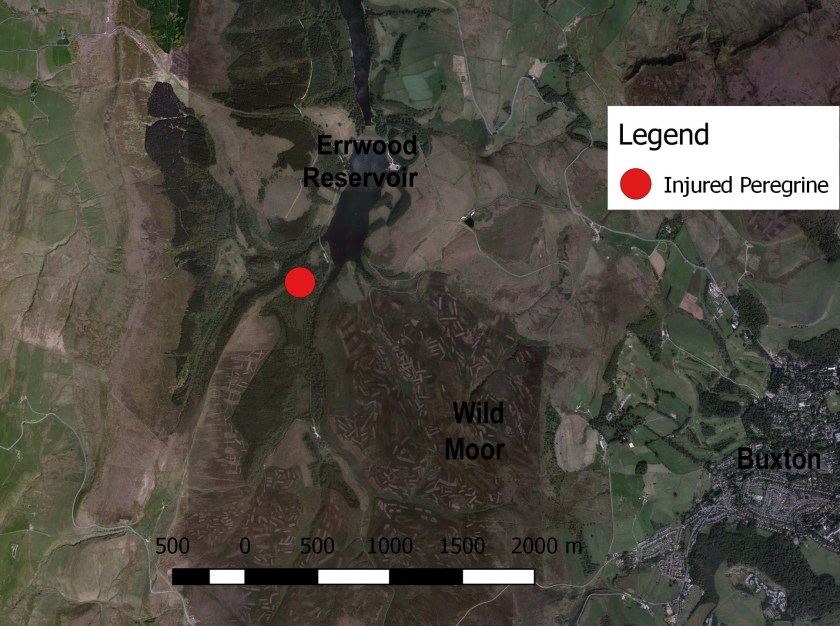
peregrine-goyt-overview-map

The Goyt Valley will be familiar to some blog readers as this was the venue for the Peak District’s 2015 Hen Harrier Day gathering, just half a mile to the south of where this peregrine was found near Errwood Reservoir. It’s interesting to note that the injured peregrine was found on the border of the Special Protection Area (SPA) boundary and also within the Site of Special Scientific Interest (SSSI) boundary. Oh, and look at the burnt strips of heather moorland to the south east of where the shot bird was found: Wild Moor is managed as a driven grouse moor. What an amazing coincidence.

goyt-peregrine-habitat-map-1

So here we are again, yet another raptor illegally killed within a National Park. And this National Park, the Peak District National Park, has, since 2011, been hosting a long-running Bird of Prey Initiative where ‘partners’ are supposed to have been ‘collaborating’ to increase bird of prey numbers. Five years in to the project we learned that none of the project targets had been met (see here) but that the Initiative was going to continue and extend from the Dark Peak to the South West Peak (which is where this bird was shot).

As Mark Avery commented at the time (here), “The response of the consortium is to keep pretending that everyone is on the same side and that chatting about things will bring an end to crime. It won’t“.

He was right. Raptor persecution within the Peak District National Park has continued, including the recent discovery of a spring-trapped osprey and a shot buzzard (see here), an armed man filmed sitting next to a decoy hen harrier (see here) and a suspected shot goshawk (see here).

Ironic, isn’t it, that while we were all sitting in a conference room in Sheffield at the weekend, at the edge of the Peak District National Park, listening to various speakers bleating on about ‘consensus’, ‘partnership working’ and ‘cooperation’ being the way forward, a few miles down the road the corpse of the latest victim was being shoved in a freezer, shot to pieces.

It is pitiful that this charade of ‘conflict resolution’ is allowed to continue when it is quite clear that some of the so-called ‘partners’ have no intention whatsoever of changing their criminal behaviour. They are out of control and the authorities seem unwilling, or unable, to stop them. Meaningful action against these criminals is being delayed by keeping everyone tied to the table in endless rounds of pointless talks. Enough.

The e-petition to ban driven grouse shooting has now amassed over 121,000 signatures and will result in a Westminster evidence session followed by a parliamentary debate. The petition closes in one week – if you haven’t already signed, please do so now and let your MP know that this issue is important to you. PLEASE SIGN HERE

UPDATE 14 Sept: Derbyshire Constabulary issues appeal for information here

UPDATE 15 Sept: BBC News runs the story here

Philip Merricks moves his “immoveable conditions”

Back in June, we blogged about the Hawk & Owl Trust’s supposed “immoveable provisos and conditions” that had been set, by them, as part of their agreement for taking part in DEFRA’s brood meddling plan (see here).

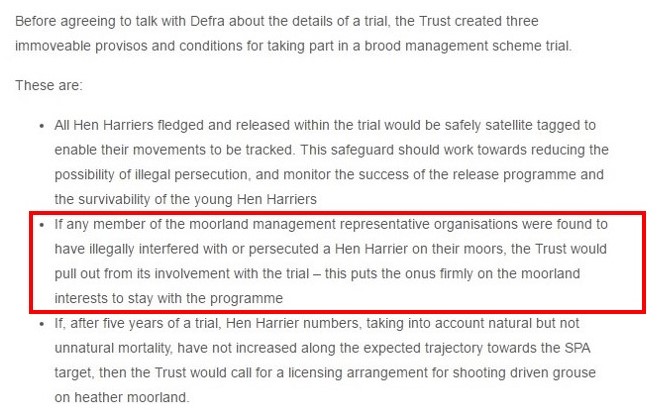
Here they are, as a reminder:

HOT2

We were interested to hear whether the setting of three illegal pole traps on the Mossdale Estate grouse moor would cause the Hawk & Owl Trust to pull out of the brood meddling scheme because it seemed that one of their “immoveable provisos and conditions” had been broken. The Hawk & Owl Trust didn’t respond.

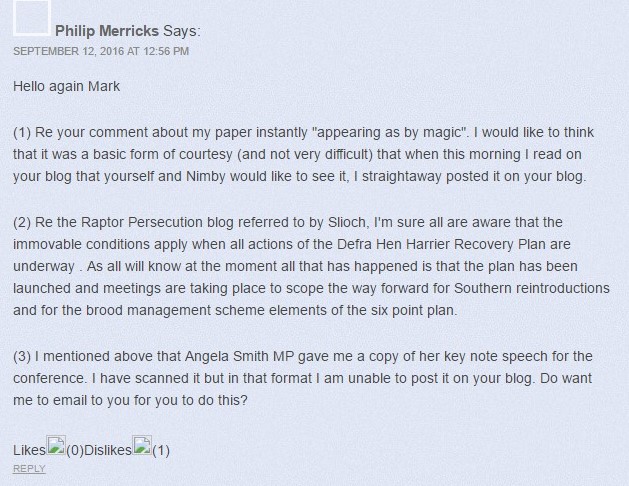
But now they have, in a comment written by Philip Merricks (Hawk & Owl Trust Chair) on Mark Avery’s blog today (see here), and the response is astonishing.

merricks-response

According to Philip, those “immovable conditions” only apply “when all actions of the DEFRA Hen Harrier Recovery Plan are underway“. As two elements of the Plan have yet to begin (brood meddling and the southern reintroduction), apparently the “immovable conditions” are not yet applicable.

But that’s not what the Hawk & Owl Trust said in their original statement about those “immoveable conditions“. Have another look at the Hawk & Owl Trust’s original statement (top image above). The first line reads:

‘Before agreeing to talk with DEFRA about the details of a trial, the Trust created three immoveable provisos and conditions for taking part in a brood management scheme trial’.

What a total bloody cop out! Philip has demonstrated that the Hawk & Owl Trust’s intentions are just as disingenuous as those claimed by the grouse-shooting industry at the beginning of the year when they professed tolerance to a limited number of hen harriers on their moors. Philip knows and accepts that since the DEFRA plan was launched in January 2016 (here), illegal hen harrier persecution has taken place – he acknowledged this throughout his presentation in Sheffield at the weekend (see here), and yet here he is, suggesting that this year’s persecution incidents ‘don’t count’ because the full plan has yet to be launched.

This isn’t conflict resolution, this is the Hawk & Owl Trust acting as apologists for an industry which relies upon the illegal killing of birds of prey. It’s shameful.

What Philip Merricks said at the Sheffield conference

There was a conference in Sheffield last Friday and Saturday: ‘Raptors, Uplands & Peatlands – Conservation, Land Management & Issues’. Mark Avery has written a blog giving an overview of his impressions (here).
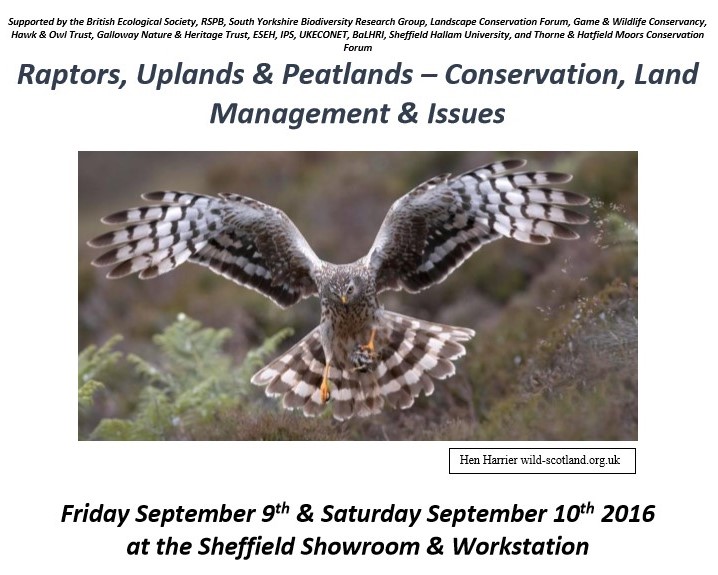
Raptor conference poster

We will be publishing a selection of transcripts from this conference and here is the first of those. Note, this is NOT a parody. You’ll probably need to remind yourself of that if you manage to reach the end.

Philip Merricks, Chair of the Hawk & Owl Trust:The Hawk & Owl Trust’s involvement in the Hen Harrier Recovery Action Plan‘.

It’s very good to be at Sheffield. Our daughter spent four happy years here at uni and she very much enjoyed it and got to know and love the moors, and when I took her to meet her brother at another university, ultimately, you know, she was always thought to be brighter than him, after a day of going around his college she said, walking back to the parking, she said: ‘Dad, why do I want to have to come here and do two essays a week when I can go to Sheffield and have a real life?’. But to be serious she got to know the moors and love the moors and now she and her husband are managing a nature reserve in Kent, a long way from the moors, below sea level in Kent, but you know, she has many, many happy, well many happy years out on the moors.

Now I completely agree with everything that Angela Smith said. I don’t know her, but I thought that as local MP everything she said made a huge, huge amount of sense. And it’s a real, real disgrace, I mean a real disgrace that she and other people, Sheffield people, can’t see hen harriers, peregrines and everything else on those moors, it really is an utter, utter disgrace. She made a very good point that to resolve this issue we should remember that politics is the art of the possible, and that it’s always preferable to act on the basis of consensus and partnership, and that’s driven me all of my life and hopefully it drives the Hawk & Owl Trust. Just remember that she said that politics is the art of the possible.

Quick introduction about myself. I manage two National Nature Reserves, Elmley and Swale, and two former RSPB reserves, all below sea level, all in Kent, and the two National Nature Reserves on the Sheppey marshes, they now hold the largest concentration of breeding raptors, breeding birds of prey, in south east England, something we’re really, really pleased about, and also really large numbers of marsh harriers, which I’m sure you will all know are rarer than hen harriers. And as Ian [Ed: Professor Ian Rotherham, Sheffield Hallam University] said were incredibly rare when he was as a student or when he was a young lecturer many years ago. And then 40 miles south in Kent we manage the Romney Marsh reserve, which similarly holds, I’m told, the largest number of birds of prey on the south coast, or south east coast.

I come from a land management background, as you can understand, I’m passionately interested in management for nature conservation and I’m passionately interested in getting an understanding of land management and getting managers to understand, I mean are there any land managers, grouse moor managers in the audience? Does anybody have responsibility for managing grouse? Yeah brilliant, so there’s one guy, who, well I, I’m very keen on talking to land managers to get them to manage their land, you know, for conservation. Whether it’s, and of course I’m a long way away from the moors, but quite clearly, at the end of the, pragmatic point, at the end of the day the overwhelming majority of countryside is managed by farmers and landowners, and that’s a crucial point.

And another introduction point, I should say, I don’t shoot and I never have shot, for those that like to write about me, I’ll just repeat that, I don’t shoot and I never have shot. Ok. But I Chair the Hawk & Owl Trust, I served as a trustee over 20 years ago, a couple of terms which was six years and then the Chairman died, I was no more than an ordinary member then and I was asked to see if I would come back and Chair, which I did, and quite clearly the Hawk & Owl Trust is a pragmatic organisation and it works, its strap line is ‘Working for wild birds of prey and their habitats’. And as you might imagine, the overwhelming majority of wild birds of prey are on land managed by, well by farmers and landowners and of course on the moors and by gamekeepers. So that’s pretty important point, you know, if we’re going to work with those who manage the habitats throughout most of the UK we have to manage, we have to work with farmers and landowners and up here on the moors we have to work with the gamekeepers again.

And this is where we come to the crux of the problem for this whole conference. The Hawk & Owl Trust is more than happy to be working with those who manage the habitats, farmers and landowners, we do that every day, sometimes I do it all day, but it’s not so easy to do it with gamekeepers when it’s pretty bloody clear that a number of them are continuing to break the law, and persecuting these birds, especially hen harriers. So I’ll just repeat that, it really is a despicable crime and something that’s been going on for far too long, and, which we’ve heard today, is continuing. On that line, it’s going on, I recently called in to see a great guy, a former RSPB Chairman, former RSPB Gold medallist, one of the great guys, and he gave me, he showed me, this invitation to a press release, and it just shows that this is something, I think then he was the incoming Chairman of the Council, became Chairman of the RSPB, and it just shows, 1971, you can possibly see that closer I think, 1971 the RSPB were, basically this is staff and council members, were giving a press conference on the persecution of birds of prey. And I mean clearly they were raising awareness of it then and they’re raising awareness of it now, so I’m just showing this is nothing new. What I do like about that, the way the RSPB operated, they stopped at 12.15 for cocktails. Can you see that at the bottom there? I’m sure things go on like that exactly the same way at The Lodge today.

Right. But I said, and I’ll put this up, the position is no damn different or better today. And one of the dreadful examples we’ve seen and you’ve all heard about is the setting of a pole trap on the Mossdale grouse moor. And that is appalling. As soon as I heard about that or was told about it, I went up to Mossdale because I’m always someone who likes to see things at first hand. I’ve got to the age now where actually, I actually want to see things and talk to people about it first hand. Has anybody been to Mossdale by the way? Brilliant, some of you have.I’ve talked to the head gamekeeper, I’ve talked to the owner, has anybody done that? A couple anyway. And I, you know, it was quite appalling, you know, it’s easier in some ways for me to give them a piece of my mind because I can almost speak landowner to landowner, although, you know, they might well be up in, you know, up on the moors and I’m down below sea level but I mean the principle is just the same. It is quite a disgusting incident, despicable act. And you know, I’m sure you’re all aware of it, this is a thing on a post, it holds birds by the legs until they die. I mean, and it was done by an untrained, unsupervised twenty-something year old, 22 year old, and it was a real, real dereliction of management, of supervision, and of training, absolutely appalling. And you know, that is lack of those, supervision and management and training by the head keeper and ultimately by the landowner. And, you know, I, it’s relatively easy for me, landowner to landowner, to say, ‘Look you bloody fool, you, you are, well, not just breaking the law but you’re letting all of us down whether we’re in below sea level in Kent or whether you’re up here’. And I, I, think, you know, perhaps things like that are easier.

So, how do we bring this to an end? We all want the same thing, everyone in this room wants the same thing. I think that’s the one thing that unites us, and the only thing that we may differ about is how we do it and that’s why I think we can all agree with that. Mark, [Avery] down on the front row, will say that banning grouse shooting is the best bet, and the RSPB will say that licensing is the best bet, but as Angela Smith said this morning, politics is the art of the possible, and I did clock that pretty strongly. And, you know, on that government has made it abundantly clear that they won’t go down the route of banning it and they won’t go down the route of licensing it and it seems now that this government is stabilised, with, with, Theresa whats-her-name, Theresa May, but, you know, stabilised for another three years and probably another term after that, so for a long time, you know, this government is in power and they’re not going to change their minds. So, on the art of the possible, if the first two routes are off the table that only leaves the government’s preferred option of the DEFRA six point plan which we heard about in detail from Adrian [Adrian Jowitt, Natural England] today. And of course, there are many people who for whatever reason don’t like that, but I bring you back to this point, this Angela Smith point, about, you know, politics being the art of the possible.

But another guy I went to see, you know, and who’s a good friend of mine who I’ve known for 20 years and is one of the great, great conservationists, well he’s a guru to me more than a friend. I like, I’m proud to call him a friend, he’s a guru to me, probably for 30 years, he’s guided all my steps in conservation, possibly for 35 years, and he’s one of the great, I mean he is of probably of all conservation biologists of all time, he’s probably done more for birds of prey than anyone else. You know, we heard from Ian [Rotherham] about the effect of persistent organochlorides [sic], DDT, on raptors, and this is the guy who started and appointed the team, and that team that included great people like Derek Ratcliffe, he, he set up that team at the research and then eventually cracked the problem of the birds of prey and of course, you know, I guess many of you will know who that is, Norman Moore. He really was one of the greats and I’m proud, well, we all need our gurus don’t we. He was, he was one for me. And it was such a privilege, I had the honour of speaking at his memorial service at the cathedral earlier this year and it was a huge, huge privilege to do that, and you know, he was immensely effective and was one of the greats.

So we get to the next one [next image on screen], and this is what he said. Can everybody at the back read that? Well, you don’t need me to tell you about it, you don’t need me to read it, but I’ll just leave you with it. You. Are you comfortable now, having read it? Well the point being, now who was it made that point this morning? Was it, was it Ian? Made that point, or somebody who made it, it’s just not science. And a couple of issues, people with different points of reference, well, we know that grouse moor managers have got different points of reference so things have to be explained, but, I’m pretty certain it was Ian who made that point this morning. But what for me, we just have to, if we want to get things across we have to get them across to people who are culturally completely different.

Right, my, the subject of my talk which I hope I haven’t wandered from, you know, I’m talking about the Hawk & Owl Trust’s involvement in the DEFRA plan and we heard from Adrian this morning and he went through it, so the first one, prevention, intelligence, led by senior police officers […inaudible…]. Well done to all involved and more power to your elbow.

Second one is monitoring of hen harrier breeding sites and winter roost sites. Well I do know a bit about this because winter roost sites on, in fact all four of our, well three of the, our four reserves are winter roost sites for raptors and marsh harriers and that’s when we see these hen harriers, down with us in the south east, that’s when we see them, and it’s absolutely crucial they’re monitored everywhere and protected everywhere, so well done to the guys who do that and usually on a voluntary basis.

So, and then of course number three, the sat tagging and the satellite tracking. Well, I mean nobody knows more about that than the other Steve [Stephen Murphy, Natural England] and he’s told me all about it, and I’m really pleased to see, to say that a number of tags have been fitted this year, tags funded by the Trust and fitted by, by Steve, and, and, and Trust staff and volunteers I think were with him when, when, it was, I mean they were fitted. And I think you’ll soon, as soon as they, well Steve will be able to tell you more of the detail, but soon you’ll be able to see the, their movements on the website. I mean it’s something I’m not very good on IT but I mean it’ll be really, really interesting that, and I, and I think it’s crucial, the more sat tags that are fitted, by everyone, the RSPB have obviously fitted them in the EU LIFE campaign means they can fit a lot, the less likely it will be, criminal gamekeepers to shoot them in other areas, you know, the risk will become increasingly greater because, you know, and I think this, this really does prevent it.

And then number four, diversionary feeding. I’ve been to Langholm a couple of times, well actually three, but once in early days and I’ve seen how effective this is and we’ll hear about this tomorrow from the speaker tomorrow, Sonja [Sonja Ludwig, GWCT], the speaker tomorrow, and of course this obviously is something that’s strongly supported and it should be carried out more widely and it is of course I’m told that people do it and where they, yeah, and it’s so damn obvious.

Number five, southern reintroductions, that was explained by Adrian and that’s something that obviously hasn’t started yet but of course it’s important and that’s where it’s crucial to get some confidence of landowners, farmers and others in the areas where they’re going to be reintroduced or where it’s proposed that they’re going to be reintroduced. It’s all about getting the confidence of the guys who manage the land, and there are several places been suggested, and, and that should be very interesting.

And then number six, which is what we hear so much about, we’ve already heard today, the trialling, and I do say trialling, people seem to think it’s an action, it is a trial. It’s the trial removal of eggs and young chicks where a certain threshold’s been reached. The incubating of them, the rearing of them, and you know, and don’t forget the Hawk & Owl Trust has got world class facilities to do this, owned and managed by a Trustee, and these really are world class facilities. And then of course, as Steve was telling us, released back on to the moors. And the other thing that we’ve done, the Trust, is make a really, really determined effort to get to know moorland owners and moorland managers and we’ve got quite a, quite a list of moorland managers and moorland owners who would be keen, no, more than keen, they would be proud, I’ll say that again, they would be proud to have hen, a pair of hen harriers on their moors. Of course they know that there’s, they’re semi-colonial nesters and everything but they’re proud to act as receptor moors for those translocated birds.

And I think the key issue about the DEFRA recovery, hen harrier recovery plan, is that while that hen harriers benefit hugely from and are largely dependent on the habitats created by good moorland management, large number of hen harriers and once again as I’ve said, don’t forget they are semi-colonial nesters can make grouse shooting unviable and we’ve heard about that hence, you know, that the management has that choice. As Langholm has shown, or, I mean, you’ll dispute what it’s shown, but I’m no expert on Langholm, but that, but that, oh I’m sorry I’m just losing my place, but, well you all know what Langholm does and you’ve all made up your own mind what Langholm did but it’ll get written up over the years and then we’ll all know more about it.

But I guess that, I guess the issue is, on the moors, that gamekeepers fear for their jobs, and their income and their houses, and they do continue with this appalling persecution, or some of them continue with this appalling persecution of these lovely birds and this is quite appalling. But, I mean and Mark said, in his book, it’s an understandable crime and there’s a reason for it, and I’m going to put Mark’s book up on the thing which is a really good read, it’s an interview with many bird watchers, and Mark’ll probably tell us about it. Right, good, now I’m almost at the end which I’m sure several of you will be relieved about. Right. Behind the Binoculars, and interesting one, on we go to the next one, this is where he interviewed, that’s right, Ian Newton, Ian obviously an eminent guy, eminent guy, Hawk & Owl Trust Vice President and he Chairs the Hawk & Owl Trust scientific advisory panel, so on to what he said. Mark, the first paragraph is Mark and I’ll just read the bits that I think, clearly he had the viewpoint that it [hen harrier persecution] was understandable, so what are we going to do about it? And Ian then on the second paragraph goes through and says well there are three possibilities as we heard about this afternoon and then on to the next one and then he says, this is Ian Newton again, really I think you’re left having to accept a third proposal: that harrier densities could be limited on grouse moors, to levels that allow some hen harriers to survive but allow grouse shooting, driven grouse shooting, to survive also. Ok, the idea then was the difficulty was in finding landowners. Well the good thing is that we’ve done that work, you know, because we’ve found landowners, we’ve got as I said, quite a respectable list. Then he says that would be a potential solution, and I bring you back to this word ‘potential’. Everybody thinks well we don’t know if it’ll work but it’s a potential solution.

So, where do we go to now? And I’m being hurried up, which is good, right. So, it goes on to say that we have, and it is a trial, I’m rattling through that, and I’ll just bring you back to something that Professor Redpath said. There’s a lot of evilness out there, and I like that word, it’s been used lots of times, Chris Packham, I picked up, it is because there is a lot of evilness out there but this trial will find out whether this evilness ceases or not, it’ll discover whether removing the reason for the crime reduces the crime, which’ll be the key. Whether it’ll work, I don’t know but grouse moor owners, or some of them, say that it will and I sincerely hope it will but it’s up to the guys out on the moors. We’ll find out whether this attempt at conflict resolution, and I’m a great believer in conflict resolution, we’ll find out whether it works or not. And for the sake of our hen harriers I hope it does.

END

The real price of grouse: episode 7

NotsoGlorious-black-bg - Copy

Here’s episode 7 in a series of videos hosted by Chris Packham about the #NotSoGlorious damaging management practices associated with the driven grouse shooting industry. Episode one (an introduction to driven grouse shooting) can be watched here.  Episode 2 (the damaging environmental effects of heather burning) can be watched here. Episode 3 (traps) can be watched here. Episode 4 (parasites, medication and the mass killing of mountain hares) can be watched here. Episode 5 (flooding) can be watched here. Episode 6 (how your taxes are helping to subsidise driven grouse shooting) can be watched here.

Here’s episode 7, where Chris interviews Paul Irving, a raptor monitoring expert from the North of England, about black holes for Hen Harriers:

Over 121,000 people have joined Chris and signed the e-petition to ban driven grouse shooting. We’ve passed the 100,000 signatures needed to trigger a Westminster debate and we’re currently waiting to hear when that debate will take place. In the meantime, this petition is open until 20th September and the more signatures, the better. Please join us and sign HERE 

Thank you!

Three poisoned buzzards found in Co Laois, Ireland

The National Parks and Wildlife Service in Ireland is appealing for information after the discovery of three poisoned buzzards.

The buzzards were discovered in a field in Cappakeel, Emo, County Laois over the August Bank Holiday weekend. Toxicology tests have revealed they’d been poisoned with Carbofuran.

Full details from the Leinster Express here

poisoned-buzzards-laois

The real price of grouse: episode 6

NotsoGlorious-black-bg - Copy

Here’s episode 6 in a series of videos hosted by Chris Packham about the #NotSoGlorious damaging management practices associated with the driven grouse shooting industry. Episode one (an introduction to driven grouse shooting) can be watched here.  Episode 2 (the damaging environmental effects of heather burning) can be watched here. Episode 3 (traps) can be watched here. Episode 4 (parasites, medication and the mass killing of mountain hares) can be watched here. Episode 5 (flooding) can be watched here.

Here’s episode 6, all about subsidies (i.e. how your taxes are helping to pay for driven grouse shooting):

Over 121,000 people have joined Chris and signed the e-petition to ban driven grouse shooting. We’ve passed the 100,000 signatures needed to trigger a Westminster debate and we’re currently waiting to hear when that debate will take place. In the meantime, this petition is open until 20th September and the more signatures, the better. Please join us and sign HERE 

Thank you!

Tackling raptor persecution features in Scot Gov’s work plan 2016-17

scotgov-logoThe Scottish Government has published its work plan for 2016-2017 (see here).
We are pleased to see that tackling wildlife crime, and specifically raptor persecution, is a feature (see page 56).

We must protect the environment from those who seek to damage it for personal gain. We will increase the penalties for wildlife crime and consider the creation of new sentencing guidelines in line with the recommendations from the Wildlife Crimes Penalties Review Group“.

Good. Penalties for wildlife crimes have generally been at the lower end of the scale and penalties issued for similar crimes have been inconsistently applied. We fully support the recommendations of the Wildlife Crimes Penalties Review Group, published in November last year (see here) and we look forward to the Scottish Government getting on with implementing them.

However, increasing the tariffs available to the judiciary will count for little if the problems of early-stage enforcement (e.g. Police under-resourcing, the slow pace of gathering evidence and poor follow-up investigations – see here) are also not addressed. Regardless of the punitive value of a sentence, the deterrent effect will be limited if an offender knows that the chances of being caught and receiving the punishment are minimal.

It seems that the Scottish Government has recognised this in the work plan:

Police Scotland will create a new Wildlife Crime Investigation Unit to support the existing network of wildlife crime officers in complex investigations“.

We tentatively welcome this news, although of course much will depend on the details of how this new unit will function. It’s all very well being able to say you’ve got a special wildlife crime unit, but if it’s as semi-dysfunctional as the current National Wildlife Crime Unit (NWCU – very effective at dealing with the international trade in endangered species but wholly ineffective at dealing with raptor persecution) then there’s little point to its existence.

It’s also a little bit worrying that there is no mention of increased investigatory powers for the SSPCA to help Police Scotland tackle wildlife crime. Is that a sign of the Government’s direction on this issue? Time will tell.

Also included in the work plan is this:

In order to safeguard vulnerable species from illegal persecution, we will carry out a review of prevention measures including the operation of the Partnership Against Wildlife Crime [PAW Scotland] and supporting Police Scotland in their work to target wildlife crime hotspots. We are prepared to introduce legislation where necessary“.

We very much welcome a review of how PAW Scotland operates. We have been highly critical of this so-called ‘partnership’, particularly the PAW Raptor sub-group, which is dominated by land management groups, some of whom are tainted (indirectly, by association) with raptor persecution. Some of these groups consistently misrepresent raptor crime data and refuse to accept that persecution is an on-going problem. As a result, the PAW Raptor group has achieved very little in terms of tangible results and we hope this review will recognise the group’s failings and act accordingly.

We would welcome the Government’s claim that it is ‘prepared to introduce legislation where necessary‘ but we’ve heard it so many times before that it’s now just seen as empty rhetoric. If they’d just get on with it we’d be 100% supportive.

How to stop the illegal persecution of raptors in the Cairngorms National Park

Yesterday we blogged about the illegal persecution of birds of prey in the Cairngorms National Park (CNP) and how, 13 years after the Park was first established, persecution continues (see here).

Some (but definitely not all) the grouse moor managers within the CNP are running rings around the Park Authority (CNPA), and have been doing so for years: Golden eagles poisoned, golden eagles ‘disappearing’, white-tailed eagles ‘disappearing’, white-tailed eagle nests felled, hen harriers shot, breeding hen harriers in catastrophic decline, goshawks shot, goshawk nests being attacked, peregrines shot, peregrine nest sites burnt out, breeding peregrines in long-term decline, buzzards poisoned, buzzards shot, red kites poisoned, short-eared owls shot, poisoned baits laid out, illegally-set traps, and mountain hares massacred. All within the Cairngorms National Park, a so-called haven for Scottish wildlife. It’s scandalous.

Lad HH

So what has the Cairngorms National Park Authority been doing about all this? To date, they’ve adopted the softly, softly partnership approach, which, to be fair, is a reasonable starting point. But this approach relies on ALL the ‘partners’ pulling together in the same direction; it’s not going to work if some of the ‘partners’ don’t or won’t comply with the law (i.e. not killing protected birds of prey).

We’ve seen the Cairngorms Nature Action Plan, a five-year initiative which included the aim of restoring the full community of raptor species within the NP and managing mountain hare populations for the benefit of golden eagles (see here). Three years on and evidence we produced yesterday shows the Plan is going nowhere fast (see here).

We’ve seen the Convenor of the CNPA pleading with the then Environment Minister to help combat raptor persecution within the NP because it ‘threatens to undermine the reputation of the National Park as a high quality wildlife tourism destination‘ (see here). The then Environment Minister (Dr Aileen McLeod) attended a meeting with ‘partners’ during which there was a ‘recognition of the progress made in recent years’ (see here). Eh? Have a look at our list of raptor persecution crimes within the CNP (here) – can you spot any sign of progress? No, because there hasn’t been any.

The next approach from the CNPA was the ‘East Cairngorms Moorland Partnership’. This is an interesting one. One of the stated aims of this ‘partnership’, comprising six contiguous estates and the CNPA, is to ‘enhance raptor and other priority species conservation’. A noble aim, but when you look at the details of this Partnership’s work plan it’s all pretty vague and lacking substance. It can be downloaded here:

east-cairngorms-moorland-partnership_statementofpurpose

Things don’t improve when you realise who is involved with this ‘Partnership’. One of the six estates is none other than Invercauld Estate. You remember Invercauld Estate – the place where illegally-set spring traps were recently discovered (here). The Estate’s response was (a) to suggest it didn’t happen but if it had happened it was probably a set-up to smear the grouse-shooting industry (see here), and (b) despite nothing happening, the Estate ‘took action’ although we’re not allowed to know what that ‘action’ entailed because it’s a secret (see here). Presumably, the setting of illegal traps isn’t part of the work plan designed to ‘enhance raptor and other priority species conservation’.

So where does the CNPA go from here? Well, we said yesterday that there was light at the end of the tunnel. And there is. The CNPA is currently consulting on the NP’s ‘Partnership Plan’ for 2017-2022. This is the management plan for the CNP for that five-year period and will help guide the CNPA’s work on the most pressing issues. The CNPA has identified several ‘big issues’ on which it wants to hear your views, and one of those is ‘Moorland Management’.

The question the CNPA is posing is:

How can management for grouse be better integrated with wider habitat and species enhancement objectives such as woodland expansion, peatland restoration and raptor conservation?

The obvious answer to achieving raptor conservation is to get the grouse shooting estates to stop illegally killing raptors! But how?

In the consultation document, the CNPA says the East Cairngorms Moorland Partnership is the stated mechanism for delivering raptor conservation within the eastern side of the NP. Er, illegally set traps being found on one of the Partnership estates doesn’t inspire confidence, does it?

There must come a time when the CNPA has to realise that the ‘partnership’ approach is not working, and to be frank, is unlikely to ever succeed. In our opinion, that time is now.

The CNPA actually has a great deal of power and authority to act against those who continue to persecute raptors within the NP. Have a read of this blog (here) published on the always interesting ParksWatchScotland blog. The authors suggest that the CNPA can introduce ‘hunting byelaws’ for grouse shooting estates within the CNP. Permits could be removed if wildlife crime is discovered and also if Estates refuse to allow monitoring cameras. Permits could also be used to limit the size of grouse ‘bags’, thus helping break the cycle of ever-increasing intensification of grouse moor management practices. Permits could also be used to limit the number of traps in use.

As the authors also point out, byelaws were recently created for the Loch Lomond & Trossachs NP to try and limit camping. So why not create them for the CNP to try and limit raptor persecution?

The CNPA has four aims, set out by Parliament:

  1. To conserve and enhance the natural and cultural heritage of the CNP;
  2. To promote sustainable use of the natural resources of the CNP;
  3. To promote understanding and enjoyment (including enjoyment in the form of recreation) of the special qualities of the CNP by the public;
  4. To promote sustainable economic and social development of the CNP’s communities.

These aims are to be pursued collectively. However, if there is conflict between the first aim and any of the others then greater weight must be given to the first aim (section 9.6 of the National Parks (Scotland) Act).

We’d encourage as many of you as possible to participate in the CNPA’s consultation process (it closes on 30 Sept 2016) and mention the idea of these byelaws and the CNPA’s responsibility for conserving the natural heritage above all else. You might think, ‘Oh, what’s the point, the CNPA won’t listen to me, they’re in the pockets of the large shooting estates’. Well, perhaps so in the past but perhaps things are changing. Have a read of this blog (here), entitled ‘Time to move with the times‘ recently written by Will Boyd Wallis, Head of Land Management and Conservation at the CNPA. There are clear signs in Will’s blog that the old regime is being challenged and the more people who write in support of this, the better.

You can access the consultation documents here.