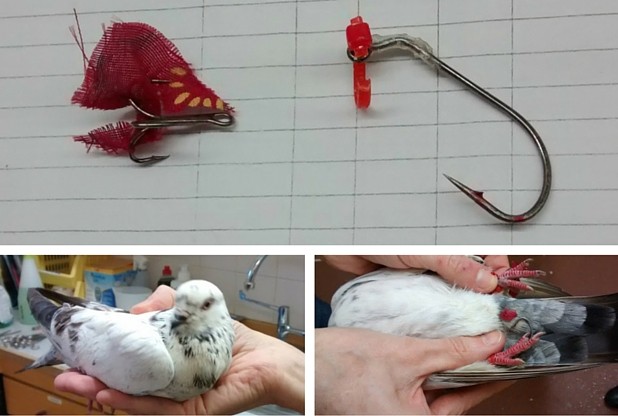
Hooks attached to pigeon’s legs designed to injure raptors

The RSPCA is appealing for information after the discovery of a pigeon that had sharp hooks attached to its legs. The bird was found stuck in someone’s garden in Poolfield Road, Lichfield on Tuesday.

There’s only one reason for attaching hooks like this to a pigeon, and that’s to cause serious damage to any raptor, like a sparrowhawk or a peregrine, that might try to prey on the pigeon.

Pigeon hook 1

pigeon hook 2

Presumably the RSPCA has paid a visit to the local pigeon racing lofts in the Lichfield area as part of their investigation.

Full article in the Lichfield Mercury here

Hen Harrier Holly: cause of death unknown

Hen Harrier Holly 2015In November 2015 we blogged about the death of satellite-tagged hen harrier, ‘Holly’, one of several birds being monitored by the RSPB’s Hen Harrier Life+ Project.

Holly was a 2015 bird from a site on Ministry of Defence ground in Argyll. She fledged in August 2015 and in mid-October was reported to have dispersed to ‘the uplands of Central Scotland’. By November, data from her satellite tag suggested she had died but no further information was available at the time (see here).

Yesterday an update was posted on the RSPB’s Skydancer blog (here) as follows:

As soon as her satellite tag data showed us she had died, we went to the site– an area of upland farmland and forestry to the north east of Glasgow – to look for her. We searched the area thoroughly but, unfortunately, we were unable to locate her. This is disappointing as we would have wished to submit the body to a government laboratory for a post mortem examination to try to establish how she died.

Survival rates for young harriers like Holly are low, with only around 1 in 3 surviving to a year old.  These youngsters will often die of natural causes such as starvation, but we cannot speculate as to the cause of death in her case.

We will of course provide an update if any further information comes to light“.

END

What the update failed to mention was that as well as dying from natural causes, young hen harriers are also highly susceptible to illegal persecution (see here).

Another sat-tagged hen harrier from the project, named ‘Chance’, has been overwintering in France (see here).

Photo of Holly by John Simpson

General Licence restrictions reinstated on Raeshaw and Burnfoot Estates

On 4th November 2015, SNH announced its decision to apply General Licence restrictions to four properties in response to raptor persecution crimes that had occurred there.

General Licence restrictions are a relatively new sanction in the fight against raptor persecution, brought in by former Environment Minister Paul Wheelhouse in July 2013 and have been available for SNH to use since 1st January 2014 (see here). The restriction orders announced by SNH in November 2015 were the first to be applied.

There were two restriction orders. Restriction #1 applied to parts of the Raeshaw Estate (a grouse moor in the Borders) and parts of the neighbouring Corsehope Estate, where, as we understand it, gamekeepers from Raeshaw Estate also carry out ‘pest’ control.

Restriction #2 applied to parts of the Burnfoot Estate (a grouse moor in Stirlingshire) and parts of the neighbouring Wester Cringate Estate, where, as we understand it, gamekeepers from Burnfoot Estate also carry out ‘pest’ control.

The specific reasons for applying these restriction orders have been shrouded in secrecy. We do know the general reasons behind both of them because an SNH spokesperson mentioned them during a radio interview in early November (see here). We know that the restriction on the Raeshaw and Corsehope Estates relates to “the illegal placement of traps” and the restriction on the Burnfoot and Wester Cringate Estates relates to “issues associated with poisoning birds of prey and illegal use of traps“.

We have speculated previously about what these incidents might be, by cross-referencing reported (published) incidents of raptor persecution in the two areas concerned but we really should emphasise that it was only speculation. It is highly probable that other incidents that may have occurred have not been recorded in the public domain so it’s impossible for us to state, unequivocally, which incidents have triggered the General Licence restriction orders on these estates. Only SNH and Police Scotland (who provided the evidence on which SNH has based its decision) know the actual reasons for applying the General Licence restrictions on these particular estates (and presumably the estates’ lawyers are also now aware of the evidence) and so far they haven’t been willing to be transparent about those reasons.

The restriction orders were due to begin on 13th November 2015 and run for three years, ending 12th November 2018. We blogged about these restriction orders and the implications to the estates here.

However, on 19th November 2015, six days after the restriction orders had begun, SNH suspended both restriction orders because the Estates were appealing SNH’s decision to enforce the restrictions. We blogged about that here and the following notices appeared on SNH’s website:

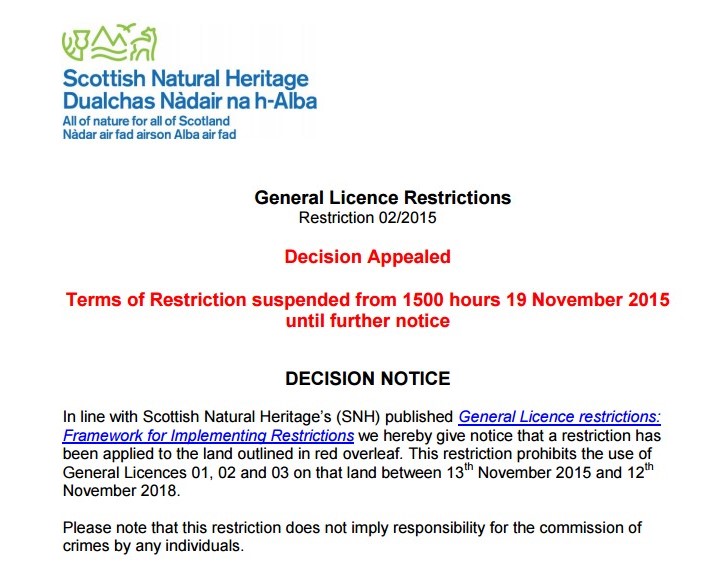
SNH GL restriction 1 SUSPENSION - Copy

SNH GL restriction 2 SUSPENSION - Copy

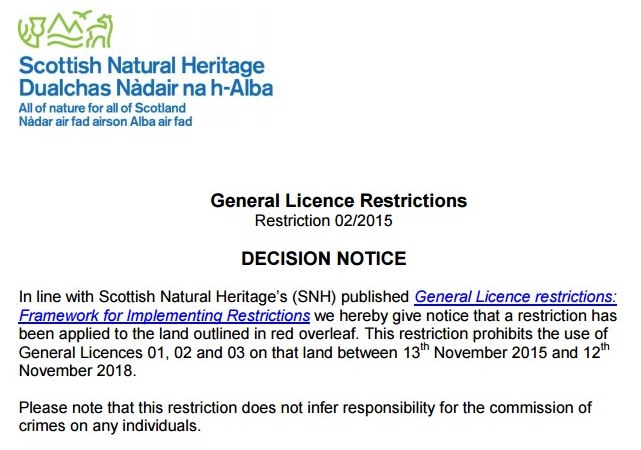
It all went quiet since the appeal process began but then yesterday, quietly, two and a half months on from the suspension, the following appeared on SNH’s website:
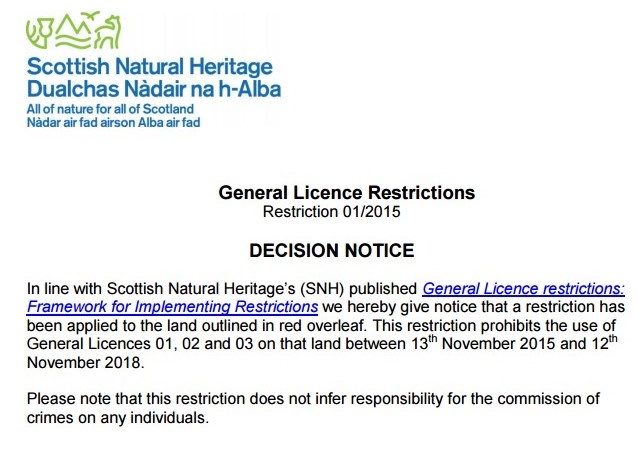
GL restriction 1 - Copy

GL restriction 2 - Copy

It would appear, then, that the Estates’ appeals have failed and SNH has decided to go ahead and apply the restrictions. From our perspective, SNH deserve credit for pushing ahead and sticking to their guns on this, although it’s disappointing that they didn’t issue a press statement yesterday to announce their decision and instead it’s been left to those of us who monitor these things to bring it to the public’s attention. Nevertheless, if the evidence of raptor persecution crimes on these estates is sound (we don’t know that it is but presumably SNH think it’s sound or they wouldn’t have applied the restrictions), then a three-year ban on the use of General Licences could have a considerable impact on the game-shooting activities of these estates, and perhaps more importantly, should also be a good deterrent for others.

It sounds good on paper, and it is a way of penalising estates where raptor persecution occurs but the evidence isn’t good enough to meet the criminal standard of proof needed to charge a named individual and take him/her to court – a regularly occurring problem in this area of wildlife crime. However, it’s not quite as good as it sounds.

First let’s just review what these General Licence restriction orders mean:

Basically, the following activities, usually permitted under General Licences 1, 2 and 3, are now not permitted on these estates until 13th November 2018 –

The killing or taking of the following species:

Great black-backed gull, carrion crow, hooded crow, jackdaw, jay, rook, ruddy duck, magpie, Canada goose, collared dove, feral pigeon, wood pigeon, lesser black-back gull, and herring gull.

The use of the following methods to kill/take these species are not permitted:

Pricking of eggs, oiling of eggs, destruction of eggs and nests, use of Larsen trap, use of Larsen Mate trap, use of Larsen Pod trap, use of multi-catch crow cage trap, shooting with any firearm, targeted falconry, and by hand.

So one of the main questions now is, how will the restriction orders be enforced? Who is going to monitor whether any of the above activities are still taking place on these estates? Daily checks by SNH? Daily checks by Police Scotland? Of course that’s not going to happen. Perhaps intermittent, and one would hope, unannounced, checks will take place, but again, that seems unlikely given the scarcity of available resources. A restriction order will only be effective if it is suitably enforced and we just don’t see how it can be, especially as we anticipate more and more General Licence restriction orders being made across the country. Incidentally, there was a discussion about this very topic at a recent RACCE parliamentary meeting but we’ll be blogging about that separately in the near future.

The second issue is that even though the General Licence restrictions are now in place, the affected estates still have a get-out clause because individuals from those estates can apply to SNH for an individual licence that would allow them to continue the activities that were previously permitted under the General Licence. This clause just makes a mockery of the whole principle of General Licence restrictions. What’s the point of applying a General Licence restriction order if it can be side-stepped so easily? According to SNH (see here), individual licences will be considered on merit on a case-by-case basis, and as such may not be available to all who apply, but those who do apply successfully will apparently be ‘subject to strict conditions and compliance monitoring measures’. Again, how will those ‘strict conditions’ be enforced and who will monitor them?

The third issue is whether these General Licence restriction orders will remain in place for the full three year term. The Estates have been through SNH’s appeal process, and failed, but there is now a strong possibility that they could opt to try for a Judicial Review if they feel that SNH has acted unfairly in applying these restrictions to their properties. That would be quite interesting on a number of levels, not least in that it might offer us (the public) some transparency about these cases and inform us about the evidence used by SNH to make their decisions.

In the meantime, if any of you are out and about on these four estates and you notice that the (above listed) traps are in use or you see gamekeepers shooting at any of the (above listed) species, you should report it immediately. Here are the maps which show the areas where the General Licence Restriction Orders are in place:

Parts of RAESHAW ESTATE & CORSEHOPE ESTATE in the Borders:

Raeshaw Corshope GL restriction map 2015

Parts of BURNFOOT ESTATE and WESTER CRINGATE ESTATE in Stirlingshire:
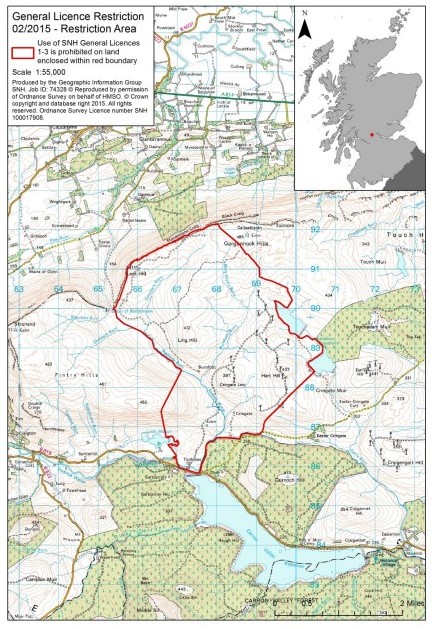
Burnfoot Wester Cringate GL restriction map 2015

More raptors illegally killed in Peak District National Park: police appeal 5 months later

Derbyshire Constabulary has today issued a press release appealing for information following the illegal killing of an Osprey (caught in a spring trap) and a buzzard (shot) that were discovered in the Peak District National Park last September. The RSPB is offering a £1,000 reward for information that leads to a conviction.

Here’s the press release:

Derbyshire Police and the RSPB are appealing for information following the illegal killing of two birds of prey near to Glossop, Derbyshire. A £1000 reward has been offered by the RSPB for information leading to a conviction.

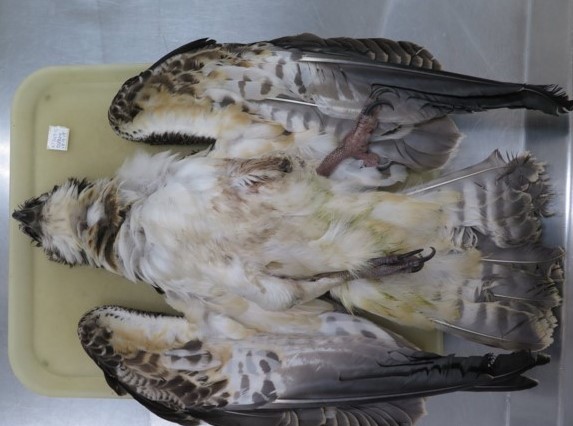
On September 09, 2015, a dead osprey was found to the west of Derbyshire Level. A post mortem on the bird revealed that both its legs had been recently broken, injuries which were consistent with it being caught in a spring trap prior to its death. Ospreys are rare visitors to the Peak District and this one would have been on migration to West Africa.

On September 30, a buzzard was found shot dead close to Hurst Reservoir, only a short distance from where the osprey was found. This follows the shooting of another buzzard in the same area in March 2014.

Sergeant Darren Belfield from Derbyshire police said: “I would appeal to anyone who might have any information as to who may be responsible for these cruel acts to contact the police on 101. The continued persecution of birds of prey in the Peak District is totally unacceptable. If you suspect someone of committing any crimes against wildlife, act now. Your call will be dealt with in confidence. If you don’t feel you can talk to the police, pass the information to us through Crimestoppers by ringing 0800 555 111.”

RSPB Investigations Officer Alan Firth said: “Yet again, we are seeing the senseless killing of fantastic birds of prey in the National Park.”

Last year, the RSPB published its annual Birdcrime Report 2014, which revealed Derbyshire as one of the worst places in the UK for bird of prey persecution. In 2014, the RSPB received 16 reports of bird of prey incidents in the county including a shot buzzard, a shot sparrowhawk and an illegally trapped goshawk.

END

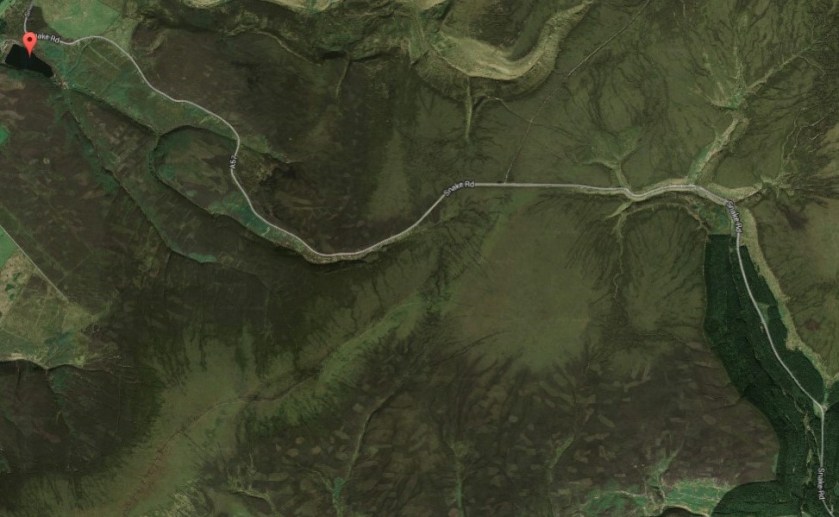
So these birds were found “close to Hurst Reservoir”. Have a look at this map and see what else is “close to Hurst Reservoir” (reservoir marked with the red pin). See those tell-tale rectangular strips of burnt heather to the south and south-east of the marker? Quelle surprise, it’s driven grouse moor country.

Hurst Reservoir - Copy

You may remember back in November we blogged about the failed ‘Bird of Prey Initiative’ in the Dark Peak region of this National Park. It was a five-year project aimed at restoring the populations of several raptor species in the area and involved various organisations: The Moorland Association, The National Trust, Natural England, Peak District National Park Authority, and the RSPB. None of the targets were met (see here). In response, the Moorland Association and the Peak District National Park Authority said they’d make ‘renewed commitment’ to protect raptors in the National Park (see here). Riiiiiight, that’s working well then.

Interestingly, the failed initiative was widely reported in the local press, including the Derbyshire Times, whose article on 26th November was entitled ‘Birds of prey killed and abused in Derbyshire’. In reponse to that article, Robert Benson, Chairman of the Moorland Association, penned the following letter:

I would like to emphatically state in response to your story, ‘Birds of prey killed and abused in Derbyshire’, on November 26th, that one single bird of prey killed illegally is one too many.

However, the Moorland Association was heartened to see RSPB’s latest bird crime figures show a dramatic cut across the UK. Significant reductions in the illegal trapping of birds of prey represent a 78 per cent drop since 2013, with just four confirmed incidents last year.

Of the 19 prosecutions for wild bird offences, three involved gamekeepers, but none were employed on moorland managed for grouse shooting.

Our members spend £52.5 million a year maintaining and conserving habitats which benefit all moorland wildlife. This year, grouse moor managers in England were praised for their part in the most successful hen harrier breeding season for five years.

Many other threatened species, such as lapwing, curlew, and golden plover – in serious decline elsewhere – are doing well on managed moorland. Not birds of prey, but wild, endangered and important nonetheless.

Wildlife crime is being successfully tackled. We already have a robust wildlife licensing system which needs to be used fairly to manage conflict between rapidly increasing bird of prey populations and legitimate and beneficial land use“. Robert Benson, Chairman, Moorland Association.

END

So there we have it. According to Robert, everything’s just rosy, grouse moors are great, and there are too many raptors so gamekeepers should be given licences to kill them legally.

The thing is, Robert Benson is not telling the whole story. He’s right to say that there were four confirmed illegal trapping incidents recorded in 2014, but what he ‘forgot’ to mention was that those four incidents were just a fraction of the 478 incidents of illegal raptor persecution recorded in 2014, including 179 reports of illegal shooting and destruction (of which 46 raptors were confirmed victims) and a further 53 confirmed victims of illegal poisoning. Doesn’t sound quite so rosy now, does it, Robert? He also ‘forgot’ to mention that Derbyshire was the 4th worst region in the UK for raptor persecution crimes in 2014. Oh, and he also ‘forgot’ to mention the quote from the National Wildlife Crime Unit:

Intelligence continues to indicate a strong association between raptor persecution and grouse moor management“.

One for you anagram fans: Moorland Association = A sad morons’ coalition.

Here are some photos of the latest victims (photos by RSPB)

An x-ray of the shot buzzard:

shot BZ PDNP Sep 2015 - Copy

The osprey alive, with two smashed up legs:

osprey springtrapped PDNP Sep 2015 - Copy

The osprey dead, with two smashed up legs:

osprey springtrapped 2 - Copy

The osprey’s smashed up right leg:

osprey right leg - Copy

Catastrophic decline of breeding hen harriers on grouse moors in NE Scotland

A new paper has been published today, describing the catastrophic decline of breeding hen harriers on grouse moors in north east Scotland.

This won’t be totally unexpected news to many readers of this blog; it’s well known, and has been known for over 30 years, that hen harriers are illegally killed on most driven grouse moors in the UK. This paper can be added to the piles of other scientific papers that have documented the illegal persecution of certain raptor species on grouse moors (e.g. hen harriers, peregrines and golden eagles – see here for a brief list of some of those papers).

But what’s different about this latest paper is that it shows it’s not just grouse moor managers screwing over hen harriers in North East Scotland – it’s also the government’s statutory nature conservation advisor, Scottish Natural Heritage.

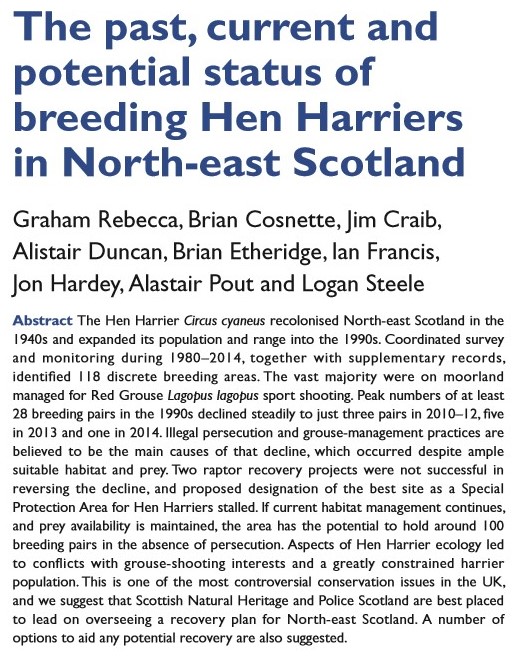
The paper has been published in the February 2016 edition of British Birds (vol 109, pages 77-95). Unfortunately we’re not permitted to provide a full copy of the paper here – you have to subscribe to BB to access that – but we can publish the abstract and we can discuss the contents. Here’s a screen grab we took of the abstract:

Rebecca et al HH paper - Copy

The paper’s authors are all members of the North East Raptor Study Group (NERSG) and/or the RSPB, and they have drawn on their own data (comprehensive and thorough monitoring from 1980-2014 where the vast majority of hen harrier breeding attempts were believed to have been recorded) as well as a wide array of other data that were collected as part of national surveys for other moorland priority species by various statutory and NGO agencies.

From these data (which included studies on habitat and prey availability), 118 hen harrier breeding areas were identified as being suitable, 87% of which were on managed grouse moors. In 2014, only one hen harrier breeding attempt was recorded. To say that is pretty damning would be a gross understatement. It’s as shameful as the data from the grouse moors of the neighbouring Angus Glens, where there hasn’t been a single record of a hen harrier breeding attempt since 2006 (see here). It’s important to reiterate that these data are from Scotland. Usually the bad news stories about hen harriers are from English sites, and the grouse-shooting industry will often point to Scotland as a reason why we shouldn’t be concerned – ‘Ah, there’s hundreds of hen harriers in Scotland and they’re all doing fine, what’s the big fuss about?’ (see here). Forget ‘concern’; this latest paper, along with several others, shows exactly why we are right to be outraged.

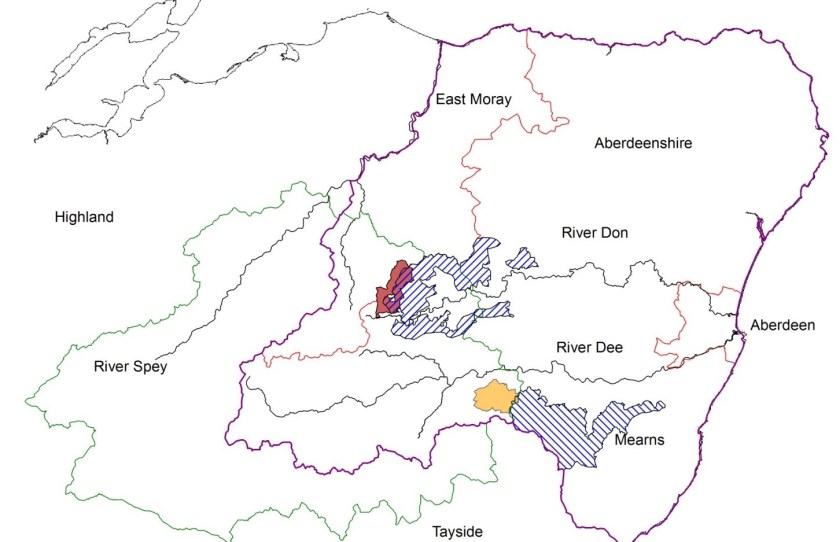
As mentioned earlier, this paper not only puts grouse moor managers in the frame (again), but it also reveals SNH’s role in this sordid tale. Before we discuss that, it’s worth looking at this map to get your bearings. The purple boundary depicts the monitoring area of the NERSG, including the following important areas for hen harriers: lower Deeside (blue back-slashed hatch), upper Donside (blue forward-slash hatch), the Glen Tanar Hen Harrier SPA (orange zone), and the Ladder Hills potential SPA (brown zone). The green border shows the Cairngorms National Park boundary as of 2014.

NERSG monitoring area - Copy

The following text is para-phrased from the paper:

In the mid-late 1990s, SNH was considering the Ladder Hills as a proposed Special Protection Area (pSPA) for hen harriers and in 1995 and 1999 SNH approached the NERSG and RSPB for information regarding Annex 1 species that were using this area. The NERSG and RSPB strongly suspected that illegal persecution of hen harriers (and other raptors) was taking place at the Ladder Hills: in 1998 (a national  hen harrier survey year), eight of the nine hen harrier nests located in the Ladder Hills failed, with no obvious biological causes, and most pairs disappeared between survey visits (harriers often attempt to re-nest following a natural failure). In 1999 only three pairs were located in the Ladder Hills. Based on the data received, in early 2000 SNH proposed the Ladder Hills SSSI as an SPA, with hen harrier as the main qualifying interest.

Subsequent discussions between NERSG and RSPB with SNH revealed that landowners had objected to the proposal, claiming there were insufficient numbers of hen harriers and questioning the authenticity of earlier data. In some years data was collected by NERSG members with informal access and in others by workers with full access arrangements. ‘Full access arrangements’ means that RSPB fieldworkers participating in the 1998 national hen harrier survey were required to liaise fully with Estates over access and report their findings (to the Estates), and in extreme cases were accompanied by a gamekeeper during survey visits. We’ll come back to this.

In late 2000, the SNH position was that raptor persecution was likely on the Ladder Hills, but also that other factors such as habitat condition and prey availability might have also been contributing to the low occupancy and poor productivity of hen harriers. NERSG and RSPB did not support the ‘habitat and prey deficiency’ hypothesis and were convinced that human interference was the primary cause of the decline, yet this was difficult to prove.

A decision on SPA classification was deferred in 2000–03 while SNH commissioned further population survey and monitoring, and assessed prey availability and habitat suitability. In 2002 and 2003 these studies extended to other areas in Aberdeenshire and Moray to enable comparison. The assessment concluded: “There are large areas of breeding habitat with suitable nest sites available across the site and no evidence of lack of prey” (R. MacDonald, SNH Area Manager, Grampian, in litt. to Ian Francis, February 2004). Nevertheless, breeding numbers did not recover and the site was removed from the pSPA list following review. Concurrently, the site was designated as an SAC under the EU Habitats Directive and is now also part of the recently established Cairngorms National Park.

The paper’s authors welcomed the SAC and subsequent National Park designations, but do not consider them as appropriate substitutes for an SPA for hen harriers. They say that in the 1990s they had one of the best areas in the UK for this species. Grouse moor owners and managers did not agree with this assessment (and possible SPA designation) presumably because they believed their management would be open to greater scrutiny. The authors contend that SPA designation should have been pursued using either the average hen harrier breeding figures from the 1990s, as had been done for similar notified pSPAs in Scotland, or on the basis of the suitable ecological conditions, with the expectation that harriers would recolonise the area with protection.

The authors point out that the Scottish Government appears committed to eradicating hen harrier persecution and enhancing its breeding status but the Ladder Hills scenario is inconsistent with these objectives. There was no support for the ‘habitat and prey deficiency’ hypothesis following the commissioned research, and no reasons were given for the non-designation of the pSPA. The habitat and prey availability at the Ladder Hills SSSI/SAC are still considered suitable for breeding hen harriers and if harriers were to recover in North East Scotland, the site should be reconsidered as a pSPA.

[End of para-phrasing].

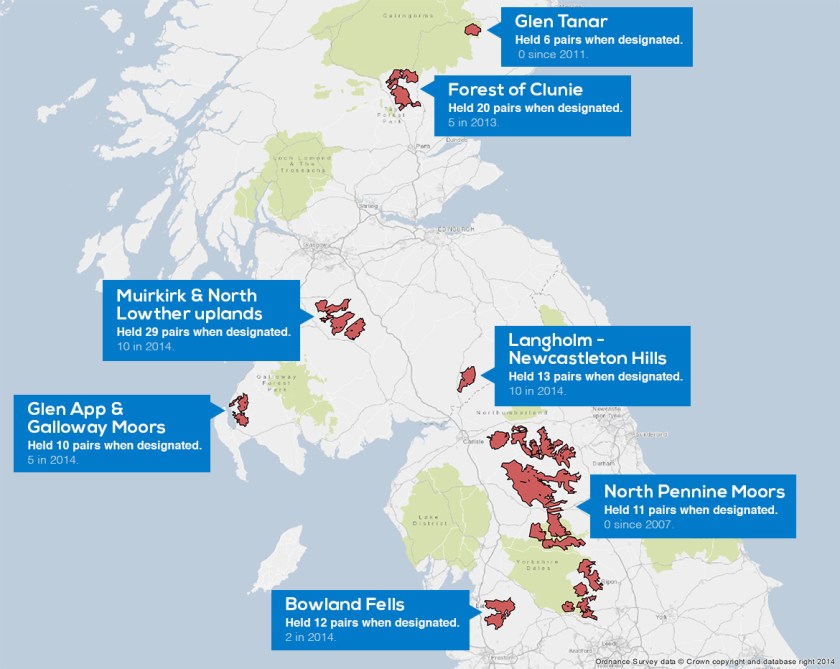
The Ladder Hills case study provides a fascinating insight to several things. First of all, it shows just how weak SNH has been in standing up to influential landowners. We’ve known this for some time but to learn that it was happening as far back as 16 years ago is surprising (to us at least, maybe not to some older readers of this blog). Even after commissioning further research to identify potential threats to hen harriers (which ruled out lack of suitable habitat and lack of prey availability as potential causes), and despite accepting that persecution was indeed one of the causes of breeding hen harrier failures in this region, SNH dropped their proposal to designate the Ladder Hills as a Special Protection Area. What’s the point of commissioning research (with tax payers money) if you’re then going to totally ignore the findings? Talk about not fit for purpose! SNH buckled when they were in a position, with strong supporting evidence, to create an SPA for this species. Not that designating a site as an SPA will automatically lead to species protection – look at all the other hen harrier SPAs in the UK (see map below, taken from RSPB’s Hen Harrier Life+ Project website – they’re all failing miserably – but at least the designation would have given conservationists some leverage to apply some pressure with European legislative backing.

HH SPA map

The second point of interest from this paper is the revelation that RSPB fieldworkers who were participating in the 1998 National Hen Harrier Survey were required to inform Estates about their survey visits and any subsequent survey results pertaining to their land, and in some cases were accompanied to those sites by the Estates’ gamekeepers. Is it just coincidence that many of the hen harrier nests that were recorded in NE Scotland during that survey year ‘mysteriously’ failed, and the number of sites found the following year dropped significantly from previous years? We don’t think so. Two + two = four, not five.

This issue of ‘transparency and trust’ is quite timely, given the blog we wrote four days ago about landowners wanting access to raptor study group data (see here). Tim (Kim) Baynes of the lairds’ lobby group Scottish Land and Estates stated that ‘The persecution of raptors is becoming a thing of the past, but there is also a duty on [the] raptor lobby to engage and share information“. Given the contents of this latest paper, he’s having a bloody laugh. Indeed, the authors write: “Levels of trust and cooperation between most raptor enthusiasts and grouse-moor estates in NE Scotland are at an all time low“. And who can blame them?

The authors discuss several potential solutions to help conserve hen harriers in NE Scotland, including the use of buffer zones around nest sites (already routinely used by SNH to protect harriers at windfarm development sites), the use of nest cameras, the use of supplementary feeding, and encouraging more golden eagles to reach natural densities in these areas as they’re predicted to naturally suppress the hen harrier population. All good suggestions, but all doomed to failure if the grouse-shooting industry is allowed to continue behaving with impunity.

UPDATE 4th Feb 2016

Two other blogs have been written about this paper and are both well worth a read:

Mark Avery here

Ian Thomson (Head of Investigations, RSPB Scotland) here