Just when you thought that all the detrimental environmental and health hazards associated with driven grouse moor management had been exposed, and just when you thought you understood the extent of corruption and/or incompetence by the government agencies responsible for preventing the detrimental environmental and health hazards associated with driven grouse moor management, along comes something else to make your jaw drop.
This time it’s medicated grit.
First, some background about medicated grit: what it is, why it’s used etc., for those who may be new to this.
The red grouse’s diet is predominantly heather. Heather can be quite fibrous and tough so the grouse ingest grit that can be found naturally on grouse moors to help digest their food. All perfectly natural. Red grouse also suffer from infestations of the parasitic Strongyle worm, which live in the gut and can cause cyclical ‘population crashes’ of red grouse every 4-5 years. Again, all perfectly natural. However, these cyclical population crashes are not very popular on intensively-managed driven grouse moors because they result in less red grouse available to kill. When your business model depends on a high density of red grouse to shoot, you want to avoid these natural population crashes at all costs. So in the 1980s the grouse shooting industry came up with a brilliant wheeze: they worked out that if they added a pharmaceutical wormer drug to the grit, they could ‘medicate’ the grouse without too much effort and halt the population crashes. Genius, eh?
The original drug used in medicated grit was Fenbendazole and this grit was placed in piles at regular intervals across grouse moors so the red grouse could eat it with easy access. The amount of grit put out depended on the density of grouse so sometimes these grit piles would be placed as frequently as every 75 m. The use of this grit was quite successful in that it reduced worm burdens in red grouse by an average of 44% and, more importantly to the grouse moor manager, increased grouse productivity by 40%. Great! More grouse available to kill! However, the drug and the fat used to bind the drug to the grit were temperature-sensitive, which meant that if there was an unseasonably mild spring, the drug would melt too soon and thus attempts to medicate the grouse during the crucial period would fail.
Not to worry, though. In 2007 the industry came up with a solution – switch to another wormer drug (Flubendazole) and another fat with a weather-resistant coating. This new grit contained 5% Flubendazole, the maximum strength permitted (licensed) for use in the UK. Tests showed that this new medicated grit would persist in the environment for much longer: 70% of the active drug remaining after nine months of being laid out, and 50-60% remaining after 18 months.
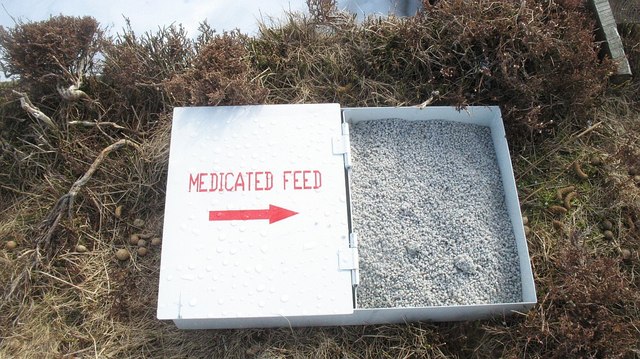
To comply with the law (which states that this drug must be withdrawn from use no later than 28 days before the start of the grouse-shooting season on 12th August to ensure the drug doesn’t find its way in to the food chain), some (but not all) grouse moor managers started to use ‘medicated grit boxes’ which comprise two compartments, separated by either a hinged or a sliding door. One compartment holds the medicated grit and the other compartment contains non-medicated grit. This allows the moorland gamekeeper to simply close off the medicated grit compartment at the appropriate time, assuming the gamekeeper is diligent and isn’t tempted to leave out the medicated grit for longer than the law allows.
Photo: medicated grit box. Image by Richard Webb.
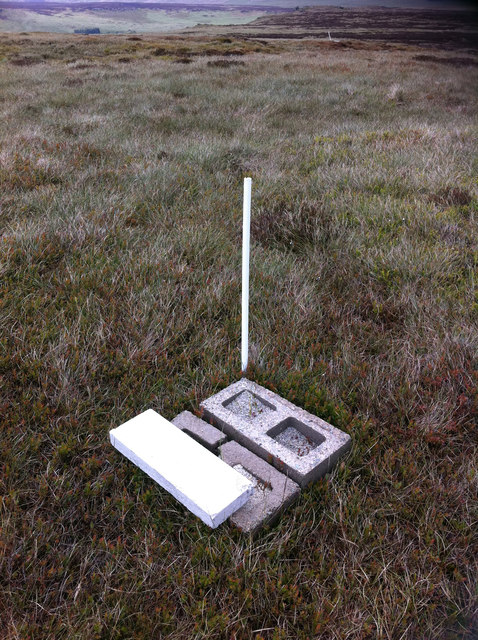
Not every moor uses specialist grit boxes though. Some moors use a home-made version:
Photo: breeze block grit dispenser. Image by Phil Champion.
And some moors place the grit directly on to cut pieces of turf:
Photo: grit on cut turf. Image by Richard Webb.

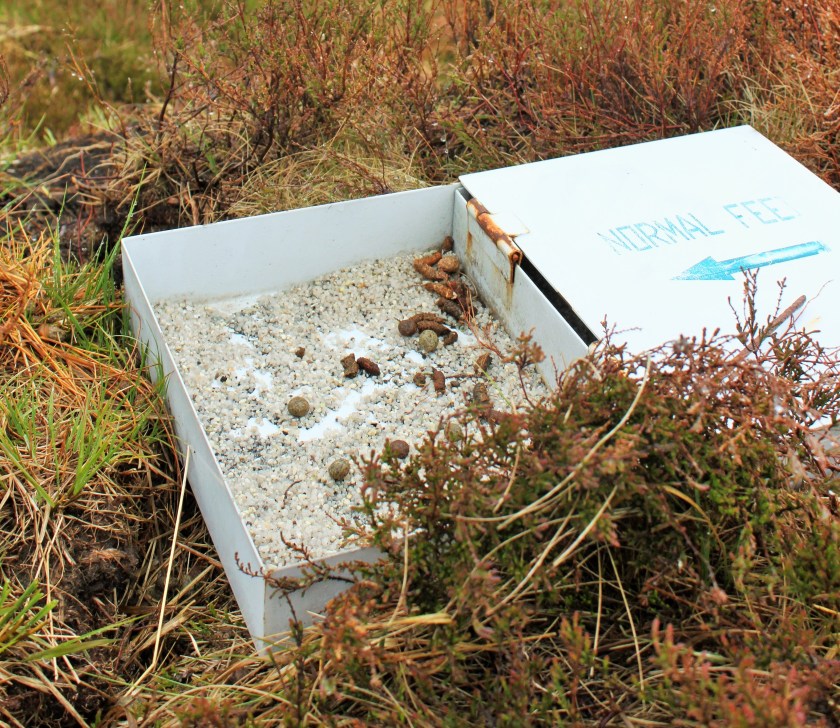
Whilst the use of medicated grit boxes might seem a very good idea, they are not without their problems. When red grouse use the boxes, they can sometimes scrat around for quite some time while they choose which piece of grit they want to pick up. This can result in large amounts of faecal matter being deposited inside the box which in turn can spread disease to other grouse using the box. The ‘best practice guidelines’ issued by GWCT encourages the regular removal of all these faeces but it’s apparent that this isn’t happening on all moors. This may well explain the recent increase in the highly contagious ‘Bulgy Eye’ disease in red grouse that’s being reported on moors in northern England as well as Scotland.
Photo: grit box contaminated with grouse faeces. Image by Ruth Tingay.
Although some grouse moor managers were using double strength medicated grit, they still weren’t satisfied with performance so a new ‘super-strength’ medicated grit has been developed which is ten times the strength (and according to grouse moor management ‘guru’ Mark Osborne, can be twenty times the strength). The ten times strength grit contains a suspension of 50% Flubendazole, which is far greater than the 5% limit permitted for use in the UK. The manufacturers get around this by using a Special Import Certificate.
In addition to the use of medicated grit, some grouse moor managers are also using direct-dosing methods whereby the grouse are caught in the middle of the night and have a tube shoved down their throats to deliver a few mls of an anthelmintic drug.
So, with all these pharmaceutical wormer drugs being given to red grouse, you might expect a high level of monitoring by the statutory agencies to ensure that these drugs are not entering the food chain when people are eating shot red grouse, right? Pretty much all other meat destined for human consumption is subject to rigorous testing so red grouse shouldn’t be any different, right?
WRONG!!
You may remember back in July we blogged a little bit about the use of medicated grit on driven grouse moors, in response to a ludicrous claim by SNH that red grouse are ‘healthy’ and ‘natural’ to eat (see here). We said we were interested in the testing regime and had read that the Food Standards Agency was responsible for testing shot red grouse as well as for randomly sampling medicated grit boxes.
So an FoI was sent to the FSA to ask them for the following information:
- How many individual birds (red grouse) were tested in England and Scotland in each of the following years: 2010, 2011, 2012, 2013, 2014? Please provide a breakdown of each country in each year.
- From how many geographically separate grouse moors did these birds originate? Please provide a breakdown of county for each year.
- On what dates were these birds tested? Please provide a breakdown for each county in each year.
- How many of the birds tested in each year were found to contain the presence of illegal residues of Flubendazole? Please provide a breakdown of each county in each year.
- If illegal residues were detected in any bird, what action, if any, was taken?
- How many individual grouse moors in England and Scotland were randomly visited in each of the following years (2010, 2011, 2012, 2013, 2014) to test the contents of grit boxes for the presence of Flubendazole? Please provide a breakdown for each country in each year.
- How many grit boxes were inspected on each grouse moor of each year in each country? Please provide a breakdown of each moor, in each country, in each year.
- On which dates were these inspections made? Please provide a breakdown of each moor, in each country and in each year.
- How many of the inspected grit boxes were found to contain Flubendazole? Please provide a breakdown of each moor, in each country, in each year.
- If any illegal residues were detected in any grit box, what action, if any, was taken?
The FSA said they didn’t hold the information and recommended contacting the Veterinary Medicines Directorate (VMD) at DEFRA who should be able to help. It turns out that ‘the VMD are the competent authority for the National Surveillance Programme which is carried out in accordance with EU Directive 96/23/EC. This is implemented nationally under The Animal and Animal Products (Examination for Residues and Maximum Residue Limits) (England and Scotland) Regulations 2015 and The Animal and Animal Products (Examination for Residues and Maximum Residue Limits) Regulations 1997 as amended’.
So the same FOI was sent to the VMD. Their response was as follows:
“The VMD’s Residues Team haven’t taken any red grouse samples under the National Surveillance Scheme (NSS) in the years you cite, nor in any other year. We don’t therefore have the information you request”.
A further FoI was sent to the VMD to ask why they hadn’t collected any samples from any red grouse, ever. This was their response:
“The legislation does allow us to sample red grouse, but the issue is that we do not have any details of abattoirs processing this species. We continue to sample partridge and pheasants at abattoirs – these are from game shoots and taken to abattoirs to be gutted and cleaned. The abattoirs have to hold a licence to be able to do so.
In accordance with the Legislation, we must take samples at the primary production point – on farm or at abattoirs. But as we do not have any details of abattoirs processing red grouse, we have been unable to carry out any sampling under the surveillance programme.
If you do have concerns that there is use of an unauthorised substance or the withdrawal period is not being observed you should contact the Local Authority”.
 We were fascinated by the idea of gamebirds being sent to “abattoirs” to be gutted and cleaned. We’d never heard of that, although we did know that some gamebirds are sent to game processing plants to be plucked etc. One such plant is Yorkshire Game, which we also knew processed red grouse. So another FoI was sent to the VMD to ask for a list of all “abattoirs” and processing facilities they had visited in the last five years to sample pheasant and partridge, as we were keen to see whether Yorkshire Game appeared on their list. Surely, if we, as ordinary members of the public, knew that Yorkshire Game processed red grouse, then the specialist team from the VMD would also know that….it’s kind of their job to know! We also asked why, if the legislation states that samples must be taken at the primary production point (“on farms or at abattoirs”) no samples had been taken at any red grouse ‘farms’ (grouse moors)?
This was their response:
“Under the programme samples are taken at abattoirs and some of these abattoirs also act as a processing facility. Attached is a list of all game samples taken including the abattoir from 2011 to date. [Ed: this list did indeed include Yorkshire Game, as well as a number of other processing facilities in England and Scotland].
Samples taken on farms are from animals in a managed environment and the animals are usually housed to allow the sampling officer to target a specific animal to be sampled. The practicalities of taking a sample from birds that are roaming free would be more difficult and take up additional resources.
However, since my last e-mail the VMD have now successfully identified a number of abattoirs where red grouse is processed. As a result the National Surveillance Programme for 2016 will include sampling from red grouse and full results will continue to be published on gov.uk”.
So, it turns out that the VMD had been sampling pheasants and partridge at Yorkshire Game (and other game processing plants known by us to process red grouse), but were apparently unaware that red grouse were also available to sample there. That’s kind of hard to believe, isn’t it?
Their response to why they haven’t sampled red grouse directly at grouse moors is also hard to believe. They state that sampling free-flying birds would be difficult (yep, that would be true) but don’t say anything about why they haven’t sampled dead (shot) birds at the end of a day’s shooting.
It’s good to hear that this ‘specialist’ team “has now successfully identified a number of abattoirs where red grouse are processed” and we look forward to seeing the results of extensive sampling that should begin in 2016.
But the VMD still hadn’t answered the question about testing medicated grit boxes on grouse moors, to see whether the anthelmintic drug had actually been withdrawn within the statutory withdrawal period or whether it was still freely available to the grouse at the on-set of the shooting season. So, another FoI was submitted to ask how many grit boxes on grouse moors had been tested over the last five years. This was their response:
“The prescribing of wormers in grouse grit is permitted under the rules of the prescribing cascade in the Veterinary Medicines Regulations 2013. Use of medicines in animals under the cascade is down to the professional judgement of the prescribing veterinary surgeon, taking into consideration the impact on the animals concerned, in response to a specific animal welfare need. Therefore, the VMD does not specifically monitor such use.
A statutory withdrawal period when using medicines under the cascade has to be applied and that means that the medicated grit must be removed from the grouse moors at least 28 days prior to the shooting of the birds. The Legislation referred to in my previous e-mail sets out that primary products of animal origin should be sampled and grit is not included in the programme. Samples of red grouse muscle will be taken as part of the 2016 programme”.
Amazing! So a pharmaceutical drug of at least ten times the licensed strength permitted (twenty times the strength if you believe Mark Osborne) is being used on grouse moors without ANY statutory monitoring whatsoever! Isn’t that astonishing? Do you think that the public would accept other meat industries (e.g. dairy farmers) getting away with this lack of regulation and scrutiny? No, of course they wouldn’t, so how come the grouse shooting industry is exempt?
The grouse shooting industry will probably argue that they have ‘best practice guidelines’ for the use of medicated grit – and indeed they do – but who will believe that they’re adhering to these guidelines? We don’t. This is an industry that routinely breaks the law so we’d fully expect them to ignore ‘best practice guidelines’, especially if they know the authorities aren’t checking.
Anyone still fancy eating a ‘natural’ and ‘healthy’ red grouse? Go on, it’s good for you – as well as all that toxic lead, there’s free, high-dosage wormer included too! Yum!
And what about the environmental consequences of using this high persistence pharmaceutical drug in an open landscape of supposed high conservation value? What short and long-term effect is it having and how does it impact on other species? Nobody knows. Is anyone researching this or is it yet another case of turning a blind eye to the actions of the grouse shooting industry?
An argument could easily be made that shot red grouse is actually ‘hazardous waste’. The HSE’s definition of hazardous waste is this:
‘Waste is considered ‘hazardous’ under environmental legislation when it contains substances or has properties that might make it harmful to human health or the environment. This does not necessarily mean it is an immediate risk to human health, although some waste can be’.
It’s time driven grouse shooting was banned. Please sign the petition HERE
UPDATE 3 March 2017: Are red grouse safe to eat? Don’t rely on Government testing to tell you (see here).
UPDATE 1 January 2018: High risk of eating contaminated red grouse after inadequate safety checks (here)
UPDATE 12 July 2018: High risk of eating contaminated red grouse as inadequate safety checks continue (here)
UPDATE 19 February 2024: More scrutiny on its way for use of toxic medicated grit on Scottish grouse moors (here)

 As part of the RSPB’s Hen Harrier Life+ Project, the movements of two satellite-tagged hen harriers can now be followed online – see here.
 A new report has been published today entitled
 Criminal proceedings continued yesterday against Scottish gamekeeper William Curr of Glenogil Estate in the Angus Glens.
 Yesterday the Scottish Government published its latest report on wildlife crime: ‘Wildlife Crime in Scotland: 2014 annual report’ (see
  Raptor Persecution UK