
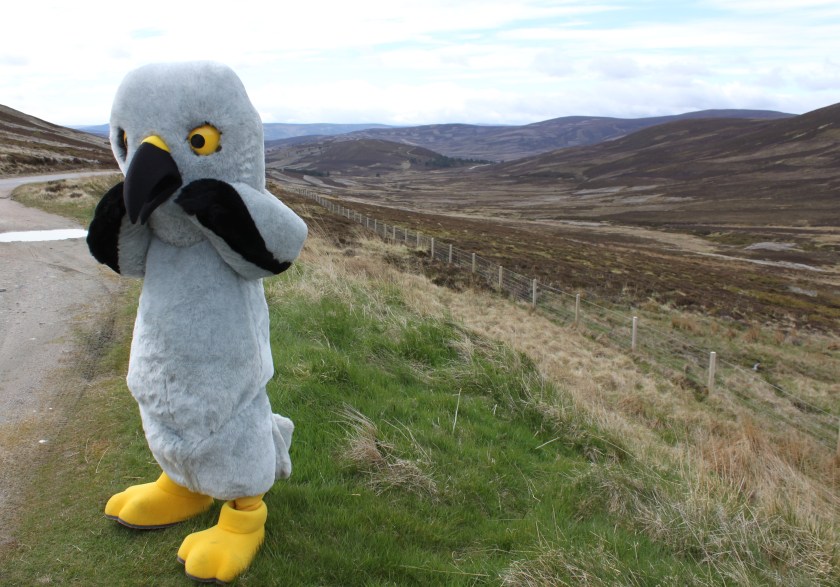
This is the eastern side of the Cairngorms National Park.
When you read about landscapes that are ‘dominated by driven grouse moors’, this place is as good as any to understand what is meant by that. Ugly burnt rectangular strips of heather for as far as the eye can see are a bit of a giveaway, as are the lines of grouse-shooting butts marching across the hillsides.
This layby, on a public road, might be a good place to pull over for spectacular views of the glen, and perhaps it would provide the perfect opportunity to watch for a hen harrier settling down to roost on the hillside in the fading hours of daylight. Armed with a decent pair of binoculars and a rudimentary understanding of hen harrier ecology, you might expect a special evening enjoying views of the protected wildlife safe within the boundaries of a National Park.
But then you remember. This is the Cairngorms National Park.
Perhaps it was a spot just like this where, in 2013, the alleged coordinated hunting and shooting of a male hen harrier took place on a driven grouse moor on the eastern side of the Cairngorms National Park?
How many pairs of successfully breeding hen harriers do you think there are inside the Cairngorms National Park?
 Raptor Persecution UK
Looking at that degraded landscape it is hard to imagine it is in a National Park, Scotland and the UK should be ashamed to call a desert like that a National Park. Not likely to see much wildlife there – the gamekeepers have made sure of that.
Puts conservation in the UK in a very poor light
I couldn’t agree more. We visited this area of Scotland last year and were shocked at the degradation. The bulldozed tracks across the hills are very visible and have opened up the ground to rainwater erosion, and where the ground was recently burned only the green fronds of bracken were growing.
We made our feelings known to the owner of the campsite who was equally distressed and said the Scotland they grew up in had changed dramatically. Our visit also coincided with replacing the pylons along the A9 also making huge scars, along such an important tourist gateway to the Highlands why not put them underground?
Needless to say we did not log a raptor along the route whereas if it was here in Wales there would have been a choice of fine birds to admire!
Also when you drive along the M40 you can see dozen’s of Red Kites, but up here in the Highlands you are lucky to see one. The gamekeepers have been very successful in not allowing the Black Isle population to grow and re-colonise.