RSPB Investigations Team: 1; Countryside Alliance: 0

Last October, the Countryside Alliance launched a scathing attack on the RSPB’s latest annual Birdcrime Report (Birdcrime 2013). The link to their article has mysteriously ‘disappeared’ from their website, so here’s a copy we took:

Thursday, 30 October 2014, Countryside Alliance website:

Countryside Alliance Director for Shooting Adrian Blackmore writes: The RSPB’s Birdcrime Report for 2013, which was published on Thursday 30th October 2014, provides a summary of the offences against wildlife legislation that were reported to the RSPB in 2013. It should be noted that in 2009, the RSPB took the decision to focus on bird crime that affected species of high conservation concern, and crime that it regarded as serious and organized. The figures supplied do not therefore give a total figure for wild bird crime in the UK in 2013, and they are not comparable with figures provided for years prior to 2009.

As is becoming increasingly the case, the report makes sweeping allegations against the shooting community, and grouse shooting in particular – allegations that are not consistent with the evidence provided. It claims that activity on grouse moors is having a serious impact on some of our most charismatic upland birds, and that current measures have failed to find a solution. The report claims that “over the years, a steady stream of grouse moor gamekeepers have been prosecuted for raptor persecution crimes”, and lists each of the offences for which those gamekeepers have been found guilty between 2001 and 2013. Over that 13 year period, 20 gamekeepers employed on grouse moors (an average of 1.5 per year) are shown as having been prosecuted, but according to the RSPB’s birdcrime reports for each of those years, the total number of individual prosecutions involving wild birds totalled 526 individuals. Given that grouse moor keepers therefore represent a mere 4% of those prosecuted in the courts, one can only wonder why the RSPB should choose not to focus on the occupations of the other 96%.

The RSPB also states in the report that “it believes it is the shooting industry as a whole, not individual gamekeepers, that is primarily responsible for raptor persecution in the UK”. It has therefore repeated its call for: political parties to introduce licensing of driven grouse shooting after the election; the introduction of an offence of vicarious liability in England; increasing the penalties available to courts for wildlife offences; and for game shooting to be regulated with an option to withdraw the ‘right’ of an individual to shoot game or businesses to supply shooting services for a fixed period following conviction for a wildlife or environmental offence.

For the third year running, the RSPB has included a piece of research in its Birdcrime Report that is intentionally misleading. Both the 2011 and 2012 reports covered in detail a research paper which claimed that peregrines on or close to intensive grouse moor areas bred much less successfully than those in other habitats, and that persecution was the reason for this. That same research paper is covered again in the 2013 Birdcrime report. The research in question used data from 1990 – 2006 and at the time it was published a representation was made to the National Wildlife Crime Unit which resulted in a caveat being circulated to all Police Wildlife Crime Officers in the UK explaining that the data used in the paper was out of date, and that in using such information there was danger that the research paper suggested a current situation. For the RSPB is well aware of that caveat, and to include this once again makes a complete mockery of its previously stated belief that reliable data are essential to monitoring the extent of wildlife crime.

Summary of statistics

341 reported incidents of illegal persecution in 2013 – a reduction of 24% since 2012 when there were 446 reported incidents, and well below the previous 4 year average of 573.

164 reported incidents of the shooting and destruction of Birds of Prey which included the confirmed shooting of 49 individual birds of which only 7 took place in counties associated with grouse shooting in the North of England.

74 reports of poisoning incidents involving the confirmed poisoning of 58 Birds of Prey of which only 2 occurred in counties in the North of England where grouse shooting occurs.

In total, there were 125 confirmed incidents of illegal persecution against Birds of Prey in 2013. Just 18 of those occurred in counties in the North of England where grouse shooting takes place, and none of those have been linked to grouse shooting.

Of the 32 individual prosecutions involving wild birds in 2013, only 6 individuals were game keepers, and one of those was found not guilty. Therefore, of those prosecuted, only 16% were gamekeepers and only 6% of the 32 cases involved birds (buzzards) that had been killed. Only one of the cases concerned an upland keeper employed by an estate with grouse shooting interests, and that case did not involve the destruction of a bird of prey.

Of the 14 incidents of nest robberies reported in 2013, only 3 were confirmed, one of which involved the robbery of at least 50 little tern nests.

There is no evidence to support the RSPB’s allegation of persecution of birds of prey by those involved in grouse shooting. The RSPB’s Birdcrime Reports show that between 2001 and 2013 there were 526 individual prosecutions involving wild birds, and according to its 2013 report only 20 of those individuals (4%) were actually gamekeepers employed on grouse moors.

Land managed for grouse shooting accounts for just 1/5th of the uplands of England and Wales.

The populations of almost all our birds of prey are at their highest levels since record began, and only the hen harrier and the white-tailed eagle are red listed as species of conservation concern.

REPORTED INCIDENTS IN 2013

In 2013, the RSPB received 341 reported incidents of wild bird crime in the UK, the lowest figure since 2009. This represents a reduction of 24% since 2012 when there were 446 reported incidents, and well below the previous 4 year average of 573.

SHOOTING INCIDENTS

As in previous years, the, the most commonly reported offence in 2013 was the shooting and destruction of birds of prey, with 164 reported incidents in 2013. Of these, the shooting of 49 birds of prey are shown in the report as being confirmed, of which 7 were in counties of the North of England where grouse shooting takes place. The remaining 23 incidents that were confirmed in England occurred elsewhere.

POISON ABUSE INCIDENTS

During 2013 there were 74 reports of poisoning incidents involving the confirmed poisoning of 58 Birds of Prey of which only 2 occurred in counties in the North of England where grouse shooting takes place:

ILLEGAL TRAPPING AND NEST DESTRUCTION

There were 18 confirmed incidents of illegal trapping of birds of prey in 2013, and no confirmed cases of nest destructions, compared to 2012 when there had been 10 incidents of nests being destroyed. Although this figure of 18 is an improvement on that for 2012, it is still above the previous 4 year average of 14 incidents.

WILD BIRD RELATED PROSECUTIONS

In 2013 there were 32 individual prosecutions involving wild birds. Only 6 of those individuals were game keepers, and one of those was found not guilty. Therefore, of those prosecuted, only 16% were gamekeepers and only 6% of the 32 cases involved birds (buzzards) that had been killed. Only one of the cases concerned an upland keeper employed by an estate with grouse shooting interests, and that case did not involve the destruction of a bird of prey:

CONCLUSION

It is clear from its 2013 Birdcrime Report that the RSPB is continuing in its efforts to promote an anti-shooting agenda, especially against driven grouse shooting. It has less to do with aconcern about birds and more about ideology and a political agenda. Like reports of recent years, the 2013 Birdcrime Report is deliberately misleading, and many readers will invariably take at face value the claims and accusations that have been made. Many of these are serious, and made without the necessary evidence with which to substantiate them.

ENDS
The reason, perhaps, this article has mysteriously ‘disappeared’ from the CA’s website can probably be explained by the following…..

The Countryside Alliance used this article to lodge a complaint against the RSPB with the Charity Commission. The CA’s claim was based on this:

The report [Birdcrime 2013] makes sweeping allegations against the shooting community, and grouse shooting in particular – allegations that are not consistent with the evidence provided [in Birdcrime 2013]”.

The Charity Commission was obliged to investigate the CA’s complaint that the RSPB had ‘mis-used’ data and had made ‘un-founded allegations’ and they have now issued their verdict – they have rejected every single complaint made by the Countryside Alliance against the RSPB.

Strangely, although the Charity Commission’s response letter was sent to the CA on 7th January 2015, the findings have not appeared on the CA’s website. Can’t think why. Anyway, here’s a copy for those who want to read it – it’s really rather good:

Charity Commission response to Countryside Alliance complaint re RSPB Jan 2015

Not to be deterred by making yet another ‘embarrassing blunder‘, this week the Countryside Alliance wrote a response to the sentencing of goshawk-bludgeoning gamekeeper George Mutch, sent to jail for four months for his raptor-killing crimes. The CA’s response starts off well, condemning Mutch’s actions, but then it all goes badly wrong. According to the CA, it’s the RSPB’s ‘wider policy’ that is driving the continued illegal persecution of raptors!

You couldn’t make this stuff up. Why is it so hard for the game-shooting industry to take responsibility for their actions instead of continually trying (and failing) to discredit the RSPB? Is it because they have no intention whatsoever of addressing the widespread criminality within their ranks and so they churn out all this anti-RSPB rhetoric as a distraction technique? Nothing to do with the RSPB being so effective at exposing and documenting the game-shooting industry’s crimes, of course.

Expect more ludicrous attacks on the RSPB over the coming weeks and months….a predictable response from an industry unable, or unwilling, to self-regulate and undoubtedly feeling the pressure of scrutiny and demand for change from an increasingly well-informed public.

The link to the CA’s latest absurd accusation can be found here, but just in case it also mysteriously ‘disappears’, here’s the full text. Enjoy!

Countryside Alliance website

16th January 2015

‘Shooting, livelihoods and raptors’

The illegal killing of birds of prey is about the most selfish crime it is possible to commit because even if there are short term benefits for the preservation of game (and those benefits are as likely to be perceived as real) they will always be outweighed by the long term damage to the shooting industry as a whole.

That is why the Alliance has no hesitation in condemning an Aberdeenshire gamekeeper who was sentenced to four months in prison earlier this week for four offences including the killing of a goshawk.

Raptors as a whole may be the biggest success story in British birds with numbers having increased hugely as a result of legal protection and reintroduction, but some species remain rare and killing them for the sake of providing more birds to shoot is never going to be anything but a political and PR disaster.

The RSPB collected the evidence which convicted that gamekeeper and was understandably pleased with the outcome of the case. Whilst its actions in relation to individual cases like this are entirely justified the Society must, however, consider whether its wider policy is actually helping to perpetuate, rather than reduce, illegal persecution.

This might sound a strange statement, but it is worth considering the RSPB’s own history and how other wildlife conflicts have been resolved. The RSPB was founded by a group of women appalled by the trade in exotic feathers for ladies’ hats. Its first campaign was not aimed at prosecuting the people killing birds, but at removing the causes of persecution, which in that case was the high value of feathers. By reducing demand for rare birds it removed the economic imperative for persecution.

One argument might be to simply ban shooting and with it one of the main reasons someone might have for killing a raptor. However, that policy would create far greater conflict and remove the many positive environmental, economic and social benefits of shooting which far outweigh the negatives of any associated raptor killing.

Another, we would argue far more logical, approach would be to consider the causes of any illegal raptor killing and how the drivers for that activity could be removed. In two areas in particular the RSPB seems unwilling to consider proposals which tackle the causes of persecution, as well as persecution itself.

Firstly by refusing to endorse proposals for hen harrier ‘brood management’ which would give assurances to upland keepers that colonies of hen harriers could not make their moors unviable and their jobs redundant. And secondly by opposing absolutely any management, even non-lethal, of the burgeoning buzzard population even if they are having a significant economic impact on game shooting.

We are not suggesting that these management practices must take place, but surely an agreement that they could be used where absolutely necessary to protect livelihoods would make it less likely that people would make the wrong decision about illegal killing?

END
“The eradication of mountain hares in eastern & southern Scotland is disgraceful”

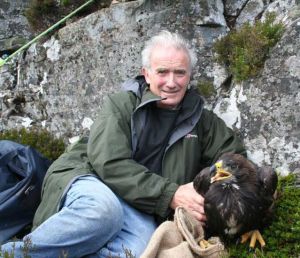
Roy Dennis with AlmaFollowing last week’s Out of Doors programme on BBC Radio Scotland, which included an unchallenged interview with Dr Adam Smith of the GWCT who was trying very hard to justify mountain hare culls on grouse moors – see here [comment #8], we were pleased to hear the subject raised again on this week’s show, this time with someone with an opposing view.
That someone was conservationist Roy Dennis, probably best known for his involvement in several raptor reintroduction and satellite-tracking projects (visit his two websites here and here).

It’s a good, well-rounded interview. Whilst he recognises that there may, in some instances, be a requirement for local culling (to protect young trees), he doesn’t buy into the argument that the widespread mass culling of hares is beneficial for controlling disease in red grouse and he describes the eradication of mountain hares in eastern and southern Scotland [on grouse moors] as “disgraceful”.

He talks about the sustainable hare population on one Highland sporting estate where he has been providing ecological advice for a number of years (proabably Coignafearn Estate – one of the few that doesn’t kill hares –  see here) and welcomes SNH’s call for land managers to exercise ‘voluntary restraint’, although he thinks SNH struggled to get that through against opposition from landowners and GWCT. Roy’s own recommendation to SNH and the Government had been for a voluntary two-year moratorium on all mountain hare culling, allowing time for an assessment of the species’ conservation status and the impact of long-term, widespread culls.

Roy doesn’t agree with the calls for a ban on the shooting of mountain hares. Others disagree and a petition has been launched, calling for exactly that. See here.

Roy’s interview can be heard here for another month. [Starts at 16:04]

The photograph shows Roy with young golden eagle ‘Alma’, hatched on the Glenfeshie Estate in 2007 and satellite-tracked by Roy. She was found dead on the Millden Estate two years later. She’d been poisoned.

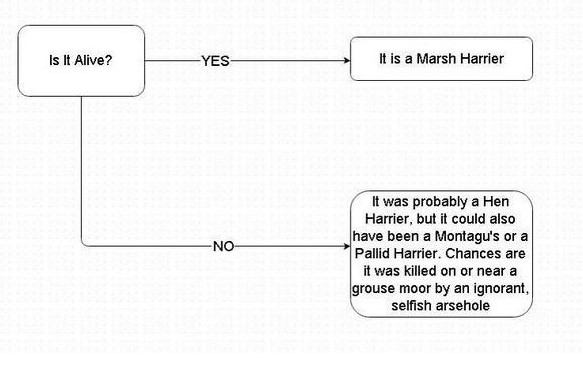
Useful guide to aid harrier identification (author unknown)

HH ID guide

UPDATE: Have just been told this is the creative genius of @YOLObirder

“Horrible” raptors are “becoming more aggressive”, says idiot

Yesterday, the Irish radio station ‘Newstalk’ broadcast a discussion on the theme ‘Are the birds going the way of the dinosaur?’

The presenter, Pat Kenny, was interviewing Professor Luke O’Neill, a prominent biochemist from Trinity College, Dublin. This leading academic was introduced as someone who has been studying the depletion of bird populations. According to Professor O’Neill, worldwide bird declines are attributable to “horrible” raptors that “are going up in numbers” and are “becoming more aggressive“. He also said a lot of other really stupid and inaccurate things.

You can listen to the broadcast here.

Is it any wonder that raptors continue to be persecuted when idiots like this are given air-time? His comments have probably set back raptor conservation in Ireland by years.

We were intrigued about O’Neill’s credentials in the field of raptor ecology and biology so we checked out the Professor’s webpage on his university’s website. We couldn’t find any evidence of his academic involvement in bird population studies, or any other ecological expertise for that matter. Have a look at his research publications here.

In response to the Professor’s unsubstantiated and moronic vilification of raptors, Dr Allan Mee, a leading raptor ecologist working with the Golden Eagle Trust in Ireland (specifically, managing the White-tailed Eagle Reintroduction Project) has today written to Professor O’Neill (email reproduced here with Dr Mee’s permission) –

Dear Prof O’Neill,

I was astonished at many of your statements made yesterday during your piece on the Pat Kenny show. I’ve made my feelings known to Newstalk and asked then for a right to reply. I’m not saying everything you said was factually incorrect but much was. Even disregarding the jocular tone of the programme the scene was set by focussing on raptors…..“the raptors, which are the horrible birds of prey, they’re going up in numbers some of those and one reason for the decline is they’re getting more aggressive” (no idea of source for this). This is set out as the centrepiece of your argument for the causes of declines in birds (songbirds, all birds?) and sets the tone for the rest of the piece and the general implications that raptors are the prime cause of bird declines.

Please by all means show me a scientific paper which shows this? No I don’t think you will find one.

Please show me a paper which attributes population declines and/or extinction to raptors? I don’t think you will find any evidence of this either apart from possibly the impacts of hen harriers on grouse on grouse moors in the UK where raptors are persecuted (shot, poisoned, trapped) because they conflict with the grouse moor owners desire to artificially maximise grouse numbers and thus profit. Look at all the evidence for declines in birds worldwide (see for example the data published by BirdLife International referenced below) or even closer to home where all our farmland birds and breeding waders have declined to the brink of extinction in many cases. No you won’t find any discussion of raptors as a causal factor there either because there are NO data to support this, rather the overwhelming evidence of declines due to farmland modernisation, loss of hedgerows, ryegrass monocultures replacing traditional meadows etc. Moreover it’s a long held tenet of ecology that predator populations respond to and are maintained by changes in prey populations, NOT the other way round.

Even your claim that climate change only changes the distribution of birds (they just move elsewhere) is wide of the mark. Birds can and do of course “respond” by changing their distribution/extending their ranges as has recently happened with Little Egrets in Ireland (if the raptors don’t get them first). But in many cases birds can’t just go somewhere else. They may be non-migratory or the habitat in “somewhere else” is already saturated with populations of that species. Or they literally have nowhere to go such as arctic relict species such as Ptarmigan on Scottish montane plateaux. The prognosis for such species isn’t good as climate warms up the montane environment and habitat changes so that the montane zoo moves further up the mountain until there is nowhere else to go. For many endemic species confined to a single island site these changes are likely to mean extinction.

You mention Red Kites increasing. Yes these have recently been reintroduced back to Ireland after being lost to human destruction 200-300 years ago. Their numbers are approx 30-50 pairs largely confined to Wicklow. They eat very few birds being largely specialist on rodents (rats), crows (young from nests), young rabbits and even earthworms. Even if they were to feed only on small birds this wouldn’t explain a decline in songbird numbers given that the numbers don’t stack up: 30-50 pairs or some 100-120 individuals compared to some hundreds of thousands of “small birds”, even if these are declining. Don’t take my word for it. Go to Avoca in Wicklow in winter to witness the stunning spectacle of many of the Wicklow kites roosting together just outside the town in winter. No you won’t find any sitting on garden bird feeders waiting for an easy meal and you’ll probably find lots of small birds feeding away happily.

Funnily enough, just to reinforce the point that raptors and healthy populations of small birds (their prey) do coexist, we once had at least 6 species of raptor in Ireland that became extinct in the last 300 years due to human persecution. Along with all that diverse and much larger raptor population there existed a diverse assemblage of bird species and much greater “small bird” populations in historic times when Ireland was still relatively pristine, lots of native woodland, intact bogs, stunningly rich marshes, healthy unpolluted rivers and lakes, beautiful extensive upland blanket bog and moorland etc. Oddly enough small birds did survive and thrive in the presence of all those raptors!

Over the past 10+ years we have been working hard to spread awareness among the public regarding the vital role birds of prey have in our ecosystem in the face to human persecution such as shooting and poisoning. There are plenty of folk out there who take what they hear on radio as “fact” especially when delivered by a Prof and backed up by a well-known presenter. It is a shame this lack of understanding still abounds even in academic circles and has the potential to damage years of conservation work by reinforcing long-held but misguided beliefs.

Over the past 25 years I have worked on species from golden eagles in Scotland, California Condors in the US and currently White-tailed Sea Eagles in Ireland (as well as being chairman of the Irish Raptor Study Group……at our annual conference in Dublin on 31 Jan we have several talks including one on raptor persecution entitled Natural  Injustice – the failure of wildlife crime enforcement in Scotland) where the common theme has been the destructive effects of human misconceptions regarding raptors and their role in ecosystems. It seems like not much has changed.

Allan

Complaints to Newstalk can be emailed to the Station Editor Garrett Harte: garrett@newstalk.com

Complaints to Professor O’Neill can be emailed to: laoneill@tcd.ie

UPDATE: Complaints from other organisations & individuals have already been made – see here.

Another UPDATE: Commentary on cause of bird population declines, and the valuable role of raptors in the environment, provided by real ecology experts from Trinity College, Dublin, not a pretend one – see here.

Gamekeepers “the doctors & nurses of the countryside”

Ah, Alex Hogg, the SGA Chairman – he’s the gift that just keeps giving.

He and his son Kyle featured in an ITV Border Life programme that aired on Monday and Alex gave us another one of his classic quotes:

We kill animals because probably we’re the doctors and nurses of the countryside. Animals don’t have an old folks home to go to; when their teeth fall out they’ll starve to death so we’ll probably shoot that animal before that happens“.

What a deluded analogy. Doctors and nurses heal the sick; gamekeepers kill most species that might threaten the number of gamebirds available, er, to be killed. Where’s the similarity between these two professions?!

He also says he’s proud that things haven’t changed in 150 years of gamekeeping: “It’s part of our natural heritage, almost“.

What he meant of course was 150 years of gamekeeping has had a devastating impact on our natural heritage, wiping out several species (some of which have since been reintroduced by conservation organisations) and reducing others to a fraction of their former range and abundance.

If you want a laugh, you can watch the programme here (look for programme aired Jan 12th).

Who owns Kildrummy Estate?

Following yesterday’s news that Kildrummy Estate gamekeeper George Mutch has been jailed for four months for his raptor-killing criminal activities, a common question we’ve heard is, ‘Will there now be a vicarious liability prosecution?’

We think that there is the potential for a prosecution, although obviously we’re not privy to any evidence that the Crown might have available when they make a decision whether to proceed or not. We’ll just have to be patient and see what happens.

Let’s assume the Crown does decide that there is sufficient evidence to proceed, and that it would be in the public interest to prosecute, then the question becomes, ‘Who would be charged?’

That will depend on who was in the chain of command above Mutch and what managerial responsibilities they had at the time he committed his crimes (see here for our interpretation of how vicarious liability works). For example, if there was a Head Gamekeeper then perhaps he/she might be the one charged. If there was an Estate Factor then perhaps he/she might be the one charged. Perhaps there wasn’t anyone in a hierarchical managerial role between Mutch and the landowner, in which case, the landowner may be the one charged. But in this case, that might be a bit difficult.

Why? Have a read of Andy Wightman’s brilliant blog here and you’ll understand!

George Mutch sentenced to four months in prison

Scottish gamekeeper George Mutch, convicted in December for trapping a goshawk and then battering it to death (and a few other things – see here) on the Kildrummy Estate in Aberdeenshire, has been sentenced to four months in prison for his crimes.

He was led away from the court in handcuffs and is currently en-route to a prison cell.

What an unbelievably brilliant outcome – we never thought we’d see the day. Mutch is the first gamekeeper ever to be jailed in the UK for killing raptors.

Huge congratulations to the RSPB Investigations Team, SSPCA, Police Scotland and the Crown Office, and kudos (and thanks) to Sheriff Noel McPartlin for handing out this sentence. An acknowledgement also to former Environment Minister Paul Wheelhouse, who pushed hard for the admissibility of video evidence. Had he not done so, this case would probably not have made it to court.

For anyone who missed it when he was convicted in December, here is the video nasty showing gamekeeper Mutch carrying out his crimes on the Kildrummy Estate in Aberdeenshire.

We understand there’s the potential for a vicarious liability prosecution in this case. We’ll have to wait and see whether COPFS deems there’s enough evidence to proceed. Although that may prove difficult – have a read of Andy Wightman’s blog about who owns Kildrummy Estate, here.

Media coverage:

A bizarre statement from the SGA here. Isn’t it great to see the representative organisation strongly condemning his crimes, er…

BBC news here, including statements from the Sheriff, RSPB Scotland, COPFS, SGA and SLE.

RSPB Scotland statement here

Press & Journal here

Herald here. This is an interesting one, with quotes from defence agent David McKie about Mutch’s employment status and the status of his firearms certificates.

Telegraph here, with claims that Mutch had been sent a ‘threatening letter’ following his conviction in December. The police are investigating.

Daily Mail here, with a classic quote from Superintendent George MacDonald (Police Scotland) suggesting it’s just a “small minority” of gamekeepers who are at it. What he meant, of course, is that it’s just a small minority that are actually caught.

Courier here, which is pretty much a carbon copy of the Mail’s piece.

COPFS statement here

Sentencing today for gamekeeper George Mutch, convicted raptor killer

Convicted gamekeeper George Mutch will be sentenced today at Aberdeen Sheriff Court.

Mutch, a 48-year old (now former) member of the Scottish Gamekeepers’ Association who worked on Kildrummy Estate, Aberdeenshire, was found guilty of four wildlife crimes in December, including the illegal killing of a goshawk which he trapped and then clubbed to death, and the trapping and taking of a further goshawk and a buzzard (see here).

All eyes on Sheriff McPartlin, who said in December that a custodial sentence was being considered….

Status of hen harriers in Scotland

The plight of the English hen harrier population has been well-documented, spiralling to near breeding extinction in recent years thanks to the criminals within the grouse-shooting industry who continue to show a zero tolerance policy for this species when it tries to nest on their grossly mis-managed grouse moors.

But what of the Scottish population? There hasn’t been as much focus on this, and some of what has been written has been immensely misleading.

One common misconception is that ‘Scottish hen harriers are doing ok, because there are hundreds of them as opposed to the single-figure breeding attempts in England, right?’ This false declaration is usually trotted out by representatives of the grouse-shooting industry, presumably in an attempt to cover up what is actually happening on many Scottish grouse moors.

Take the GWCT for example. They have a web page, written in 2014, called The Status of Hen Harriers in Scotland (see here). They paint a rosy picture and say that in 2004, hen harriers were nationally in favourable conservation status in Scotland, based on the results of the 2004 national hen harrier survey. The 2004 survey did indeed show an increase in the overall hen harrier breeding population (since the previous national survey in 1998), although this national increase masked the finer details of local scale: those increases were restricted solely to areas in the west and far north (i.e. areas without driven grouse moors) whereas breeders in the east and south (i.e. areas of intensively-managed grouse moors) had suffered significant declines. Sound familiar? It should – it’s exactly the same scenario for the golden eagle (e.g. see here).

Not only did the GWCT article fail to acknowledge the 2004 regional declines associated with driven grouse moors, but it also glossed over the results of the more recent 2010 national survey. Why? Well, perhaps because the 2010 national survey showed an overall decline of 20% in the Scottish hen harrier breeding population, and the species was only considered to be in favourable conservation status in five of 20 Scottish regions. Unsurprisingly, none of those five regions are in areas managed for driven grouse shooting.

For those of you who prefer to source your information from a more reliable authority, you’d do well to read this article, written by one of Scotland’s foremost hen harrier experts.

For an even more detailed view, the standard work to consult is the 2011 Hen Harrier Conservation Framework, written by leading scientists in the field. This report has since been updated although we’re still waiting for SNH to publish it, more than a year since it was submitted.

This report sets out very clearly what the main issue is: Illegal persecution is the biggest single factor affecting hen harriers and it is having a dramatic impact on the population, not only in northern England but also in Scotland:

  • The potential national hen harrier population in Scotland is estimated (conservatively) to be within the range 1467-1790 pairs.
  • The current national hen harrier population in Scotland as recorded during the most recent (2010) national survey is 505 pairs, more than a 20% decline from the numbers recorded during the 2004 national survey.
  • In Scotland, the hen harrier has a favourable conservation status in only five of 20 regions.
  • Two main constraints were identified: illegal persecution, and in one region, prey shortages.
  • The species is particularly unsuccessful in the Central Highlands, Cairngorm Massif, Northeast Glens, Western Southern Uplands and the Border Hills. There is strong evidence in these grouse moor regions that illegal persecution is causing the failure of a majority of breeding attempts.

The next national hen harrier survey will take place in 2016. We look forward to seeing the results.

In October 2014, a new five-year project was launched, ‘aiming to achieve a secure and sustainable future’ for hen harriers in northern England and parts of Scotland (we blogged about it here). The project website has just been launched (see here) – just an outline at the moment but more detail will be added as the work gets underway. Take a look at the map they’ve published showing the status of breeding hen harriers in seven Special Protection Areas (SPAs) in Scotland and northern England. These SPAs were designated specifically for hen harriers. Not one of them is functioning as it should.

2014 saw the launch of the first Hen Harrier Day, initiated by the campaign group Birders Against Wildlife Crime, which included a large social media campaign and a number of public demonstrations in England. Unfortunately, Scotland missed a trick by not holding its own demonstration, although a number of us did travel to demos in Northumberland and Derbyshire to show solidarity and support. This was appropriate given that ‘English’ hen harriers regularly visit Scotland, and ‘Scottish’ hen harriers regularly visit England. They also visit Northern Ireland, the Irish Republic, the Isle of Man and Wales, and vice versa. We shouldn’t view the hen harrier issue as just an English problem, because it isn’t; it’s a problem throughout these isles and we need to stand united against it.

Hen Harrier Day will take place again this year (Sunday 9th August) and this time there will be Scotland-based demonstrations. We’re not directly involved in the organisation of these events but we’ll post information here as plans develop.

HH Day orig2

New petition puts more pressure on SNH to protect mountain hares

There’s been a lot of publicity recently, and quite rightly, about the unregulated mass slaughter of mountain hares on Scottish grouse moors (e.g. see here, here, here and here).

However, this issue isn’t new.

Nine years ago (yes, nine), a complaint was made to the EU that Scotland was in breach of European law (Habitats Directive) because SNH was allowing the unrestricted killing of mountain hares on grouse moors without knowing whether those culls were affecting the species’ conservation status. The complaint was made by Neil Macdonald, a former wildlife officer with Tayside Police. His complaint was publicised by environmental journalist Rob Edwards, here.

According to Edwards’ report, SNH accepted that there could be a problem. SNH’s scientific director Colin Galbraith was quoted as follows:

The culling of mountain hares on some Highland estates is an issue that SNH is aware of and takes very seriously“.

So what happened to that EU complaint? Well, according to Dr Adam Watson (we blogged about his tirade against SNH’s failure to protect mountain hares here) this is what happened:

EU staff did follow this up, by requesting SNH for its views and advice. I have been told that SNH senior staff responded to the EU by asserting that they would have informed the EU if they had been aware of such severe problems. Thus the EU then ended their pursuit of Macdonald’s complaint‘ [quoted from page 132 of Watson’s book Mammals in north-east Highlands (2013)].

So here we are, nine years on, and what’s SNH doing? Calling on grouse moor managers to practice ‘voluntary restraint’ on hare culling – in our opinion, a pointless effort (see here). Oh, and conducting more ‘trials’ to work out how to count mountain hares. Seriously, we can do full face transplants, we can communicate immediately with millions of people around the globe with a single click, we can land a robot on the surface of a comet…..but we can’t figure out how to count hares on a few hill sides? Come on.

And as we predicted, SNH’s latest ‘trials’ are being used as an excuse by the Government to delay any immediate action to protect mountain hares. In December, Alison Johnstone MSP asked a Parliamentary question on what action the Scottish Government is taking to protect hares. This question was answered last week by Environment Minister Aileen McLeod (although to be fair to her, her response is probably just a regurgitation of what SNH has told her). Here’s what she said:

Question S4W-23615: Alison Johnstone, Lothian, Scottish Green Party, Date Lodged: 10/12/2014

To ask the Scottish Government, further to the answer to question S4W-18470 by Paul Wheelhouse on 4 December 2013, whether it will provide an update on the information regarding mountain hares.

Answered by Aileen McLeod (06/01/2015):

Scottish Natural Heritage (SNH), the James Hutton Institute and the Game & Wildlife Conservation Trust, acting on the advice of several mountain hare experts, have started work on field trialling a range of methods of assessing mountain hare numbers, to develop a better monitoring strategy and to improve the quality of the information used to assess population status and the sustainability of hare management measures. This programme of work is due to be completed in 2017.

Until this study is complete, and because of recent concerns about the status of mountain hares, SNH has developed a joint position statement on the subject of hare culling following consultation with key stakeholders representing moorland managers, namely Scottish Land & Estates and the Game & Wildlife Conservation Trust. The statement is evidence-based and argues that large scale culls of mountain hares to reduce tick loads, and thus to benefit grouse and other bird survival, are only effective when other tick-carrying animals are removed as well, or where they are absent. The intention is to work with estates to put in place effective but sustainable management of mountain hares. More information about the joint position statement can be found on the SNH website

http://snh.presscentre.com/News-Releases/SNH-GWCT-SL-E-position-on-large-scale-culls-of-mountain-hares-to-reduce-louping-ill-15f.aspx

In addition, a review of sustainable moorland management is currently being undertaken by a sub-group of experts from SNH’s Scientific Advisory Committee chaired by Professor Alan Werritty. This includes the management of mountain hares as one of a number of issues connected with sustainable moorland management practices. This review is due to be completed by March 2015.

Earlier in 2014, SNH was provided with additional hare count data, collected over many years in some cases. These quantitative data are potentially very useful, as previous evidence of local declines was largely based on anecdote. This information has been made available to the above SNH Scientific Advisory Committee sub-group as part of the review process.

END

If, like us, you don’t think SNH is doing anywhere near enough to protect this iconic species from the indiscriminate slaughter that continues across Scotland’s driven grouse moors, you might want to consider signing a petition which calls on SNH to confer immediate protected species status on the mountain hare and thus put an end to this barbaric, disgusting butchery. Please sign it HERE.

mountain hare cull angus glens large