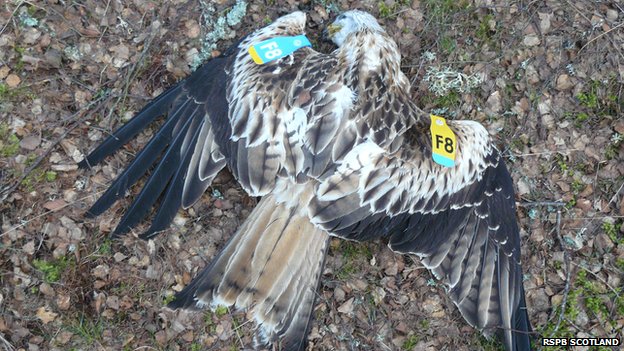
 Brian Etheridge should have been celebrating this week; it’s the 19th anniversary of his work as the RSPB’s Red Kite Officer in the Black Isle area. Instead, he’s witnessed one of the worst mass poisoning incidents in recent times: 12 red kites and 4 buzzards found to date. The 12 red kite victims were birds that he’s known for years.
Brian said: “This has been the worst two weeks of my life. I have worked with all of the birds – each one was ringed and tagged by me. I was there at the very beginning when they were only a few weeks old and I was there at the end when I went to collect their bodies. It’s a huge mix of emotions; I’ve gone from being very, very angry to extremely sad. Some of these birds I’ve known very well and for a very long time.”
One of the dead birds was a 16-year-old female that Brian first tagged in 1998. She had been breeding in the Black Isle for 14 years and had raised between 25 to 30 young – one of which, an eight-year-old female, was also among the dead.
Brian said: “I’ve gone to her nest every year since she first bred back in 2000 and I’ve climbed up to her nest so she probably knew me quite well. She was like an old friend and a very familiar sight so I will miss her this year. She had mated with one male for 13 years and he was so faithful. He has been sitting on their nest, waiting for her to come back.
Something like this can just wipe out so many birds and so many years of work. This is by far the worst example I’ve ever witnessed. There has been a huge reaction from the public. The community has really taken these birds to its heart. This was the very first reintroduction programme in Scotland so most people are very proud of their red kites.”
Many of the poisoned birds will have been regular visitors at the nearby Tollie Red Kite Visitor Centre – an initiative between RSPB Scotland the Brahan Estate – where the general public can go and watch the daily feeding of the kites. Some of the volunteers from the project have also been talking about their reaction to this latest atrocity – see here.
Previous blogs on the Ross-shire Massacre here, here, here, here and here.

 Raptor Persecution UK