
 Talking of very, very stupid people….
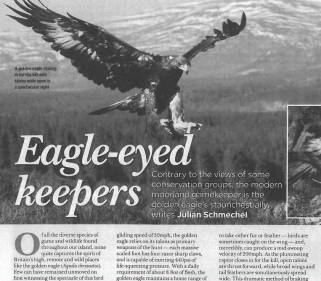
An article has appeared in the latest edition of the Shooting Times & Countryside Magazine that once again repeats the ludicrous notion that gamekeepers on Scottish grouse moors are a force for good as far as eagle conservation goes, and suggests that accusations to the contrary are ‘unfair’.
We’ve provided a PDF of the article here: Eagle-eyed keepers Shooting Times March 2014
Really? How many times do we have to go over this? The evidence is there for all to see. These continuous denials just serve to further entrench positions and frankly make a laughing stock of those pumping out this clearly inaccurate guff.
So, let’s lay out the facts once again for the benefit of those new to the issue.
Scotland’s golden eagle population is not ‘stable’. On a superficial level it appears to be stable, but the overall population figure (estimated at ~430 pairs, give or take a few) masks some very big differences in regional abundance. For example, there has been a substantial increase of golden eagles in the Western Isles over the last ~20 years, largely thanks to a reduction in illegal persecution in that region. In contrast, there has been a significant decrease in the number of golden eagles in the central, eastern and southern uplands (hence all those vacant territories), thanks largely to illegal persecution on driven grouse moors. That is a fact, backed up by a suite of scientific peer-reviewed studies. That’s why the population appears to be ‘stable’ – because all the losses in the east are being counterbalanced by the gains in the west. We’ve blogged about this in greater detail here.
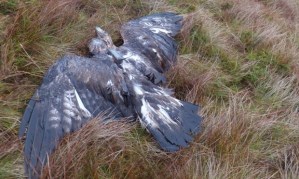 The golden eagle in Scotland does face a variety of threats or potential threats, including afforestation and the construction of wind farms. We don’t dispute that. However, the main scientific report on this issue has shown that the single biggest threat to golden eagles in Scotland is illegal persecution on driven grouse moors. That is a fact, backed up by scientific peer-reviewed evidence (see link above).
The article says: “Unfortunately, even in recent times, a handful of Scottish golden eagles have been found dead as a result of poisoning“. What the article fails to say is that the majority of those poisoned birds have been found on driven grouse moors. And not only poisoned, but shot and trapped as well. In addition, plenty of satellite-tagged golden eagles have ‘disappeared’ – unsurprisingly their last signals emitted from driven grouse moors. Oh, and it’s more than ‘a handful’. Our latest count is 31 eagles in 7 years, either illegally persecuted or mysteriously ‘disappeared’, with the majority of them on driven grouse moors (see here). And those are only the birds we know about because the majority of them were wearing satellite tags. How many more are being killed that we don’t know about? Plenty more if you look at the population figures and the rather telling ‘gaps’ in distribution.
The article says it is “unfortunate and unfair” to blame sporting estates when these illegally-killed eagles are discovered on, er, grouse moors. It is neither unfortunate nor unfair. The blame is fairly and squarely put at the feet of those involved with grouse moor management based on decades of scientific evidence. The link between driven grouse moors and raptor persecution (not just of eagles but of several raptor species) has been clearly established as this suite of scientific papers demonstrates (see here for a recent blog on this).
The article cites the SGA’s recent claims of ’55 active eagle nests on keepered grouse moors in eastern and central Scotland’ as evidence that golden eagles are doing just fine on driven grouse moors. We blogged about that claim here. We also blogged about the Scottish Raptor Study Group’s research into that claim (see here). Here’s part of what we wrote:
“According to the SGA, there are ‘at least 55 active golden eagle nests’ in these ‘keepered grouse areas’; the SRSG is saying that there are 52 ‘active nests’ in the area, and of those 52, only 8 are on driven grouse moors. Crucially, the SRSG also includes information about the vacant golden eagle territories in the area – information that the SGA conveniently ‘forgot’ to include. According to the SRSG, there are an additional 57 ‘non-active’ golden eagle nests in this area, and 31 of them (54%) happen to be on driven grouse moors.
Hmm. The picture doesn’t look quite so rosy now, does it?”
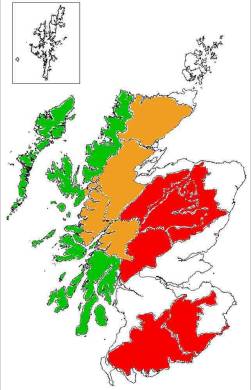 The article goes on: “It is interesting to note that eagle numbers are highest in eastern Scotland, where grouse moors are actively managed“. Er, no, they’re not. Try looking at the scientific data (see here especially) and pay particular attention to territory occupancy rates:
Western Isles = 91%
Western Highlands = 89.5%
Argyll West & Islands = 81.5%
Central Highlands = 48%
Cairngorms Massif = 42.4%
North East Glens = 17.6%
Also pay particular attention to the map which shows the species’ conservation status across Scotland. You’ll find that the golden eagle only has favourable conservation status (green colour on the map) in three of sixteen regions, and those three regions are nowhere near the driven grouse moors of the eastern and central uplands.
This incredible article finishes with this: “The fact remains, however, that far from being the purveyor of poison and pole traps – so often portrayed in the popular press – the 21st century moorland keeper is probably the golden eagle’s staunchest ally“. Aye, right.
You carry on chucking out this fantastical image of the raptor-friendly moorland keeper and we’ll keep publishing the facts which show that the majority of them are anything but.
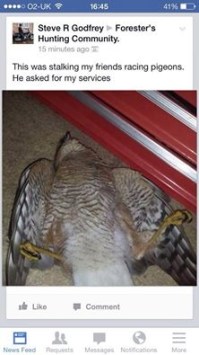 Some people are just very, very stupid.
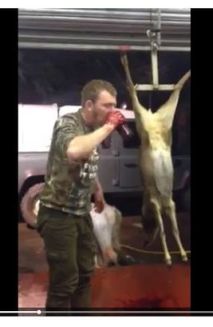 Another investigation has been launched after a video of a man slitting a deer’s throat and drinking its blood was posted on Facebook last month. The ‘stunt’ was allegedly part of the ‘neknominate’ craze where someone drinks alcohol, performs a stunt and then nominates someone else to take part. The video was posted by someone called Shaun Wilson from Newcastle. An article in the Newcastle Chronicle (see
  We’ve been following the progress of the RSPB’s submission to the Scottish Parliament to have the golden eagle declared as Scotland’s national bird.
 It’s all very strange, especially when you consider Wheelhouse’s response to the recent designation of the Scots Pine as Scotland’s national tree. Following that designation, Wheelhouse revealed plans were in place to have a National Tree Week and to set up a special fund to help promote Scotland’s national tree! He was quoted as saying that having a national tree was a “clear symbol of our affinity with Scotland’s trees, woods and forests, and their importance to us all” (see
  The Scottish Gamekeepers’ Association publishes a quarterly magazine for its members. The latest edition (winter/spring 2014) includes a list of recent donors. We were intrigued to see the following entry:
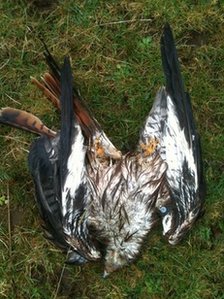 In July 2010 a poisoned red kite was discovered in the area (see
 We were also critical of the police investigation, which included arriving on scene in marked police vehicles, thus notifying any poisoner(s) of their presence and allowing the poisoner(s) valuable time to hide any remaining evidence. We also criticised their failure to conduct a police search of the adjacent moor for any evidence of baits that had already been set out. Their failure to conduct an immediate search was particularly stupid given (a) the known history of poisoning incidents in this area and (b) the knowledge that one of the two game bags was only half full of baits.
 Raptor Persecution UK