Official statements about the Leadhills poisoned peregrine

Following on from Saturday’s blog post about the poisoned peregrine that was found in the Leadhills area and the appalling response from the police (see here), we expected to read some official statements today from the likes of Environment Minister Paul Wheelhouse, PAW Scotland, Police Scotland, National Wildlife Crime Unit, Scottish Land & Estates, the Scottish Gamekeepers’ Association etc etc.

Here’s what we found:

NOTHING.

Why did we expect a response? Well, partly because of all the rhetoric we’ve been fed over the past few years about how stamping out wildlife crime is a priority for Police Scotland, for the Government, for SLE, for the SGA etc etc, and partly because this particular incident is number 45 on a long list of other raptor persecution incidents reported from the Leadhills area since 2003 (and we know there are many more incidents that went unrecorded because we’ve reported some of them ourselves!).

We know that over 50 of you have emailed the Minister (thank you) to demand some specific action, including an inquiry into PC Everitt’s alleged refusal to accept this incident was probably a wildlife crime, and to insist that SNH now use their new powers to restrict the use of General Licences in the Leadhills area.

The Minister has 20 working days in which to respond. For those of us who wrote to him over the weekend, that means he has to respond by 2nd May 2014. However, we know from previous incidents that the Minister usually waits until the very last day of that 20-working day period before he actually does respond. If we were cynics we would think that these delayed responses were designed to ‘wait out’ the public’s anger which will probably have subsided by the time the 20 working day deadline has expired.

We also know from past experience that the Minister will likely tell us that he can’t comment about Police Scotland procedures (e.g. “it’s a police matter and it would be inappropriate for me to comment”) and that he can’t comment about the potential withdrawal of General Licences (e.g. “it’s an SNH matter and it would be inappropriate for me to respond”).

He might surprise us but none of us are expecting him to. So, in anticipation of a feeble, question-dodging response, we thought we’d bypass him and go directly to those agencies ourselves.

If any of you are also interested in doing this, here are some useful contact details:

To find out why Police Scotland and the NWCU failed to act when this crime was reported to them, there are three key players to contact –

The Police Scotland Wildlife Crime Portfolio is led strategically by Assistant Chief Constable Malcolm Graham. Email: Acc.CrimeMCPP@scotland.pnn.police.uk

Police Scotland Wildlife Crime Portfolio Lead Officer is Det. Sup. Cameron Cavin. Email: Cameron.Cavin@scotland.pnn.police.uk

Police Scotland Wildlife Crime Coordinator is Sgt. Andrew Mavin. Email: Andrew.Mavin@scotland.pnn.police.uk

We’re sure all three gentlemen would love to have the opportunity to explain what happened (or more to the point, why nothing happened) and how their failure to respond fits in with their much-publicised approach to tackling wildlife crime (see here for details).

To ask SNH whether they will be enacting the new enabling clause in the 2014 General Licences and thus restricting their use in the Leadhills area, contact the Chief Executive of SNH, Ian Jardine. Email: ian.jardine@snh.gov.uk

We’re still interested in what the Environment Minister has to say about it all, of course. For those of you who haven’t yet emailed him to demand robust action, here’s his email address: Ministerforenvironment@scotland.gsi.gov.uk

They might all think that by keeping quiet for a few days we’ll all forget about it and move on to something else. They’d be pretty stupid to think so.

Poisoned peregrine found nr Leadhills boundary: police response appalling

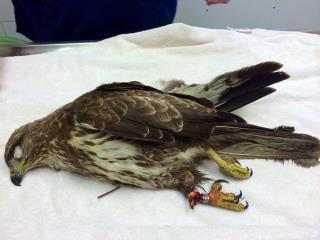
Peregrine poisoned Leadhills Feb 2014In the middle of February, a member of the public found a dead adult peregrine falcon in suspicious circumstances close to the boundary of Leadhills Estate in South Lanarkshire.

The person who found it immediately ‘phoned Police Scotland and asked them to attend. The person was told that it wasn’t a police matter. The person queried that response and asked the Police to double check. The Police said ‘No, definitely not a police matter, call the RSPB’.

The member of the public was clued-up enough to know that it wasn’t an SSPCA matter because the bird was already dead (and therefore the SSPCA had no powers to investigate). So the person called the RSPB for help.

According to information provided to us by the member of the public, the RSPB called the National Wildlife Crime Unit (NWCU) and spoke to PC Charlie Everitt, who allegedly told them it wasn’t a police matter as there was no evidence of a crime having been committed. The RSPB asked if they could retrieve the corpse and permission was granted (this permission is needed for any RSPB-collected evidence to be admissible in a future criminal case, as the RSPB do not have any investigatory powers).

The RSPB collected the dead peregrine and submitted it for a post-mortem and it then went on to SASA for toxicology analysis.

We’ve been waiting to hear the results of those tests before we blogged about the incident.

Yesterday the results were made public – the peregrine had been poisoned (the name of the poison has not been released). However, the news didn’t come in the form of an all-singing-all-dancing Police Scotland press release. It came out, almost buried, in a BBC News article about the mass poisoning of red kites and buzzards in the Black Isle (see here).

We have several serious concerns about this incident.

First of all, the Police Scotland response. The operator who took the first telephone call didn’t realise that this was a police matter. That’s almost forgiveable – perhaps they were new, inexperienced, whatever. It’s not good enough though – had the member of the public not been clued up enough to know that they could contact the RSPB, this incident would have gone un-investigated and unrecorded.

Of greater concern is the alleged response of PC Charlie Everitt of the NWCU (pictured on the right of this photo, shaking hands with SGA Chairman Alex Hogg as they sign an MOU for greater partnership working on wildlife crime). For those who don’t know, PC Everitt is employed as the Scottish Investigative Support Officer at NWCU and one of his main roles is to focus on raptor persecution. Here is a description of his full role as documented in the Scottish Government’s report Wildlife Crime in Scotland, 2012:

The Scottish Investigative Support Officer (SISO) plays a significant role in partnership working and is jointly funded by SNH and Police Scotland. The SISO post (held by PC Charles Everitt) focuses on issues of significant threat in Scotland (raptor persecution and the illegal taking of freshwater pearl mussels). In addition, he leads and furthers investigations by providing expert advice, acting as a single point of contact and by providing corroboration to Wildlife Crime Officers” (see here, page 30).

PC Everitt is well aware of the long list of recorded raptor persecution incidents in the Leadhills area, and especially the frequency with which poisoned baits have been found. Here is our list of 44 known reported incidents in this area between 2003-2013. The latest poisoned peregrine becomes #45:

2003 April: hen harrier shot

2003 April: hen harrier eggs destroyed

2004 May: buzzard shot

2004 May: short-eared owl shot

2004 June: buzzard poisoned (Carbofuran)

2004 June: 4 x poisoned rabbit baits (Carbofuran)

2004 June: crow poisoned (Carbofuran)

2004 July: poisoned rabbit bait (Carbofuran)

2004 July: poisoned rabbit bait (Carbofuran)

2005 February: poisoned rabbit bait (Carbofuran)

2005 April: poisoned buzzard (Carbofuran)

2005 June: poisoned rabbit bait (Carbofuran)

2005 June: poisoned rabbit bait (Carbofuran)

2006 February: poisoned buzzard (Carbofuran)

2006 March: poisoned buzzard (Carbofuran)

2006 March: poisoned pigeon bait (Carbofuran)

2006 April: dead buzzard (persecution method unknown)

2006 May: poisoned rabbit bait (Carbofuran)

2006 May: poisoned rabbit bait (Carbofuran)

2006 May: poisoned egg baits (Carbofuran)

2006 June: poisoned buzzard (Carbofuran)

2006 June: poisoned raven (Carbofuran)

2006 June: 6 x poisoned rabbit baits (Carbofuran)

2006 June: poisoned egg bait (Carbofuran)

2006 September: 5 x poisoned buzzards (Carbofuran)

2006 September: poisoned rabbit bait (Carbofuran)

2006 September: poisoned rabbit bait (Carbofuran)

2007 March: poisoned buzzard (Carbofuran)

2007 April: poisoned red kite (Carbofuran)

2007 May: poisoned buzzard (Carbofuran)

2008 October: poisoned buzzard (Carbofuran) [listed as ‘Nr Leadhills’]

2008 October: poisoned rabbit bait (Carbofuran) [listed as ‘Nr Leadhills’]

2008 November: 3 x poisoned ravens (Carbofuran) [listed as ‘Nr Leadhills’]

2009 March: poisoned rabbit bait (Carbofuran)

2009 March: poisoned raven (Carbofuran)

2009 April: poisoned rabbit bait (Carbofuran)

2009 April: poisoned magpie (Carbofuran)

2009 April: poisoned raven (Carbofuran)

2010 October: short-eared owl shot

2011 March: illegally-set clam trap

2011 December: buzzard shot

2012 October: golden eagle shot (just over boundary with Buccleuch Estate)

2013 June: significant cache of pre-prepared poisoned baits found in woodland next to grouse moor

2013 August: red kite found shot and critically-injured in Leadhills village

Based on the bulging intelligence file available, PC Everitt, the lead intelligence officer for raptor persecution crimes in Scotland, should have immediately suspected this was a potential poisoning incident and should have either attended the scene himself or at the very least, directed a local Wildlife Crime Officer to attend. Why didn’t he? That deserves an inquiry.

Another concern is the pathetic publicity of this incident. Was it a case of ‘this is a good day to bury bad news so let’s sneak it out while everyone’s focusing on the mass poisoning incident in Ross-shire’?, because that’s what it looks like.

However, the biggest concern of all is that here, yet again, is another illegal raptor poisoning incident in the Leadhills area. The scale of these crimes in this one area is phenomenal. The number of criminal convictions in relation to the number of incidents is disgraceful – only two convictions have ever been secured here – and both involved gamekeepers employed on the Leadhills Estate.

With the number of confirmed poisoned raptors in Scotland this year already at 17, no more evidence is required to show that government initiatives and partnership working is wholly ineffective. Environment Minister Paul Wheelhouse MUST respond robustly and we must hold him to account.

We urge you to email Mr Wheelhouse and demand the following action:

1. Launch an inquiry into why Police Scotland told a member of the public this was not a police matter, and publish the findings.

2. Launch an inquiry into PC Everitt’s alleged response to this incident, and publish the findings.

3. Launch an inquiry into Police Scotland’s media response to this wildlife crime, and publish the findings.

4. Launch an inquiry into why illegal raptor persecution continues to flourish in the Leadhills area, and publish the findings.

5. Insist that SNH uses the new enabling clause in the General Licences to withdraw their use in the Leadhills area with immediate effect.

6. Insist that Mr Wheelhouse stipulates the exact time scale he intends to use to ‘see whether his new enforcement measures [introduced in July 2013] take effect’.

Environment Minister’s email address: Ministerforenvironment@scotland.gsi.gov.uk

Ross-shire Massacre: Your opportunity to contribute to reward fund

The RSPB has set up an on-line donation page where those of us who want to show our disgust and outrage at the Ross-shire Massacre can contribute towards the ‘reward for information’ fund.

The reward was initially set up by RSPB with a £5,000 contribution. This has now been increased to £10,000 thanks to an anonymous donor. Here’s our chance to further increase the reward.

If the reward is unclaimed, the funds will be used directly for contributing towards the RSPB’s Investigation Unit – a small team of dedicated professionals doing their utmost against the powerful, well-funded and influential game-shooting industry.

If you’d like to show your support, and ramp up the pressure on the poisoning criminals who continue to commit these atrocities, you can donate here.

RSPB press release here.

Previous blogs about the Ross-shire Massacre here, here, here, here, here, here, here and here.

Some light relief, thanks to the SGA

Following the news of the last few weeks, we’re all in need of some light relief.

Thanks to our friends at the Scottish Gamekeepers’ Association, we’ve got some.

The following was posted on the SGA’s facebook page this morning – it’s about their latest so-called ‘scientific’ study of waders on grouse moors. Whoever chose this image to illustrate this particular story is a genius. Thanks for the laugh, SGA!

SGA 1st wader counts

Fatally-injured spring-trapped buzzard, West Yorks: police appeal for info

Buzzard spring trapped Winscar Reservoir 2While all the media focus has been on the mass poisoning of 16 raptors in Highland Scotland, it’s business as usual in other parts of the UK.
West Yorkshire police are appealing for information after the discovery of a spring-trapped buzzard near Winscar Reservoir back in February.

Walkers found the buzzard in distress and unable to fly. When they approached it they discovered its leg was caught in a large spring trap. They removed the trap and took the bird to a vet but its injuries were so severe it had to be euthanised.

The buzzard was less than a year old and had hatched at Dove Stone, an RSPB/United Utilities Partnership site. It had been ringed as a chick by the Peak District Raptor Monitoring Group.

More details of the crime and police contact details here.


Ross-shire Massacre: more media coverage

BBC News video footage here, including an interview with the RSPB’s Black Isle Red Kite Officer, Brian Etheridge, and a local resident calling for a jail term for the poisoner(s).

A detailed article in the Guardian, written by Severin Carrell here, providing good background information about the poor conservation status of the Black Isle Red Kite population.

Previous blog posts on the Ross-shire Massacre here, here, here, here, here, here and here.

Photo of a red kite by Claire Marshall.

Ross-shire Massacre: reward now stands at £10K

An anonymous donor, so concerned about the reported mass poisoning of 12 red kites and 4 buzzards in Ross-shire, has come forward and increased the value of the reward for information to £10,000.

He/she has added an extra £5K to the £5K reward already put up by RSPB Scotland.

The reward is offered to anyone who provides information leading to a successful conviction.

£10,000 is a lot of money. Let’s hope it will prompt someone to go and talk to the police. If you’re that person, dial 101 and ask to be put through to Dingwall Police Station.

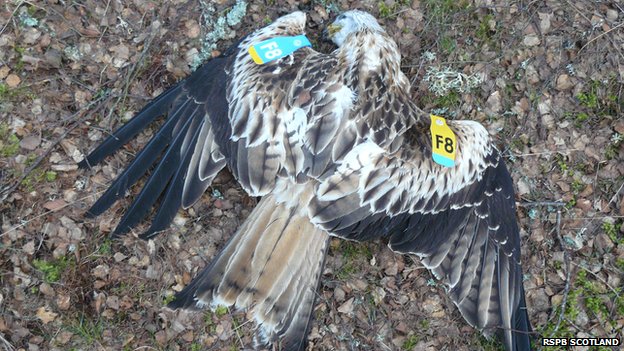
The photo shows dead red kite ‘F8’, one of the 16 victims (and there may yet be more corpses to be recovered).

Red Kite F8 Ross-shire Massacre

 Previous posts on Ross-shire Massacre here, here, here, here, here and here.

Ross-shire Massacre: “The worst 2 weeks of my life”, says red kite officer

Brian EtheridgeBrian Etheridge should have been celebrating this week; it’s the 19th anniversary of his work as the RSPB’s Red Kite Officer in the Black Isle area. Instead, he’s witnessed one of the worst mass poisoning incidents in recent times: 12 red kites and 4 buzzards found to date. The 12 red kite victims were birds that he’s known for years.

Brian said: “This has been the worst two weeks of my life. I have worked with all of the birds – each one was ringed and tagged by me. I was there at the very beginning when they were only a few weeks old and I was there at the end when I went to collect their bodies. It’s a huge mix of emotions; I’ve gone from being very, very angry to extremely sad. Some of these birds I’ve known very well and for a very long time.”

One of the dead birds was a 16-year-old female that Brian first tagged in 1998. She had been breeding in the Black Isle for 14 years and had raised between 25 to 30 young – one of which, an eight-year-old female, was also among the dead.

Brian said: “I’ve gone to her nest every year since she first bred back in 2000 and I’ve climbed up to her nest so she probably knew me quite well. She was like an old friend and a very familiar sight so I will miss her this year. She had mated with one male for 13 years and he was so faithful. He has been sitting on their nest, waiting for her to come back.

Something like this can just wipe out so many birds and so many years of work. This is by far the worst example I’ve ever witnessed. There has been a huge reaction from the public. The community has really taken these birds to its heart. This was the very first reintroduction programme in Scotland so most people are very proud of their red kites.”

Many of the poisoned birds will have been regular visitors at the nearby Tollie Red Kite Visitor Centre – an initiative between RSPB Scotland the Brahan Estate – where the general public can go and watch the daily feeding of the kites. Some of the volunteers from the project have also been talking about their reaction to this latest atrocity – see here.

Previous blogs on the Ross-shire Massacre here, here, here, here and here.

Ross-shire Massacre: death toll rises to 16

A total of 12 red kites and four buzzards have now been retrieved in the Ross-shire Massacre – one of the worst mass poisoning incidents to have been uncovered in recent years.

The victims have all been recovered from a very small area near Conon Bridge in the Highlands. They include breeding adults and juvenile birds – the impact of these deaths on the already-struggling Black Isle red kite population will be significant.

This mass poisoning comes on the back of the news that reported poisoning incidents in Scotland in 2013 doubled from 2012 figures. Other types of persecution were also reported, including shooting, trapping, nest-tree felling and birds that were trapped and then beaten to death.

We await the Scottish Government’s response to this latest outrage with great interest.

The RSPB has put up a £5K reward for information leading to a successful conviction.

Previous blogs on the Ross-shire Massacre here, here, here and here.

Photo of red kites at Gigrin Farm, Wales, by David Bowman.


Public consultation on increased powers for SSPCA investigators finally launched

sspca_badgeThe Scottish Government has finally launched its public consultation on increasing the powers of the SSPCA to investigate a wider suite of wildlife crimes.

We have campaigned long and hard for this and it’s taken the Government three years since they first committed to opening a consultation, so now it’s vitally important that as many people as possible actually respond to it. The Government wants to hear your views, whether in support or opposition, so this is your chance to influence policy and make a real difference in the fight against wildlife crime in Scotland.

The consultation document itself is extremely well-written, and we are delighted to see that the consultation period will be open for five months (closing 1st September 2014). We are also pleased to see that the consultation questions are straightforward:

1. Do you agree that the law in Scotland should be changed to give the SSPCA the powers as set out in section 4.1 [of the consultation document]?

2. Please set out your reasons for your answer to Q1.

3. If you would prefer to see changes to the SSPCA’s powers to investigate wildife crime other than those set out in section 4.1, please describe them.

So what’s it all about? The finer details can be read in the consultation document (see below) but in a nutshell….

Currently, the SSPCA has the power to investigate wildlife crimes that involve an animal in distress. So for example, if they are called out to an incident of a golden eagle that had been caught in an illegally-set spring trap and the eagle was still alive, the SSPCA has the power to collect evidence as part of a criminal investigation. This is because they have powers under the animal welfare legislation and this incident would certainly fall into a welfare category where the animal was ‘under the control of man’.

However, if they are called out to an incident where a golden eagle had eaten a poisoned bait and had died two minutes before the SSPCA arrived on scene, the SSPCA does not currently have the power to investigate because the welfare legislation doesn’t apply (the bird is already dead) and the dead bird is not ‘under the control of man’. In this scenario, all the SSPCA can do is to call the police and hope that the police attend the scene in a timely manner. How stupid is that?

Another example – if the SSPCA was called out to an incident of an illegally-snared badger, and that badger was already dead, and the SSPCA found 100 illegally-set snares at the same location, the SSPCA would not be able to investigate; they would have to rely upon the police to attend. If the badger was still alive (suffering), the SSPCA could investigate.

The proposal laid out in the consultation is to widen the investigatory powers of the SSPCA so that they’re not just limited to operating under welfare legislation; the increased powers, if granted, would also allow them to operate under certain parts of the Wildlife & Countryside Act in addition to the welfare legislation.

Importantly, the increased powers would  allow them to continue their investigations into animal welfare incidents where an animal is in distress, but also to investigate wildlife crimes where the animal is already dead, and even wildlife crimes that haven’t yet involved an animal – for example an illegally-set trap.

For us, the increased investigatory powers are a no-brainer. If you care about wildlife crime and you want to see improved detection rates, more prosecutions and a greater chance of conviction, then these increased investigatory powers are a logical step. Here’s why:

1. The SSPCA has a successful track record for investigating [a limited number of] wildlife crimes, both on their own and in partnership with the police.

2. Their inspectors and specialist investigations team have long experience in this field and are already fully trained.

3. SSPCA inspectors are fully focused on animal welfare and wildlife crime – they are not part-timers like many of the police WCOs and nor are they distracted by having to investigate other types of crime, as police WCOs can be.

4. The SSPCA is already a Specialist Reporting Agency, which means they can report alleged offences [within their limited remit] to the Procurator Fiscal and they know what evidence is required for a potential prosecution.

5. With increased investigatory powers, a total of 64 experienced SSPCA staff would be available to respond to a wider range of wildlife crimes.

6. These 64 experienced SSPCA staff would come at no cost whatsoever to the public purse. It would be a free resource to bolster an often under-resourced police force.

7. The specialist skills of the SSPCA are already recognised and utilised by the police in multi-agency searches. The sticking point, under current legislation, is that the police are not obliged to invite them to participate on such searches. Sometimes they do, sometimes, inexplicably, they don’t; it all depends on the personalities involved, which is not, in our opinion, the best way of investigating a wildlife crime.

8. The increase of powers to the SSPCA would not mean that the police are excluded from such investigations. The police would still retain their powers but crucially, they’d now have a further resource to call upon if they needed help. Alternatively, the SSPCA would have the powers to conduct their own investigation if the police couldn’t attend at short notice, for whatever reason. That would be true partnership working and, most importantly of all, increase the chances of a thorough investigation leading to a successful prosecution.

9. Last year we calculated the conviction rate for raptor persecution crime in Scotland as being a pathetic 7.3% (see here). Obviously, something is not working and by giving increased powers to the SSPCA we would expect to see this conviction rate rise considerably. Surely that’s in everyone’s interest (apart from the wildlife criminals, of course).

We know that there will probably be a lot of opposition to the proposal. For example, the Scottish Gamekeepers Association were not in support when the issue was first raised during the WANE bill consultations several years ago. We’re fairly sure that others from within the game-shooting industry will also oppose it – you’ll have to draw your own conclusions on their motivation for opposition. It’ll certainly be interesting to see the consultation responses of various organisations when they are published after the close of the consultation period.

At a time when there is an increasing public awareness of wildlife crime, and an ever-growing sense of frustration at the endless series of failed investigations (with a handful of exceptions), this consultation couldn’t have come at a better time.

Please, have a look at the consultation document and send in your views to the government using the official response form (see below). If you want to copy and paste any or all of our reasons listed above for increasing the SSPCA’s investigatory powers, please feel free.

The time is long-overdue for the pressure to be ramped up on the wildlife criminals (the Untouchables) running amok in our countryside, illegally poisoning, shooting, trapping and bludgeoning our wildlife and sticking up two fingers to the rest of us. Let them know we’ve had enough and let the government know that they have our full support to implement these changes.

Download the SSPCA Consultation document: SSPCA Consulation document

Download the Consultation and Response Form: SSPCA Consultation Questions and Response Form