Norfolk gamekeeper faces series of raptor persecution charges

A Norfolk gamekeeper is facing seven charges of alleged wildlife crime.

Allen Lambert, 64, of Stody, near Melton Constable, has been charged with killing 16 wild birds (14 buzzards, 1 sparrowhawk and 1 tawny owl), possession of nine birds (buzzards), failure to comply with a firearms certificate, and four counts of possession and storage of banned poisons (Aldicarb and Mevinphos).

The alleged offences took place between January and April 2013.

Lambert is currently on bail and will appear before King’s Lynn Magistrates court on Thursday (19th Dec).

News articles here and here

Morvich Estate gamekeepers’ trial delayed again!

The trial of three gamekeepers from the Morvich Estate, Sutherland, has once again been postponed. This is the 8th adjournment since the case was first brought in November 2012.

The three defendants, Mathew Johnston (21), Jamie Neal (37), and William Docharty (58) are charged with a string of wildlife crimes alleged to have taken place on Morvich Estate on 16 February 2012.

Their trial was due to start on Monday (16th December 2013) but has now been put back until 7th April 2014 – more than two years after the alleged offences occurred.

Thanks to the contributor who sent in a copy of the following article from yesterday’s Press & Journal:

Estate trio on wildlife charges.

Three north estate workers face trial next year accused of committing a string of wildlife offences on a sporting estate in Sutherland.

Mathew Johnston, 21, Jamie Neal, 37, and William Docharty, 58, were not present at Tain Sheriff Court yesterday when their case called.

All three pleaded not guilty through solicitors. The case had been due to go to trial next week but was postponed to next year at the request of the court. The trial is now due to start on April 7 [2014].

All the charges are alleged to have taken place on Morvich Estate, Sutherland, on February 16 last year [2012].

Johnston, of Morvich House, Morvich Estate, Rogart, faces four charges. These include that he set six snares on a fence which would have caused an animal unnecessary suffering as any creature caught would likely have become suspended from the contraption.

Neal, of The Bothy, Morvich Estates, faces the same charge involving seven snares.

Docharty, of 10, Elizabeth Court, Dornoch, faces a similar charge involving two snares set on a log over water which would likely cause any animal trapped to be suspended from the log and drown.

Johnston is further alleged to have been in possession of a dead barnacle goose and to have failed to dispose of three sheep carcases in an appropriate manner.

Neal faces four further charges including two alleging that he failed to provide a suitable environment for nine crows by not providing food and water, a perch and adequate shelter.

For previous blogs about this case please see here.

North Yorks still worst place for raptor persecution in 2012

The RSPB has published its 2012 Birdcrime report documenting bird persecution throughout the UK.

North Yorkshire has once again come top of the league for the number of reported crimes against birds of prey (34), with Aberdeenshire a close second with 31 reported incidents. Both counties, of course, include large areas of land used for driven grouse shooting.

The 2012 report includes statistics that are all too familiar: confirmed shootings of short-eared owls, sparrowhawks, buzzards, barn owls, tawny owls, hen harriers, golden eagles, marsh harriers, and peregrines; confirmed nest destruction of peregrines, goshawks and barn owls; confirmed illegal spring-trapping of buzzards, golden eagle and peregrine; other types of illegal trapping (including crow cage traps) of sparrowhawks, tawny owls, buzzards and goshawks; and the confirmed illegal poisoning of ravens, red kites, buzzards, golden eagles, marsh harriers, peregrines, cats and dogs.

Remember, these are just the confirmed incidents. Plenty more ‘probable’ and ‘unconfirmed’ cases, and of course there are all the incidents that went undiscovered/unreported.

Does that sound to you like the game-shooting industry is cleaning up its act?

Well done to the RSPB for their meticulous work and especially for their willingness to share these data with the general public.

RSPB press release here

Download the RSPB’s 2012 Birdcrime report here

The photograph shows the shot hen harrier Bowland Betty, found on a North Yorkshire grouse moor in 2012. Nobody has been brought to justice for her death.

Derbyshire Constabulary continues to impress

Derbyshire Constabulary logoUnder the leadership of new Police and Crime Commissioner Alan Charles, wildlife crime enforcement continues to be at the top of the agenda for Derbyshire Constabulary.

We’ve blogged about Mr Charles’s impressive enforcement initiatives before (see here and here). He’s the man who put tackling wildlife crime in his election manifesto when he was running for the new post of Commissioner.

His latest move includes the provision for 20 police officers (yes, 20!) to receive specialist wildlife crime training to help them carry out their duties, supported by Special Constables. There has also been a call for members of the public to help by reporting suspicious activities.

Watch the news video here.

SNH still licensing mountain hare culls

Last month a leading upland ecologist claimed that Scottish landowners were causing ‘massive declines’ of mountain hares on grouse moors around Deeside, Aberdeenshire and blamed SNH for failing in its statutory duty to protect this species (see here).

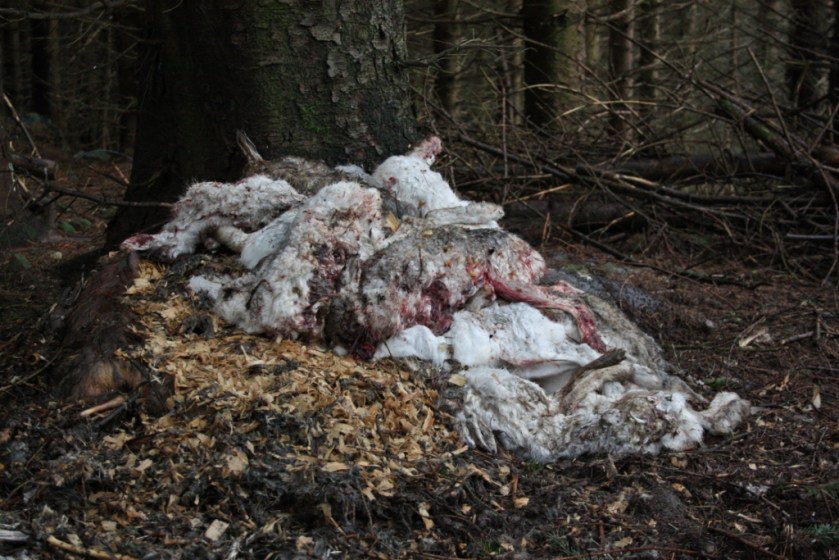
We followed up that article with some gruesome photographs showing piles of culled mountain hares left to rot on another grouse moor, this time in the Angus Glens (see here). Unregulated mountain hare culling, it seemed, was widespread.

We encouraged blog readers to contact SNH to ask them about what we thought was their long-term failure to implement an effective monitoring scheme to protect mountain hare populations. SNH responded with their usual let’s-buy-ourselves-some-time line that ‘further research was forthcoming’.

Around the same time, MSP Alison Johnstone lodged a series of parliamentary questions about mountain hare culling and how it affected mountain hare populations (see here).

Environment Minister Paul Wheelhouse has now responded to those questions (his answers presumably provided by SNH, the licensing authority). The bottom line is, SNH is still issuing licenses to allow the killing of mountain hares in the closed season, even though they admit that they are still unable to assess mountain hare abundance and therefore cannot possibly know what sort of impact, if any, these culls are having on the conservation status of the species. Quite remarkable. Where’s the precautionary principle?

Here are the parliamentary questions and answers:

Question S4W-18470: Alison Johnstone, Lothian, Scottish Green Party, Date Lodged: 19/11/2013

To ask the Scottish Government what information it holds (a) on the health of mountain hare populations and (b) that is relevant to assessing whether mountain hare are in a favourable conservation status.

Answered by Paul Wheelhouse (04/12/2013):

The National Gamebag Census data for mountain hare compiled by the Game and Wildlife Conservation Trust shows no significant trend in the data between 1961 and 2009, despite marked cyclical fluctuations which are known to exist in around half of mountain hare populations.

A questionnaire survey commissioned by Scottish Natural Heritage (SNH) in 2006-07 (SNH Commissioned Report 278) concluded that there was no evidence of an overall change in the distribution of mountain hares when compared to a similar study in mid 1990s. However, there may have been localised declines and possibly extinctions, undetectable at the 10km scale at which the data were collected and analysed.

The findings of this report provide SNH with an impression of the overall range of the species and some information on the numbers controlled, but SNH need more detailed information on hare abundance before it can be in a position to make a reliable assessment of the impact that culling is having on the population as a whole. To this end, SNH commissioned a study in 2008 into developing improved monitoring methods (Commissioned Report 444), but unfortunately, due to two severe winters hampering the fieldwork, the results did not provide SNH with the statistical relationship needed to progress this work. SNH therefore propose to develop a further programme of research, with the intention to commencing further fieldwork later in 2014. The exact detail of this work programme is still to be agreed.

Question S4W-18471: Alison Johnstone, Lothian, Scottish Green Party, Date Lodged: 19/11/2013

To ask the Scottish Government what conservation action is planned to protect mountain hare populations.

Answered by Paul Wheelhouse (04/12/2013):

In order to properly inform licence applications and to have a better understanding of the effects of culling on hare populations, a cost-effective and easily-applied method of reliably estimating hare numbers is required. This is the immediate priority and, once developed, will enable better monitoring schemes to be developed, and provision of information on population status will be improved also. Such data would then be used to inform future management decisions concerning the species, as necessary.

Question S4W-18472: Alison Johnstone, Lothian, Scottish Green Party, Date Lodged: 19/11/2013

To ask the Scottish Government what information it holds on the number of mountain hare that are culled annually and the impact of this on golden eagles (a) dispersing from, (b) likely to be recruited to or (c) nesting in natura sites for which golden eagles are a designated interest.

Answered by Paul Wheelhouse (03/12/2013):

The Scottish Natural Heritage (SNH) Commissioned Report 278 indicated that a total of 24,529 mountain hares were harvested in 2006-07 across 90 sporting estates (of these, 11,906 were reported to have been taken by 26 estates). This represents 7% of the 1995 published Scottish population estimate of 350,000 and is subject to a 50% margin of error.

SNH Commissioned Report 278 on the distribution of Mountain Hare in Scotland shows hares present in all or part of the Special Protection Areas (SPAs) designated for golden eagles.

The Report also indicates that the vast majority of hare control occurs in the central and eastern Highlands. In these areas, Report 278 suggests that there is a mixed picture of hare distributional change between 1995-96 and 2006-07 with no clear pattern of decline. The 2006-07 data are the most recent SNH holds.

(a) Golden eagles take several years to reach breeding age and juvenile birds disperse from their parent’s breeding territory and range over the Highlands and islands to varying degrees i.e. the young birds are not tied to the SPAs.

As breeding adult birds are territorial, these young birds mainly use areas of suitable habitat that does not form part of a territorial range. Some of the areas these birds will be using will be areas where hare control is being carried out. SNH Report 278 indicates that more hares are controlled from September to February, although levels of hares removed for tick control are fairly similar across the year.

(b) Young golden eagles often return and try to settle close to where they were born although some settle elsewhere. The SPAs therefore are reliant on the wider golden eagle population to support recruitment. Only a proportion of the young eagles survive to reach breeding age and it is unknown what, if any, effect the reductions in hare numbers will have on recruitment.

(c) Live prey is of key importance for chick development and successful breeding. As with (a) and (b) there is a potential impact through reducing available prey and/or requiring the birds to prey more on grouse.

Question S4W-18473: Alison Johnstone, Lothian, Scottish Green Party, Date Lodged: 19/11/2013

To ask the Scottish Government what information it holds on a link between the culling of mountain hare and the incidence of (a) louping ill or (b) other diseases transmitted by sheep ticks or other hare parasites to red grouse.

Answered by Paul Wheelhouse (03/12/2013):

The scientific evidence on this subject has been reviewed in a 2009 paper in the Journal of Applied Ecology “Culling wildlife hosts to control disease: mountain hares, red grouse and louping ill virus” by A Harrison et al.- see http://onlinelibrary.wiley.com/doi/10.1111/j.1365-2664.2010.01834.x/abstract.

The authors conclude that there is no compelling evidence base to suggest culling mountain hares might increase red grouse densities.

Question S4W-18474: Alison Johnstone, Lothian, Scottish Green Party, Date Lodged: 19/11/2013

To ask the Scottish Government how it controls the culling of mountain hare.

Answered by Paul Wheelhouse (04/12/2013):

Mountain hare are protected by a close season during which no culling can be carried out by any method except under licence granted by Scottish Natural Heritage (SNH). Mountain hare are also covered by Regulation 41 of The Conservation (Natural Habitats, &c.) Regulations 1994 which prohibits the use of certain methods of taking or killing wild animals, including the use of traps which are non-selective according to their principle or their condition of use. The use of such traps can be licensed by SNH. The use of such traps is not permissible under the terms of a general licence but can be licenced by SNH.

Question S4W-18475: Alison Johnstone, Lothian, Scottish Green Party, Date Lodged: 19/11/2013

To ask the Scottish Government how many applications it has (a) received and (b) granted for the culling of mountain hare since 2011, broken down by (i) year, (ii) purpose and (iii) area.

Answered by Paul Wheelhouse (03/12/2013):

Licences are required to control mountain hares at any time using certain otherwise prohibited means, or to kill them by any method during the “closed season”. Scottish Natural Heritage (SNH) is the licensing authority.

SNH received one application for the control of mountain hare by snaring in 2011. SNH granted that licence in 2012 and it has been amended twice. The licence was granted for the purpose of preventing serious damage to woodland.

SNH received five applications for the control of mountain hare in 2012. Two of these applications were refused. All of the remaining three were to shoot hares out-of-season and for preventing serious damage to woodland. One was in Highland, one in Moray and one in Aberdeenshire.

SNH received three applications for the control of mountain hare in 2013. Two of these were applications to renew licences issued in 2012 (one in Moray and one in Aberdeenshire). The remaining application was for another site in Moray, and again was for the purpose of preventing serious damage to woodland. Licences were granted for all three, and all three relating to shooting hares out-of-season.

MH1

‘Out of control’ buzzards need culling, says sporting estate landowner

It seems barely a month goes by without some idiot with a vested interest in game-shooting spouting off about the need to kill the plague of buzzards that has infested the countryside.

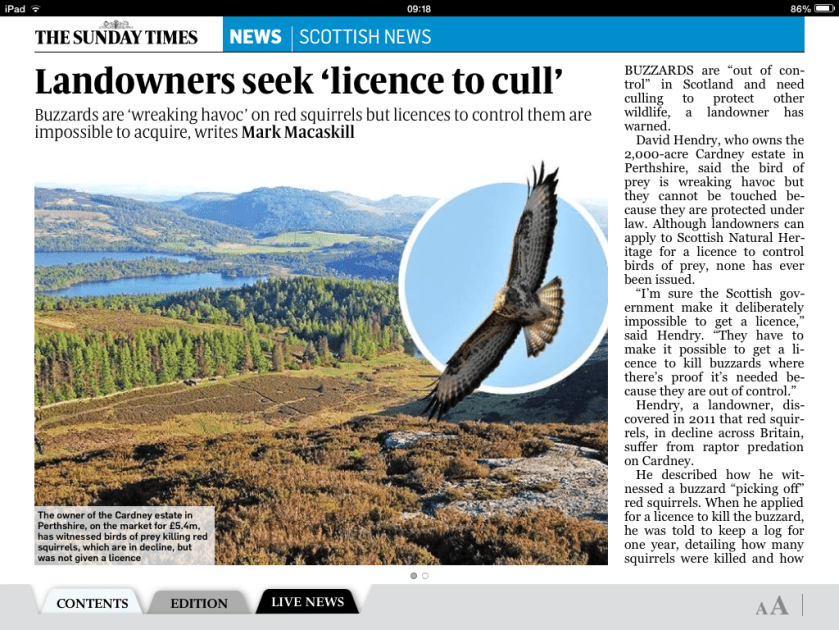
An article in yesterday’s Sunday Times reported that buzzards in Scotland are ‘out of control’ and ‘need culling to protect other wildlife’, according to David Hendry, the owner of Cardney Estate in Perthshire.

It’s no surprise that Hendry is at the centre of this latest claim. This former Chairman of the Scottish Gamekeepers’ Association has been calling for licensed raptor culling for over a decade, to include buzzards, sparrowhawks and peregrines (e.g. see here, here, here and here).

This time his justification for wanting a buzzard-killing licence was because he’d witnessed a buzzard eating red squirrels on his estate. Fortunately, his licence application to SNH was turned down because, surprise surprise, there was no evidence linking predation by the buzzard with a decline in the red squirrel population.

If we applied Hendry’s logic across the board, we would see requests for licences to kill golden eagles and a whole other suite of generalist predators whose diet may sometimes include red squirrel. It’s what predators do, Mr Hendry – they eat stuff. Get over it.

According to the article, Hendry’s desire to get a buzzard-killing licence was supported by Alan Stewart, the former Tayside Police wildlife crime officer who now works for the National Wildlife Crime Unit and who apparently has been mates with Hendry for years.

However, Stewart has written on his own blog that he was ‘mis-quoted’ in the Sunday Times article – apparently he wouldn’t support a ‘general cull’ of any bird of prey, but he would support a licence application to kill this particular red squirrel-eating buzzard, especially “since I knew the landowner concerned would not have abused any licensing privilege agreed“.

Good god. So a native bird eating a native mammal is cause for the bird to be killed??! Thankfully, the National Wildlife Crime Unit has no role whatsoever in the objective and scientific decision-making process concerning the granting of raptor-killing licences.

It’s bizarre that both Hendry and Stewart think that a buzzard is having such a detrimental impact on the estate’s wildlife that it needs be killed. According to Stewart, Cardney Estate has “an absolute wealth of wildlife” [despite the out-of-control buzzard, eh?] and Hendry’s pheasant and partridge shoots both seem to have managed just fine, with 677 birds shot on just one day in 2010 (see here).

Thanks to the contributor who sent in the following copy of the Sunday Times article:

Hendry1

Hendry 2

‘Persecution of sporting estates is bad for birdlife’ says NGO Chairman

A fascinating article has appeared on the Shooting Times website today, written by regular columnist Lindsay Waddell, who also just happens to be the Chairman of the National Gamekeepers’ Organisation.

His opening words are these:

Protection of predators and persecution of sporting estates are bad for birdlife“.

His rationale for this statement appears to be that there are no takers for the lease of what he calls a ‘prestigious moor’ (hmm, wonder what makes it a ‘prestigious’ moor?) and that soon it may be lost to conifer plantation and wind turbines, and all of this is due to the ‘relentless persecution of estate owners and those employed as gamekeepers‘.

What he doesn’t say is how he defines ‘the relentless persecution’ of estate owners and gamekeepers. Is he defining media reports as ‘persecution’? Perhaps he thinks that any publicity about the discovery of a poisoned golden eagle on a sporting estate with a long history of similar incidents is ‘persecution’ of the estate owner? Or maybe he thinks that the publication of video footage showing a gamekeeper bludgeoning buzzards to death with a fence post is ‘persecution’ of the gamekeeper? Or perhaps any commentary about yet another gamekeeper being charged with yet another alleged wildlife crime is ‘persecution’ of the gamekeeping industry?

Ironically, he goes on to suggest that had this level of ‘persecution’ been directed at any other group of workers, they would have had some form of legal redress available! Funny that – we have long argued that had any other group of workers been caught carrying out the type of sustained & widespread criminality that is regularly taking place on some sporting estates, the criminals would have been locked up a long time ago and the ‘business’ forced to close.

What Lindsay fails to grasp, even though it’s really not that hard, is that if the illegal killing of raptors, by many gamekeepers on many sporting estates, would stop, then the game-shooting industry may be viewed a lot more favourably than it is now. Unfortunately, the illegal killing continues, and organisations like the National Gamekeepers’ Organisation don’t help matters when they refuse to expel members who have been convicted of wildlife crimes (e.g. see here).

There’s some other guff at the end of his article about how predators are apparently eating all the prey and the conservation agencies should stop protecting predators blah blah blah….

In the meantime, watch this space for some more reports about dead raptors that have been discovered on sporting estates up and down the country having been poisoned/shot/trapped/bludgeoned…reports that the game-shooting industry would rather you didn’t know about.

Shooting Times article here

Another Scottish gamekeeper accused of alleged wildlife crimes

The trial of a Scottish gamekeeper accused of a series of alleged wildlife and animal welfare crimes has been adjourned until later this month.

49-year old gamekeeper James Marsh, of Middle Ballewan near Blanefield, Stirling is facing trial for offences alleged to have taken place near Duntreath Castle in April 2012.

We understand the charges include the trapping of a Tawny Owl in a Larsen trap and related welfare offences, and various other charges relating to the possession of a Jay and associated welfare offences.

Marsh denies the charges.

His trial at Stirling Sheriff Court was adjourned in mid-November and will next be heard on 19th December.

RSPB Scotland publishes 2012 persecution report

sam4RSPB Scotland has today published its annual persecution report which documents the known and suspected incidents of  illegal raptor killing throughout Scotland in 2012.

It’s a shame it’s taken so long to get it published, but that minor criticism aside, massive kudos and appreciation to them for their continued meticulous collection of these data and especially their willingness to publish them. Without these reports the general public, and probably the government, would be unaware of exactly what’s going on in our countryside. If we relied upon the ‘official’ figures (i.e. those ‘approved’ by the likes of Scottish Land & Estates, the Scottish Gamekeepers’ Association, Police Scotland etc) we wouldn’t know the half of it.

The 2012 report, just like all the previous 18 reports, makes for grim reading. Sure, it documents a reduction in the number of birds known to have been illegally poisoned last year; some people (guess who?) have spent much of 2013 shouting about this as being evidence of the game-shooting industry cleaning up its act – we know better – the 2013 figures (to date) show no such reduction and in fact show an increase in known poisoning incidents…but more of that next year. Let’s focus on the 2012 report for now.

Three things caught our attention in this report. The first thing was the Foreword by Stuart Housden, RSPB Scotland Director. This is the hardest-hitting Foreword of his that we’ve read. In the past it’s been a bit wishy-washy, with too many platitudes aimed at the landowning and gamekeeping communities and suggestions that the raptor killers are just an unrepresentative minority. This time it’s quite different:

It is evident that a significant number of individuals or estates illegally persecute birds of prey“.

Is this subtle change of language an indication that RSPB Scotland is tiring of the whole ‘partnership-working’ pretensions? Let’s hope so.

The second thing to catch our attention was an entry in Table 3 (page 24): Confirmed incidents of illegal killing or attempted killing (excluding poisoning) of birds of prey in Scotland, 2012

The entry of interest is this:

‘February. Buzzard caught in illegal spring trap. Nr Edzell, Angus’.

There isn’t any further detail about this incident, and it certainly hasn’t been publicised by the Police (no surprise there). However, for reasons that we can’t go in to right now, we are particularly interested in the details of this incident and would ask any blog reader with specific information to contact us, in confidence: raptor.persecution.scotland@hotmail.co.uk

The third thing that caught our attention was the Case Study: Poisoning in Progress (pages 19-20). This case relates to the discovery of poisoned corvids and poisoned bait found in the Borders in May 2012.

We’d blogged about this case in Sept 2012, criticising the Police for not publicising the discovery of poisoned birds and poisoned bait (see here). We also blogged about it in October this year, after the incident was excluded from the ‘raptor persecution’ section in the  Government’s ‘official’ 2012 Wildlife Crime Report (see here). We asked blog readers to contact the Environment Minister and ask why this incident had been excluded. Here is part of the reply received by one of our readers:

You ask why a bird poisoning incident was omitted from the Scottish Government’s first annual report into wildlife crime. I can advise you that the incident in question was not listed in the section on raptor crime because no raptors were involved“.

Now, have a read of the Case Study in the RSPB’s report. Guess what was found at the scene? “The feathers and bones of two dead buzzards, lying beside the old, dried-out carcases of two rabbits, in a wood beside a partridge rearing pen. A dead crow was also found a short distance away“.

That’s a pretty clear indication that raptors were indeed involved.

According to the Case Study report, the rabbits were covered in dead insects (a sure indication of the presence of poison) and they were submitted for toxicology analysis, along with the crow. The buzzards were not submitted as they were considered too decomposed.

The results – all contained the pesticide Bendiocarb.

There was no police follow-up, no search, no nothing. Why not, when there was clear evidence of long-term poisoning at the site? And even better, the site is a very well-known raptor persecution blackspot in the Borders, where many other poisoned raptors have previously been discovered.

It’s just the same old familiar pattern, same shit, same locations, different year. The sooner the Government launches its public consultation on increasing the powers of the SSPCA to allow them to investigate raptor persecution, the better. (Where is that consultation anyway? We heard it would be launched in mid-Oct. No sign yet…)

Anyway, well done and thanks again to RSPB Scotland – funny, lots of poisoning, trapping and shooting incidents but not a single ‘death by tree’ report!!

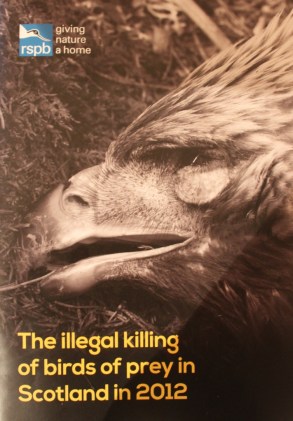
Download the report: The Illegal Killing of Birds of Prey in Scotland 2012

SGA suggests that trees are ‘biggest threat’ to golden eagles

Ah, bless. According to Alex Hogg, Chairman of the Scottish Gamekeepers’ Association, the ‘biggest threat’ to golden eagles in Scotland is trees.

In a remarkably ignorant article in the Herald, our friend Hogg suggests that the government’s plans to create more woodlands will mean that within the next few decades, ‘golden eagles will have nowhere to expand its range’.

The journalist (and that’s being kind) refers to the SGA as a ‘conservation body’ and cites the 2008 Golden Eagle Conservation Framework to support the notion that tree-planting is a potential constraint on golden eagle breeding success.

Had the journalist, and Mr Hogg for that matter, bothered to read the Conservation Framework report in detail, he might have noticed the following statements:

Currently, commercial afforestation is not considered a marked constraint on golden eagles

and

A number of lines of evidence indicated that illegal persecution of eagles, principally associated with grouse moor management in the central and eastern Highlands, is the most severe constraint on Scottish golden eagles“.

Strangely, the phrase ‘illegal persecution of eagles’ doesn’t feature anywhere in the Herald piece.

The journalist and Mr Hogg also failed to acknowledge the recently-announced strategy published by Forestry Commission Scotland which provides guidance and advice on designing and managing new woodlands to benefit golden eagles (see here).

Another Hogg quote, about the government’s planned tree-planting scheme: “Scotland will not look like the country it is now. It will look more like Norway“. Funnily enough, golden eagles in Norway appear to be thriving – see here.

If we were cynics, we might think that this article was yet another attempt to deflect attention from the on-going illegal killing of golden eagles on Scottish grouse moors…

Herald article here

2008 Golden Eagle Conservation Framework here