
 Last October the cross-party Environmental Audit Committee recommended a range of measures to help tackle wildlife crime in the UK (excluding Scotland) following an extensive public inquiry into the scale of wildlife crime (see here, here, here, here, here for previous blog entries). The recommended measures included:
- Criminalising the ‘possession’ — not just the use — of the poison Carbofuran, to make it easier to secure bird poisoning convictions;
- Introducing an offence of vicarious liability to make landowners responsible for wildlife crimes on their land;
- Providing long-term Home Office and Defra funding to the National Wildlife Crime Unit, and
- Tightening up the recording of wildlife crime data to help keep track and tackle trends in wildlife crime.
Today, the Government has published its response to the EAC report and has rejected calls from MPs to criminalise possession of Carbofuran and has refused to give funding certainty for the National Wildlife Crime Unit.
Chair of the Environmental Audit Committee, Joan Walley MP, said:
“The Government has missed an opportunity to take two simple measures to protect important wildlife threatened by poachers and criminals in the UK.
It has failed to follow Scotland’s lead in criminalising possession of carbofuran – the main poison used to kill birds of prey. And it has refused to provide the long-term financial certainty that the National Wildlife Crime Unit needs, only making money available for the next 12 months.
It’s good news that the Government will watch how well the ‘vicarious liability’ law works in Scotland, making landowners responsible for what happens on their estates. But the Government should also look at how well the tougher law in Scotland acts as a deterrent, not simply how many convictions there are there.”
Here are the government’s specific responses on the two measures directly relating to raptor persecution:
Recommended measure: To discharge its obligations under the EC Birds Directive, to demonstrate its commitment to addressing raptor persecution and to send a clear signal that it regards poisoning birds of prey as wholly unacceptable, we recommend that the Government immediately introduces an Order under Section 43 of the Natural Environment and Rural Communities Act 2006 proscribing possession of carbofuran and other similar substances in England and Wales.
Government’s response: The Government is firmly committed to addressing raptor persecution in England and Wales and this is one of the UK’s wildlife crime priorities (with a focus on hen harrier, goshawk, golden eagle, white-tailed eagle, red kite and peregrine). There is a robust legal framework for protecting birds of prey with penalties which can include imprisonment for offenders.
Approvals for pesticide products containing carbofuran were revoked in 2001; this means that the advertisement, sale, supply, storage or use of products containing carbofuran is already a criminal offence under existing UK pesticide legislation. This offence carries, on conviction, an unlimited fine.
Similar restrictions apply to all other pesticides as the basis of UK and EU pesticide legislation is that no pesticide may be sold, stored or used unless it is first approved. All sale, storage and use of approved pesticides are subject to strict legislative control and are also subject to a code of practice3 as published by Defra.
Additionally the use of any poisonous substance to kill or take wild birds is already an offence under section 5 of the Wildlife and Countryside Act 1981. The laws surrounding the possession of pesticides, such as carbofuran, which are harmful to wildlife, have been considered, and the conclusion is that there are alternative ways to handle the issue other than introducing an Order under s.43 of the Natural Environment and Rural Communities Act 2006. These include the existing powers under UK pesticide legislation (the Plant Protection Products Regulations 2011 and the Plant Protection Products (Sustainable Use) Regulations 2012), or by encouraging participation in amnesty initiatives, such as the Home Office’s pesticide amnesty, which have already been run very successfully.
It is difficult to see what more the Government could do that could make it any worse for someone caught using or possessing carbofuran or other similar pesticides.
Recommended measure: Given the scale of ongoing persecution of birds of prey, the current law appears to carry insufficient deterrent weight. We recommend that the Government evaluates the effect of the introduction of an offence of vicarious liability in relation to raptor persecution in Scotland and considers introducing a similar offence in England and Wales in that light. We expect the Government to report to us, or otherwise publish, the results of that review within the next 12 months.
Government’s response: There is already strong legal protection afforded to birds of prey through the provisions of the Wildlife and Countryside Act 1981 where it is an offence to intentionally kill or injure any wild bird; take, damage or destroy the nest of any wild bird while that nest is in use or being built; or take or destroy an egg of any wild bird.
Some birds are further protected by their listing in Schedule 1 to the Act. It is an offence to intentionally or recklessly disturb them while they are building a nest, or are on, in, or near a nest containing eggs or their young. Native raptors are listed in the Schedule and so are afforded this additional protection.
The Scottish Government introduced the concept of vicarious liability for certain offences by an employee or agent through the Wildlife and Natural Environment Act (Scotland) 2011 which inserted a new section 18A into the Wildlife and Countryside Act 1981 (as it applies in Scotland). This provision came into force in January 2012 but it is early days, and as yet there have not been any convictions under the new provisions. While there are no plans to introduce similar vicarious liability offences in England, we will be looking closely at how the new offences in Scotland work in practice and once prosecutions begin to be brought forward it will be possible to start to assess the impact that the introduction of this legislation has made. It is important that such measures are able to deliver a real improvement in the enforcement of wildlife offences if they are to be considered in the shaping of our future wildlife crime policy in England and as yet it is not possible to assess the effect of these measures.
We are happy to review this as soon as suitable statistics are available.
To read all of the Government’s responses, read the report here.
 The SGA don’t believe that the eagle was caught in an illegally-set trap because during their discussions with the estate’s staff, it was claimed they only ever use Mark 4 Fenn traps as opposed to Mark 6 Fenn traps (and of course statements made by those involved with grouse moor management should always be believed). The SGA say the Mark 4 Fenn trap is too weak to smash the legs of a golden eagle and it would be impossible for an eagle to get both feet caught inside the trap at the same time. However, if you read the RSPB’s original media statement about this incident (released 24th September 2012 –
 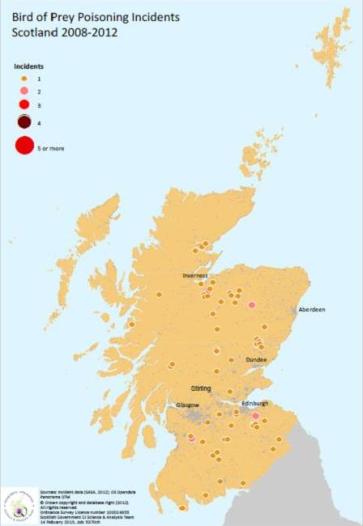 The ‘official’ 2012 incidents of confirmed poisoned raptors in Scotland have just been published and show a marked decline in the number of poisoning incidents. According to the latest figures, the number of reported poisoned raptors fell from 16 in 2011 to three in 2012 (one golden eagle and two buzzards).
 Further to our blog earlier this month about the Hawk and Owl Trust becoming the third conservation group to walk out of the Hen Harrier Dialogue process (see
 New legislation designed to provide greater legal protection in Scotland to golden eagles, hen harriers and red kites comes into force next Saturday (16th March 2013).
 We’re hearing persistent rumours, from several sources, that Leadhills Sporting Ltd are leaving their shooting tenancy on the Leadhills (Hopetoun) and Buccleuch Estates.
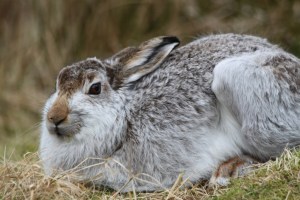 It’s interesting that SNH will be ‘reviewing its position’ about its licensing regime in light of the Lochindorb verdict. As far as we could tell, the Lochindorb ‘not guilty’ verdict was based on the specific type of snare used at that time (sometimes called a ‘w’ snare, sometimes called an ‘m’ snare, depending on who you’re talking to). That snare was legal in 2009 (at the time the alleged offences took place). During the trial the defence successfully argued that that particular type of snare had never knowingly caught any non-target species. Unfortunately the prosecution was unable to provide any evidence to the contrary. However, that snare-type has since been banned, because under the Snares Scotland Order (2010) it is no longer legal to use a snare in a way that an animal could become partially or wholly suspended.
 Raptor Persecution UK