Not counting properly, and accountability

On the subject of counting, in his latest blog the ever-sharp Alan Tilmouth examines Alex Hogg’s apparent inability to count (see here). This is well worth a read if you’re interested in understanding what ‘evidence’ the game-shooting industry uses to support its claims that raptors (especially buzzards) are decimating pheasant poults.

On the subject of accountability, George Monbiot has written a response to Magnus Linklater’s latest attack on the RSPB. This is also well worth a read, especially as Monbiot confirms Linklater’s association with game-shooting and uses it to suggest that journalists should be made to declare their interests so that readers can judge the independence of the journalist’s opinions. Monbiot’s article here.

Some not so good eagle news

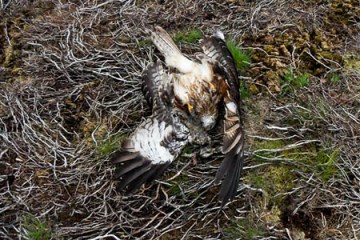
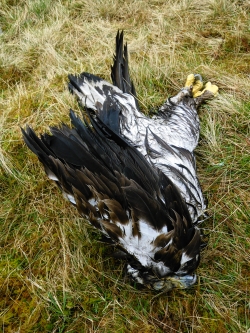
We have it on very good authority that another satellite-tagged golden eagle has gone ‘missing’ in the Monadhliaths in the last couple of weeks.

Going ‘missing’ doesn’t equate to ‘being dead’ of course, but it’s really stretching the boundaries of credibility to believe that yet another disappearance is the result of yet another dysfunctional tag, especially when the area of its last known movements just happens to be one of the country’s persecution hotspots.

How many’s that since the sat-tagging began several years ago? We’ve lost count. Just looking at this year’s reports, in addition to this latest eagle, we know about this ‘missing’ satellite-tagged golden eagle (here), this ‘missing’ satellite-tagged golden eagle (here), this dead satellite-tagged golden eagle (here), and this dead satellite-tagged golden eagle found poisoned in Lochaber (here). How many don’t we know about?

Some good eagle news for a change!

It’s refreshing to be able to report some ‘good’ eagle news for once. And not just one story – we’ve got two!

First up – the legal eagles. Solicitors Innes & Mackay of Inverness have sponsored two satellite-tagged golden eagles, raised on the Strathspey Estate in the Cairngorm National Park. The eagles, named Innes & Mackay (what else?!) have been tagged by Roy Dennis and their movements will appear shortly on his excellent RaptorTrack website (here). The solicitors also hope to involve a local school in monitoring the eagles’ progress. Their press release here. Well done to all involved, especially Strathspey Estate, whose continued efforts to support golden eagles in what is otherwise known as a persecution hotspot is unusual and very welcome.

The second piece of good news is that funds raised through the Mull Eagle Hide have been given to provide support for the Mull and Morven Agricultural Show. A grant of £250 from the Sea Eagle Partnership has contributed towards new cattle pens and hurdles for highland cattle. Press release here. Let’s hope this funding will help persuade those doubters from within the farming community that the reintroduced sea eagles, and the tourism they generate, can be of benefit. Although judging by this article (here) from 2009, some people may need more persuasion than others. The article includes a quote from a crofter who was claiming that “sea eagles took half my lambs” and he described hearing a pair of sea eagles “scraping their talons on the rock“. Presumably they were re-sharpening their claws after piercing the skin of the hundred babies they stole from prams earlier that morning. Well done to the Mull Eagle Hide team for all their efforts in the face of some astounding ignorance.

N Yorks police appeal for info 3 months after kite found poisoned on moor

North Yorkshire police have taken three months to appeal for information after the discovery of a poisoned red kite on moorland.

The kite was found by a raptor fieldworker on Lofthouse Moor, Nidderdale, in May 2012. Toxicology tests revealed it had been poisoned ‘by a combination of banned pesticides’. The press release doesn’t offer any further detail about which banned pesticides were used, but it also states that rodenticides were discovered during the tests. Confusingly, the police wildlife crime officer focuses on the ‘common problem’ of accidental rodenticide poisoning rather than the other common problem of deliberate poisoning using banned chemicals.

Why has it taken the police three months to make this appeal? Where’s the sense of urgency? Where’s the indication that this crime is being taken seriously? Does anybody know whether Lofthouse Moor is managed for grouse shooting?

North Yorkshire Police press release here

News article on the Grough website here

Magnus Linklater’s article

A fascinating article appeared in The Observer on Sunday, reproduced in The Guardian, presumably timed to coincide with the Inglorious 12th. Called ‘Why the claws are out for the RSPB‘, it would score pretty highly on the shite-o-meter and is exactly what we’ve come to expect from Magnus Linklater, whose name produces the amusing anagram ‘Glum Anal Stinker’.

It would take forever to address every single inaccuracy in the article and to be honest, in keeping with the theme, who can be arsed? Fortunately there are more hardy critics who have ripped the article to shreds in the comments section underneath the article (see here). Magnus has something of a track record, going back several years, for slagging off the RSPB and for advocating raptor ‘control’ (see here, here, here etc etc….yawn). Rumour also has it that he might just have grouse-shooting interests in Perthshire, although these alleged ‘credentials’ were not revealed in his mini-biography at the top of the article.

The SGA described this article on their Facebook page as “quality investigative journalism“. That ringing endorsement should probably tell you all you need to know about the ‘quality’ of this piece. Ironically, the article has probably been the best advert for joining the RSPB in the last ten years! You can join here.

RSPB: 1  –  Magnus: 0

SSPCA wins conviction for poison & dog neglect

A man from North Ayrshire has been convicted of causing his dogs unnecessary suffering and possessing a banned pesticide (Cymag) following an SSPCA investigation back in March 2010.

William Ralph Trivett, 40, pled guilty to five charges at Kilmarnock Sheriff Court last Friday (10 August). He was fined £600 and received a three-year ban on keeping any more than twelve dogs.

The SSPCA had removed seven dogs from make-shift kennels at Mid-House Farm, Kilbarchan, Johnstone. The jar of Cymag was found during a further search of Trivett’s home at nearby Milton Quadrant.

Well done to the SSPCA for another successful prosecution. Full story on their website here.

Compare and contrast

How very curious. Have you heard about the new project set up by SNH and University of Exeter to fit satellite tags to basking sharks on the west coast of Scotland (see here)? The purpose of this fantastic project is to help solve some of the mysteries about basking shark behaviour and to identify important marine areas that may need greater protection.

Apart from the scientific importance of this research, a substantial effort has been made to engage with the general public, which is a good thing seeing as though we, as tax-payers, have helped fund part of the project. First of all we were asked to help name eight of the tagged sharks, and then a dedicated website was launched, where we can follow the daily movements of each named shark, in close-to-real time (see here). We can even subscribe to receive daily project updates!

Now, compare and contrast the glut of detail available from the basking shark sat-tagging project (which has only been running for several short weeks), with the barely discernible detail available from the hen harrier sat-tagging project at Langholm Moor, which has been running for several years and which, incidentally, we as tax- payers also helped to fund. The ‘detail’ (and that word is used generously!) of the hen harrier sat-tag data can be seen here.

Interesting difference, eh?

Predictable shite as grouse season approaches

Yes, it’s that time of year again. The opening of the grouse-shooting season is upon us (although this year it’ll start on August 13th as the traditional opening day of the 12th falls on a Sunday) and the usual suspects are out in force to tell us all how great grouse moors are and how we should all be grateful for the conservation and economic benefits they provide. Not forgetting the predictable swipe at the RSPB along the way.

Shooting Times has an article suggesting that it’s time to sever ties with the RSPB due to their ‘bullying’ ways (see here). The best line has to be this: “For too long we have acted as gentlemen, only for our big-heartedness to be thrown back in our faces“. That’s priceless! Have a look here at an earlier blog we wrote about how the RSPB has been treated by these ‘gentlemen’!

An STV news article (here) has SGA Chairman Alex Hogg telling us how grouse shooting can save the world…or at least the rural economy, calling it a “modern industry” (ahem) and laughably explaining how “People admire Scotland’s diversity of landscape, its well-managed moorlands teeming with wildlife being a huge part of that attraction“!!!

An alternative view of grouse moor management can be found in The Guardian blog (here), where a national campaign against moorland bog-burning is due to be launched with a protest walk over the now infamous Walshaw Grouse Moor this Sunday.

Latest poisoning figures are just a smokescreen

So, SGA Chairman Alex Hogg is “hugely encouraged” by the forthcoming 2012 poisoning statistics, due to be released by the government agency SASA in the next few days (see here for STV news story and here for SGA press release). The figures are expected to show just two confirmed raptor poisonings in the first half of 2012, a considerable drop from the figures of previous years.

Unfortunately, these figues are just a small part of the story, as many regular readers will already be aware. We’ve blogged about this before, back in March when the poisoning figures for 2011 were published (see here for our previous post). As we said then, these figures look promising on a superficial level but do they really reflect the true extent of illegal persecution?

The lower poisoning figures may well be a true indicator that fewer people are still poisoning raptors. That’s what the SGA and friends clearly think and would like the rest of us to think. However, another equally plausible explanation is that the poisoners are just getting better at hiding the evidence. We’ve always known that the published poisoning figures just show a tiny fraction of actual poisoning incidents; these poisonings usually take place in vastly remote areas where few people are around to find the evidence. The poisoned birds that have been discovered have usually been discovered by chance. More recently, they’ve been discovered because more raptors are now fitted with satellite tags so it’s easier to follow their movements and to find the locations where they die.

There is another plausible explanation, too. As we’ve also said before, poisoning is not the only method of illegally killing raptors. Perhaps the lower poisoning figures reflect a substantial shift in the methods used to persecute raptors. Are more raptors being shot at the nest? Are more raptors being shot at roost sites? Are more nests and eggs being destroyed? Are more raptors being caught in traps and being bludgeoned to death? The persecutors know very well that the government doesn’t record these types of incidents; only reported poisoning incidents are published. What better way to make it look like you’ve cleaned up your act than by reducing the poisoning but increasing the other techniques that you know will never be officially reported? (Except by the RSPB who always publish these other persecution incidents in their annual reports, but which are then dismissed as being ‘unofficial’ and ‘exaggerated’ by the game-shooting lobby).

Is it plausible that other persecution methods have now taken precedence over poisoning? Let’s look at the hen harrier situation. The UK’s hen harriers continue to spiral towards oblivion and the main cause has been identified as illegal persecution. Everyone knows it and even the government has acknowledged it. But how many hen harriers do you see listed in the annual poisoning figures? Very few indeed. Mainly because poison is rarely used to kill harriers – they’re not typically a scavenging species that depends on carrion so they’re harder to poison. But just because they don’t feature on the annual list of poisoned raptors doesn’t mean they’re not persecuted! Of course they are; the national hen harrier survey results say it all.

If anyone is still in any doubt about whether the latest poisoning figures are an accurate reflection of the extent of illegal raptor persecution, then consider this. Will the figures for Jan-June 2012 include this ‘missing’ satellite-tagged golden eagle (here), or this ‘missing’ satellite-tagged golden eagle (here), or this dead golden eagle found with substantial injuries (here), or this dead golden eagle found in what was described as ‘suspicious circumstances’ here? Or just the one confirmed poisoned golden eagle found dead in Lochaber (here)?


Bowland eagle owls thwart alleged persecution attempts

Some great news reported by Tony Warburton MBE of the World Owl Trust: the Bowland eagle owls have thwarted alleged persecution attempts to produce two fledglings on the United Utilities Estate.

Full report by WOT here