
2011 poisoning stats ‘out’ in every sense of the word

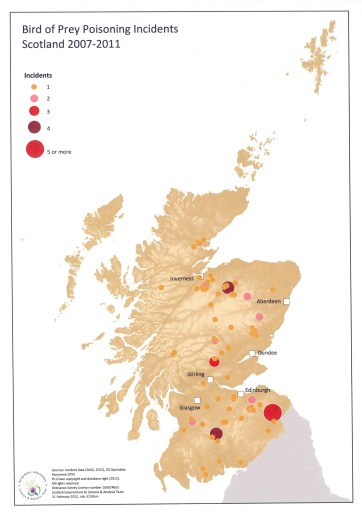
The Scottish Government has today published the 2011 poisoning map (otherwise known as Scotland’s map of shame).

The newspapers are heralding the figures as a success story, as the numbers show an apparent drop in poisoning incidents (“only [only??!] 16 raptors were killed as a result of being illegally poisoned in Scotland – 12 fewer than in 2010 and the lowest death toll since the first maps were published six years ago“, says The Scotsman). The victims included seven buzzards, four red kites, two peregrines, two sparrowhawks and a golden eagle.

On a superficial level this does look like convincing progress, but let’s scratch the surface and see what’s underneath…

The official Scottish government poisoning map only shows the places where poisoned birds were discovered. Given the remote areas involved and the fact that most of these poisoned birds were found by chance (by passing hillwalkers etc.), the official figures can in no way represent the actual number of raptors that were poisoned (but undetected) during 2011.

The figures behind the map also do not show the areas where poisoned baits (but no dead birds) were discovered during 2011. Nor do they show the other incidents of raptor persecution that were discovered during 2011, including shooting, trapping and nest destruction incidents. According to an article in today’s Guardian, it is claimed that last year’s illegal shooting, trapping and nest destruction incidents “have remained constant with previous years“. We’ll have to wait a good few months for the RSPB Birdcrime Report to see the actual figures. (Incidentally, how come the 2011 poisoning figures, as compiled by SASA, have not yet been released to the public? They’re obviously available as they were used to construct the poisoning map. So far they’ve only published data up to September 2011. Isn’t it in the public interest to release them? Why all the secrecy?).

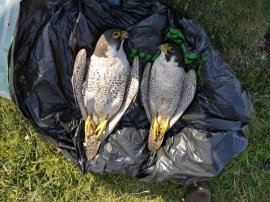
It seems plausible that some shooting estates are doing their best to distance themselves from any sign of illegal raptor persecution, especially in light of the new law on vicarious liability. A likely example of this behaviour was an incident in the Borders in September 2011. A dog walker discovered a bag full of dead raptors by the side of the busy A68  road (see here for earlier blog on this). The police were alerted and the birds were sent to SASA for toxicology tests. The results showed that the two sparrowhawks and two buzzards had been poisoned with the banned pesticide Carbofuran. Because the dead birds had been dumped away from any shooting estate or farm, without being seen, it was virtually impossible for the police to prosecute anyone (SASA reports that the police have now closed the case due to a lack of positive leads – see here). What is the probablity that other estates up and down the country are poisoning raptors on their land and then removing the evidence as far from their location as possible?  It was pure chance that this bag of poisoned raptors was discovered. How many more are left rotting and undiscovered across the country?

But let’s suppose, just for a minute, that the latest map IS an accurate representation of all raptor poisoning incidents that took place in 2011. Should we then accept that shooting estates are cleaning up their act and they’ve all suddenly decided, after over 100 years of persecution, that raptors are actually ok and shouldn’t be killed? The only way to measure that will be to look at LONG-TERM TRENDS of poisoning incidents as well as LONG-TERM TRENDS of raptor populations. We’ve blogged about this before (see here) but it’s worth repeating some of it to show the bigger picture. The graph (adapted from the RSPB’s excellent report: The Illegal Killing of Birds of Prey in Scotland in 2010, see here) shows the long-term trend of poisoning incidents in Scotland from 1989-2010. Look carefully at the graph and you’ll see peaks and troughs in the numbers recorded. Yes, there certainly have been previous drops in the number of poisoning incidents, but then look what happened in the following years – another increase, and then another drop, then another increase etc. Before the game-shooting lobby starts its self-congratulatory back-slapping, we need to see a continuous decline in the number of recorded incidents, AND we need to see raptor populations recovering in those areas where persecution has been endemic. This will take time, but could arguably be judged in about five years’ time.

Of course we all hope that the 2011 figures are the start of a new era in raptor conservation in Scotland. As Environment Minister Stewart Stevenson has said in today’s media: “I hope this proves to be the beginning of a continuing reduction in such cases, leading to the end of this outdated, dangerous and cruel practice“. It is notable that his statement contains more than a hint of caution. That man’s no fool.

See an excellent article about the latest figures in today’s Guardian here

Article in The Scotsman here
RSPB criticised over link to Hopetoun Estate for Scottish Bird Fair

An article in today’s Scotsman has criticised the RSPB’s decision to hold the first-ever Scottish Bird Fair at Hopetoun House near Edinburgh in May.
The event, to celebrate Scottish birdlife and expected to attract 5,000 visitors, is to be held at the stately home of the Earl of Hopetoun, whose family also reportedly own Leadhills Estate (also known as Hopetoun Estate) in South Lanarkshire. Leadhills is a well-known grouse moor that has been at the centre of numerous police investigations over the years for allegations of raptor persecution. Many of these investigations did not result in a subsequent prosecution, but several did. The most recent one was the conviction of a 20-year old gamekeeper (in November 2010) who was found guilty of laying a rabbit bait laced with the banned pesticide Carbofuran.

The RSPB has defended its decision to link with Hopetoun:

We understand that there is a clear separation between land managed in hand by Hopetoun Estate in West Lothian, and the Leadhills Estate, which is let on a long lease to American tenants. It is the American sporting tenants on Leadhills Estate, through a UK sporting agent, who employ and manage the land and the employees at this site, and who are therefore ultimately responsible with ensuring that birds of prey are protected on this land. We accept that Hopetoun Estate do not condone any illegal practices on their land.”

Hang on a minute. Doesn’t ‘ultimate responsibility’ lie with the landowner? Isn’t that the message from the new law on vicarious liability? Apparently not!

The Scotsman reports that attempts to contact the Earl of Hopetoun were unsuccessful. However, an article on the Deadline News website has a statement that has reportedly come from the Earl’s spokesman:

The Earl of Hopetoun’s position on wildlife crime is unequivocal. He has constantly condemned any such activity. More importantly, Hopetoun Estate has no role whatsoever in the management of Leadhills Estate. Leadhills Estate is run on a sporting lease completely separately and there is no connection between Hopetoun Estate and the sporting management of Leadhills“.

Surely that lease would contain a clause that says if any unlawful activity is shown to have taken place then the lease becomes null and void and the tenants can be removed? Apparently not!

Full article in The Scotsman here

Article on Deadline News website here

RSPB’s Scottish Birdfair website here

Hen harriers thriving on Orkney but in trouble elsewhere

The hen harrier, considered by many to be the UK’s most persecuted raptor, has reached a twenty-year high on Orkney, according to the latest study.

New figures have revealed 100 breeding females, producing more than 100 chicks, following a steep population decline there during the 1980s and 1990s. The cause of that particular decline was believed to be related to the high number of grazing sheep that reduced the amount of available rough grassland (and thus voles) that Orkney harriers depend on during the breeding season. Once the sheep numbers were reduced (with the help of agricultural support payments) the habitat was allowed to regenerate (and thus vole abundance increased) which was obviously beneficial to the harriers.

We have searched online to find this ‘latest study’ but only found this paper: ‘Long-term impact of changes in sheep densities on the breeding output of the hen harrier‘, authored by Amar et al. This was actually published in February 2011 (see here) but seems to be the one that is being referred to in today’s press releases. This paper only documents hen harrier breeding success up until 2008 though, so perhaps these new figures of 100 breeding females refer to the 2011 breeding season. That could have been made clearer in the news releases. 

RSPB press release about the latest study here; STV news article here; BBC news article here

Unfortunately, in other areas of the UK the hen harrier is doing anything but thriving, especially in northern England where it is on the verge of becoming extinct as a breeding species. A national UK hen harrier survey carried out in 2010 showed an overall decline of more than 22% over just a six-year period (see here and here). In Scotland, the population fell to 489 pairs (from 633 in 2004). Last year in England, there were just four breeding pairs, all on a single estate in Lancashire. Scientists have estimated that there is suitable habitat in England to support over 300 breeding pairs.

The cause of the hen harrier decline? You all know the answer to that by now – illegal persecution, particularly associated with driven grouse moors. We’ve blogged endlessly about it – see here, here, here, here, here….

For anyone who missed it, here’s the government’s official 2011 report on the conservation status of the UK’s hen harriers and the reasons behind their demise (here).

RSPB ‘deeply concerned’ over Natural England’s statement on Walshaw Moor

Earlier in February we blogged about legal action being taken by Natural England against Walshaw Moor Estate in the Pennines, over the way the estate’s burning regime may impact on the fragile blanket bog habitat. This was seen as an important test case that could have far-reaching implications for the way other English grouse moors are managed (see here).

Last Friday (9 March), English Nature issued a statement that said they had now ‘resolved their dispute regarding management activities at Walshaw Moor’ (see here for full statement).

However, the RSPB has issued its own statement, raising concerns about the resolution. The RSPB’s Chief Executive, Mike Clarke, has written to the Chairman of Natural England to ask for clarification about the details of the resolution (see here for full statement).

strange anomaly over photographic evidence

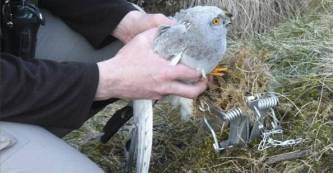
Compare and contrast this case (where a photographer’s evidence was used to convict badger baiters and the photographer was commended as “brave and courageous” by the judge, see here), with the recent OneKind crow cage incident (see here).
Strange, isn’t it?

Still waiting for a response from Scottish Environment Minister Stewart Stevenson to clarify what is and isn’t acceptable evidence in suspected wildlife crime incidents in Scotland.

Thank you to the contributor who sent us the link.

Vicarious liability – what’s it all about?

There’s been a lot of talk recently about the new offence of vicarious liability and whether it will finally address the issue of illegal raptor persecution in Scotland. Some see it as the ultimate enforcement tool that will stamp out raptor persecution on shooting estates once and for all. Others see it as an unnecessary burden on purportedly law-abiding landowners, land managers and gamekeepers who have managerial responsibilities. The truth is that nobody knows for certain just how effective this new legislation will be, and until there have been some ‘test’ court cases, that uncertainty will remain.

We had hoped that the Scottish Government would provide detailed information and advice about the new legislation, but they haven’t. The following overview is our current understanding of the issue and has been put together after reading various articles and documents and we’ve included a list of useful links for further reading at the end of this blog post.

The new offence of vicarious liability in relation to the persecution of wild birds (where one person may potentially be legally responsible for the actions of another person) came in to force on 1 January 2012, as a provision in the Wildlife and Natural Environment (Scotland) Act 2011. It was introduced as an amendment to the draft WANE Bill in November 2010 by former Scottish Environment Minister, Roseanna Cunningham. It was a direct response to the unrelenting problem of illegal raptor poisoning and the apparent inability/unwillingness of the game shooting lobby to get their own house (grouse moors) in order (see here and here for background).

Interestingly, upon its enactment on 1 January 2012, it was widely touted as being aimed at ‘the few’ or ‘the minority’ who are persistently culpable in this area of wildlife crime (see press statements from Scottish Government, Scottish Land & Estates and National Wildlife Crime Unit here). Strange that the actions of a ‘few’, or the so-called ‘minority’, could cause the creation and introduction of a new offence, don’t you think? Isn’t it more likely that the government recognised that these crimes are carried out by so many, and to such a wide extent, that new legislation had to be brought in as the only measure capable of dealing with crime on this scale? Anyway, we digress….

When will the offence of criminal vicarious liability apply? According to the provisions in the WANE Act, it will apply to certain wildlife offences, but not all. There are three main areas of wildlife crime for which a person can be held vicariously liable:

1. Intentionally or recklessly killing, taking, disturbing wild birds and their nests.

There are exceptions, such as killing certain game birds or other species that are permitted to be killed, taken or disturbed under a general licence (e.g. crows), but in general, it is an offence to interfere with certain wild birds (including raptors), their nests and their nest contents, and it is also an offence to obstruct or prevent these birds from using their nests.

2. Prohibited methods of killing or taking wild birds.

This relates to the setting or placing of articles that could cause bodily injury to a wild bird. This includes the setting of various traps (including spring traps), snares, hooks, lines, birdlime, electrical devices for killing, stunning or frightening, and any poisonous, poisoned or stupefying substance.

3. Possession of pesticides.

Anyone found in possession of a pesticide containing at least one prohibited ingredient will be guilty of an offence (unless they have a specific approval order for its use). Prohibited ingredients currently include Aldicarb, Alphachloralose, Aluminium phosphide, Bendiocarb, Carbofuran, Mevinphos, Sodium cyanide and Strychnine (as named in the Possession of Pesticides (Scotland) Order 2005).

We understand that the maximum penalty for any of the offences is six months imprisonment and/or a £5,000 fine. If the offence was committed in respect of more than one bird, nest or egg etc, they will be treated as separate offences and carry separate penalties. In other words, the maximum penalty applies to a single offence only. So if someone is convicted of being vicariously liable for the killing of two protected birds, they could face up to 12 months imprisonment and/or a £10,000 fine etc.

Who can be prosecuted for the offence of vicarious liability? Well, that will depend very much on the circumstances of each individual case, and specifically the managerial involvement of each individual person. In general terms, however, anyone who either has the legal right to kill or take wild birds, or manages or controls the exercise of that right, and anyone who secures the provision of certain shoot-related ‘services’ from someone else may be vicariously liable for offences committed by another person. This could include, either singly or in combination, landowners, trustees, directors & officers (such as in a limited company), farmers, crofters, shooting tenants, shoot syndicate members, factors, agents, gamekeepers and contractors who procure or provide services relating to habitat management or shoot management.
Before somebody can be prosecuted for the offence of vicarious liability, the prosecutor must demonstrate that the primary offence took place and that the offence was committed by a third party who has a specific relationship to the person being charged with vicarious liability. The person who committed the primary offence need not be prosecuted in order for a prosecution to be brought against the person in management or control. This seems a bit odd though, because if it can be shown that the primary offender committed the offence, then why wouldn’t he be prosecuted? Although perhaps it covers situations such as the primary offender emigrating, or dying, or having a plea-bargaining agreement with the prosecutor whereby he doesn’t get prosecuted in return for providing information about another crime or another person.

There is, of course, a defence to the charge of vicarious liability. The accused has to demonstrate to the court that:

(a)    he did not know the offence was being committed; AND

(b)   he took all reasonable steps AND exercised all due diligence to prevent the offence being committed.

It is not yet known what a court will accept as reasonable steps and due diligence, but the word ‘all’ may be significant (as in ‘all’ reasonable steps and ‘all’ due diligence). Much will depend on the specific circumstances of each case, but what does seem clear is that doing nothing will not be an adequate defence. As a minimum, the defendant should be able to show, with written documentary evidence, that work procedures have been evaluated, risks have been assessed, training has been offered if deemed necessary, a system of checks are in place and that regular reviews have been undertaken. These procedures are not dissimilar to the way a health and safety system operates so it should not be beyond the capabilities of someone with managerial responsibilities to undertake this type of procedural audit.

There is a significant amount of interest in how effective the new legislation will be, and we will watch with interest as the (inevitable) cases are brought before the courts.

It should be noted that the offence of vicarious liability (in relation to the persecution of raptors) is only currently applicable in Scotland. Other parts of the UK have not yet adopted this approach, although it has been reported that legislators in England are watching to see how well it works in Scotland. As illegal raptor persecution is just as much of a problem in England, conservationists have launched a petition to have the issue of vicarious liability debated in the English Parliament. The petition needs 100,000 signatures to trigger the parliamentary debate – please visit the petition site (here) and sign it!

FURTHER READING

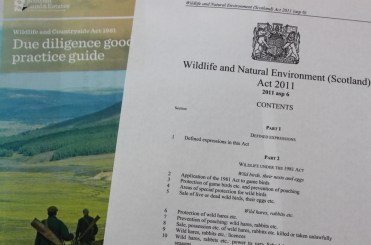
Wildlife and Natural Environment (Scotland) Act 2011 (the full text of the Act here).

Scottish Land & Estates, the representative body of Scottish landowners, has written a guide about the issue of vicarious liability called ‘Due Diligence Good Practice Guide’. It has a foreword by Scottish Environment Minister Stewart Stevenson and it is said to have been endorsed by the PAW Scotland Executive. You might think that such endorsements would mean the guide is freely available, but you’d be wrong. It’s only free to SLE members; if you’re an interested member of the public you have to pay the princely sum of £30 (thank you to the three contributors who each sent us a free copy!). It is an interesting read though, and is by far the most useful guide we’ve seen so far.  Especially helpful is the presentation of various case studies involving different sectors of the shooting sector (e.g. large grouse moor, medium-sized owner occupied mixed estate, farm syndicate shoot etc) and the discussions about who might be liable to prosecution in each scenario. It’s been prepared by several ‘legal eagles’ who specialise in wildlife law but perhaps most surprisingly, thanks are given to James Hodge of Baikie Hodge Ltd. Would this be the same Baikie Hodge Ltd. with connections to Millden Estate (see here) and also Leadhills Estate (see here to download the PDF)? Interesting! If you want to pay £30 for a hard copy of the guide, contact SLE via their website here.

Solicitor Robert Scott-Demspter’s article on vicarious liability in the Scottish Field here [Scott-Dempster is also acknowledged as a contributor in the SLE’s guide].

Law firm Lindsay’s rural bulletin on vicarious liability here.

Law firm Turcan Connell’s briefing note on vicarious liability here.

Law firm Brodies’ article on vicarious liability here

An article on VL in The Journal of The Law Society of Scotland (Aug 2012) here

“Gamekeepers are a force for good in fighting wildlife crime”, say gamekeepers

See here and here!

Ha ha ha ha ha ha ha ha ha ha ha ha ha ha ha ha ha ha ha ha ha ha ha ha ha ha ha ha ha ha ha ha ha ha ha ha ha ha ha ha ha ha ha ha ha ha ha ha ha ha ha ha ha ha ha ha ha ha ha ha ha ha ha ha ha ha ha ha ha ha ha ha ha ha ha ha ha ha ha ha ha ha …

Nest cameras to protect raptors in south west England

In a bid to tackle increasing levels of wildlife crime, Devon & Cornwall Police have teamed up with the RSPB to launch ‘Operation Wilderness’, a new scheme that will see 24 hr nest cameras installed at vulnerable sites across the region.

This is a proactive response to the spate of raptor persecution incidents last year, which included the illegal poisoning (with Carbofuran) of four goshawks and a buzzard (see here) and three peregrines (see here and here). There is also concern about egg collectors and pigeon fanciers in the area.

The cameras have been paid for by the Devon Bird Watching and Preservation Society, and Operation Wilderness is being led by Police Wildlife Crime Officer PC Josh Marshall.

Well done to everyone involved  – this is an impressive  joint effort.

BBC news article here

Egg-collector Matthew Gonshaw – latest case

The latest case against five-times convicted (and four-times jailed) egg thief,  Matthew Simon Gonshaw, was heard today at Inverness Sheriff Court.

Gonshaw faces three charges which include taking or destroying wild birds’ eggs, being in possession of wild birds’ eggs, and being in possession of equipment capable of being used in the taking or destroying of wild birds’ eggs.

His case was continued without plea and the next hearing will be in April.

Gonshaw was recently served with a ten-year asbo (anti-social behaviour order) that bans him from visiting Scotland during the bird breeding season. Background info here.

Holyrood falcon killer sentenced

Last December, Andrew Hutchison, a 67 year old pigeon-fancier from Newmills, Fife, was found guilty of maliciously shooting and killing a working falcon (called ‘Naph’, who was employed as a pigeon-scarer at Holyrood) with a .22 rifle. He was also found guilty of removing the bird’s body from his garden, separating it from its radio transmitter, and dumping the bird’s body and the transmitter with intent to defeat the ends of justice. During the trial, Hutchison had accused some falconers (who had been looking for Naph and had tracked his signal to Hutchison’s garden) of lying. “They’re all telling lies. It’s a witches’ coven“!! (see here for article in The Scotsman).

Today, Hutchison was finally sentenced at Dunfermline Sheriff Court. He was fined £350 and was also ordered to pay £1,500 to Naph’s owners, towards the cost of buying and training a replacement falcon for their pest control business.

After sentencing, Hutchison was reported to have said: “I’m a pensioner. The fine and compensation is going to cripple me“.

BBC News article here

STV article here