
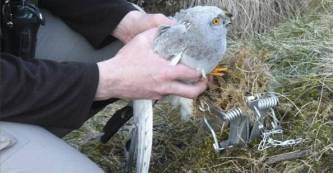
 The hen harrier, considered by many to be the UK’s most persecuted raptor, has reached a twenty-year high on Orkney, according to the latest study.
New figures have revealed 100 breeding females, producing more than 100 chicks, following a steep population decline there during the 1980s and 1990s. The cause of that particular decline was believed to be related to the high number of grazing sheep that reduced the amount of available rough grassland (and thus voles) that Orkney harriers depend on during the breeding season. Once the sheep numbers were reduced (with the help of agricultural support payments) the habitat was allowed to regenerate (and thus vole abundance increased) which was obviously beneficial to the harriers.
We have searched online to find this ‘latest study’ but only found this paper: ‘Long-term impact of changes in sheep densities on the breeding output of the hen harrier‘, authored by Amar et al. This was actually published in February 2011 (see here) but seems to be the one that is being referred to in today’s press releases. This paper only documents hen harrier breeding success up until 2008 though, so perhaps these new figures of 100 breeding females refer to the 2011 breeding season. That could have been made clearer in the news releases.
RSPB press release about the latest study here; STV news article here; BBC news article here
Unfortunately, in other areas of the UK the hen harrier is doing anything but thriving, especially in northern England where it is on the verge of becoming extinct as a breeding species. A national UK hen harrier survey carried out in 2010 showed an overall decline of more than 22% over just a six-year period (see here and here). In Scotland, the population fell to 489 pairs (from 633 in 2004). Last year in England, there were just four breeding pairs, all on a single estate in Lancashire. Scientists have estimated that there is suitable habitat in England to support over 300 breeding pairs.
The cause of the hen harrier decline? You all know the answer to that by now – illegal persecution, particularly associated with driven grouse moors. We’ve blogged endlessly about it – see here, here, here, here, here….
For anyone who missed it, here’s the government’s official 2011 report on the conservation status of the UK’s hen harriers and the reasons behind their demise (here).
 Raptor Persecution UK
Not to let Gamekeepers of the hook, but my take on the STV article, is that the major cause of the decline would appear to over grazing of their habitat by Sheep, in other words miss management by Hill Sheep Farmers.
“A study into hen harrier decline by RSPB Scotland, Scottish Natural Heritage and the University of Aberdeen revealed a direct link between the number of sheep grazing on land popular with the bird of prey, and the success of the species.”
“The number of grazing sheep on Orkney reduced by 20% between 1998 and 2008 – because of a shift in agricultural support payments – leading to a significant improvement in hen harrier numbers.”
So clearly, Hill Sheep Farmers need to be better educated & the Govt. must implement measures to prevent over grazing, if Hen harriers stand any chance of surviving on the UK mainland.
That’s not neccessarily true Ptarmi. The decline in Orkney should not be compared with declines on the mainland because the type and structure of vegetation on Orkney is quite different to that of say heather moorland in parts of mainland UK. A quote from the Amar et al 2011 paper:
“some studies on mainland Scotland have demonstrated that higher levels of historical grazing on moorlands can increase the ratio of grass to heather, thus improving the quality of habitat for meadow
pipits and field voles Microtus agrestis, and therefore favouring higher hen harrier settling densities (Redpath & Thirgood 1997, 1999; Smith et al. 2001). The effects of changes in sheep numbers are therefore likely to vary both spatially and temporally. Thus, decreases in sheep numbers might cause improved conditions in the short term, but in some areas, particularly areas where hen harrier home ranges are dominated by heather, these changes could reduce habitat quality for hen harriers in the longer term.”
Interestingly, I’ve had a similar sort of reply from the Ulster Farmers’ Union, so overgrazing is clearly not entirely to blame, but of course we already knew that, but it looks like illegal destruction of birds is more to blame, after all.
“Ulster Farmers’ Union Many farmers in hill regions participate in agri-environment schemes which set limits on stocking densities. These limits are determined by Government following extensive research and are set in order to protect the habitats and species in our hills. Much of our hill ground also falls under specific land designations such as ASSIs, which protect the land from practices such as over grazing. Over grazing and undergrazing is also prohibited under the Single Farm Payment cross-compliance conditions. However we would note that over grazing is not an issue in Northern Ireland currently, if anything under grazing of land is potentially a greater risk. It is widely agreed that livestock grazing by cattle and sheep is necessary to manage and sustain the delicate balance of biodiversity as it helps to control the spread of more aggressive species which would otherwise dominate the area. Studies have therefore shown that under grazing can actually be of a greater danger to biodiversity and thus maintaining appropriate sheep numbers on the hills is actually of high importance to the natural environment.”