
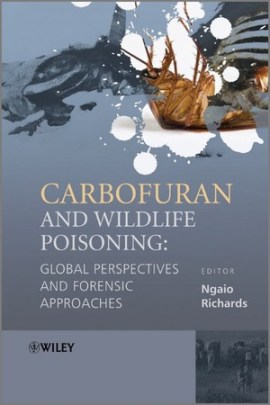
 A definitive reference book was published last month that provides a comprehensive guide to the use of the pesticide Carbofuran and its role in wildlife poisoning.
Written by a series of international contributors, this book includes detailed studies of how Carbofuran is made and applied, its acute toxicity to wildlife, how much and how long it takes to poison an animal, analytical methods of detection and strategies being implemented to prevent its use. It also contains a series of global case studies from Africa, India, Europe, Latin America, Canada and the United States. One chapter is devoted to the [illegal] use of Carbofuran to poison raptors in Scotland: ‘The effect of carbofuran poisoning and other illegal persecution methods on raptor populations in Scotland‘ (Ruth Tingay); ‘A landowner’s perspective on wildlife poisoning in Scotland’ (Douglas McAdam); ‘Monitoring carbofuran abuse in Scotland’ (Michael Taylor).
CARBOFURAN AND WILDLIFE POISONING: GLOBAL PERSPECTIVES AND FORENSIC APPROACHES. (2011). Editor: Ngaio Richards. Wiley-Blackwell, Oxford, UK.
ISBN 978-0-470-74523-6 (hardback)
From the publisher:
This cutting-edge title is one of the first devoted entirely to the issue of carbofuran and wildlife mortality. It features a compilation of international contributions from policy-makers, researchers, conservationists and forensic practitioners and provides a summary of the history and mode of action of carbofuran, and its current global use. It covers wildlife mortality stemming from legal and illegal uses to this point, outlines wildlife rehabilitation, forensic and conservation approaches, and discuss global trends in responding to the wildlife mortality.
The subject of carbofuran is very timely because of recent parallel discussions to withdraw and reinstate the insecticide in different parts of the world. Incidences of intentional and unintentional wildlife poisonings using carbofuran are undeniably on the rise, especially in Africa and India and gatherings of stakeholders are being organized and convened on a global basis. There is still a need to consolidate information on the different experiences and approaches taken by stakeholders. Carbofuran and Wildlife Poisoning is a comprehensive overview of global wildlife mortality, forensic developments and monitoring techniques and is a definitive reference on the subject.
It comprises of historical and current perspectives, contributions from key stakeholders in the issue of global wildlife poisonings with carbofuran, people on the ground who deal with the immediate and long-term ramifications to wildlife, those who have proposed or are working towards mitigative measures and solutions, those in contact with intentional or unintentional ‘offenders’, those who have adapted and developed forensic methodology and are gathering evidence.
Introduction and Table of Contents available here
 Raptor Persecution UK