
 The government-funded organisation Science and Advice for Scottish Agriculture (SASA) has just published its latest report on the illegal poisoning of wildlife, including raptors, in Scotland during 2009.
Of 166 reported incidents of suspected poisoning, 36 were categorised as ‘abuse’ of pesticide use. As in previous years, a high proportion (61%) of abuse incidents involved birds of prey. Carbofuran was once again the most common pesticide detected, even though the UK approval for use of products containing this chemical expired in 2001 and it is a criminal offence to own it.
22 abuse incidents involving 30 raptors were confirmed:
Buzzard = 22; Golden eagle = 2; White-tailed eagle = 1; Tawny owl = 1; Red kite = 4.
The regional breakdown of abuse incidents demonstrates once more the widespread nature of these crimes:
Borders = 5 incidents; Dumfries & Galloway = 1; Grampian = 1; Highland = 2; Strathclyde = 3; Tayside = 10.
The report does not include other incidents of illegal raptor persecution such as shooting, trapping and nest destruction.
In an article published in the Press & Journal, Chairman of the North-East Raptor Study Group, Rab Rae, stated the obvious: “Pesticides are used regularly by the farming community but they are now being used by the shooting fraternity. It is not an accident, it is deliberate to enhance grouse moors“.
In a rebuttal, Chairman of the Scottish Gamekeepers Association, Alex Hogg, said: “The RSG and all their members are well aware that we condemn any poisoning of wildlife. Our organisations are working towards finding solutions to the problem so it’s hardly helpful or constructive to point accusatory fingers while that process continues“.
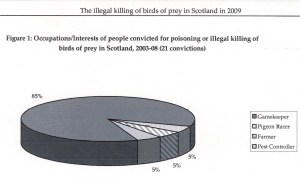
So tell us Alex, what exactly has the SGA done in its efforts to “work towards finding solutions” to the continuing illegal killing of Scottish raptors? It could legitimately be argued that sitting on the largely ineffective Partnership for Action Against Wildlife Crime (PAW) committee is a good cover for paying lip-service to raptor conservation. Talk is cheap – what ACTIONS has the SGA taken to stop criminal activities? And no, trying to legalize the killing of protected species by asking the Scottish government to provide licences to kill raptors doesnt count! According to the latest figures from the RSPB (in their report The Illegal Killing of Birds of Prey in Scotland in 2009), 85% of people convicted for illegally killing birds of prey between 2003-2008 were gamekeepers! Like I said, talk is cheap.
Download the SASA report here: SASA poisoning report 2009
Read the Press & Journal article here: http://www.pressandjournal.co.uk/Article.aspx/1856188?UserKey&UserKey=
Download the RSPB report here: Persecution Scotland 2009
During 2009, SASA reports that 19 cats and 19 dogs were also killed by poisoning. To report an incident of suspected illegal poisoning, call the SASA confidential hotline on Freephone 0800-321600.
 Raptor Persecution UK
The usual disgusting list of criminal poisonings. Very damaging to Scotland’s reputation as a tourist destination. All of these are crimes with very real victims – particularly when they are found by visitors to Scotland, particularly when they involve pets and working animals.
Anyone who claims [Mr Hogg?] that we should hold back on criticism of the shooting world and wait till some “pie in the sky” SGA or PAWCS initiative stops this, should reflect on the fact that all SASA reports going back decades now , have told the same story….and never forget these are only the most obvious cases which have been discovered and then fully reported.Many people out there will still be too scared of reprisal [usually in the form of withdrawal of access or problems over their tenancy] to report suspected poisonings to the authorities.
and I see that we still do not have named locations – even where all other details are made clear. I note that each incident now says where an investigation is ongoing – fair enough not to name those, in the interests of an effective prosecution – but what about the others? What about the hundreds of cases going back 30 years and more where the public has been kept in the dark about this deadly danger in their countryside?