
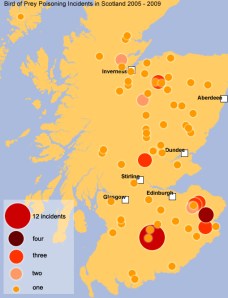
As reported on this blog yesterday, the latest figures of confirmed bird of prey poisoning events in Scotland were just released and guess what? Poisoning in 2009 was at an all time high, despite the succession of statements from the Scottish government over the last 40 years that they are “determined to stamp out” wildlife crime. By anybody’s standards, the government has failed miserably, along with the judiciary, who have never given a custodial sentence to a convicted poisoner, even though they have the sentencing powers to do so. It’s pathetic.
The latest ‘map of shame’ is a pointless piece of work in its current format. What does it tell us? It tells us that raptor poisoning is widespread in Scotland. We already knew that. What it doesn’t tell us is which Estates were responsible. A carefully-worded explanation for this lack of detail goes like this:
“Exact locations of incidents are not shown, in recognition of the fact that birds may travel some distance after ingesting poison. The map therefore randomises precise locations of incidents to produce a variation of around 1km. This avoids any inference being drawn from the exact point of discovery of the bird, but still allows an overview of the worst affected areas“.
Now, I’m no expert geographer, but I’m fairly certain that most Estates in Scotland are bigger than a kilometre. So if a poisoned raptor has been found on an estate where the boundary fence is greater than 1km away, we can be fairly certain that the bird has been poisoned on the estate where it was found, can’t we? And where did this arbitrary distance of 1km originate from anyway? Surely, a forensic expert would be able to calculate the distance a poisoned bird could travel based on the type, amount and toxicity of the poison used? Just look at some of the images on this blog – many dead raptors are found in very close proximity to the actual poisoned bait, sometimes even slumped over it, leaving no doubt whatsoever how and where the bird was killed. Why are these locations not published?
Leaving the dead raptors aside for one moment, why is there not a map showing the location of poisoned baits that have been found? There can be none of this hiding behind concern over an ‘incorrect inference’ for these cases – a posioned bait can’t “travel some distance” from where it was laid, so why are we not seeing the names of the Estates where these baits have been found (with the exception of Glenogil Estate in Tayside, which we all know about)? According to the latest figures released yesterday, 63 poison baits were discovered between 2005 and 2009. And these only relate to incidents involving birds of prey. A quick scan of SASA poisoning reports shows that there are plenty more poisoned baits out there in the countryside that do not get mentioned in the lastest government report. Isn’t it in the public’s interest to know where these baits have been found? I certainly wouldn’t want my children or my pets to be walking in these areas. It only takes one granule of the commonly-used (but illegal) pesticide Carbofuran to kill a human. Why should my children and pets be put at risk, just because the government is too weak and timid to stand up to the (highly rich and influential) members of the SRPBA (Scottish Rural Property & Business Association), who are allegedly behind the secrecy of poisoning locations in Scotland. Not good enough.
If you share this view and wish to express your disgust and concern, you can email the Scottish Environment Minister, Roseanna Cunningham, to let her know your thoughts: ministerforenvironment@scotland.gsi.gov.uk
 Raptor Persecution UK