
This is a guest blog written by conservation campaigner Bob Berzins who has featured previously on this blog here, here, here, here, here and here.
Huge swathes of England’s Pennine uplands are managed for grouse shooting, an activity that benefits a handful of people but has a negative effect on millions more – those living downwind and downstream and the global community affected by carbon emissions.
In a biodiversity and nature emergency these uplands are robbed of life and the most glaring example is continued wholesale persecution of raptors and the land itself has been degraded over the last 200 years where ownership has often remained in the same family. Right now we pay those landowning families millions in subsidies and millions more in restoration grants in an attempt to put right the damage they’ve done – but the damage continues. There has to be a better way. In this blog I’ll make the case for compulsory purchase of land that’s being managed to the detriment of local communities.
The English Devolution Bill is due to be debated in Westminster parliament this autumn. The proposals will empower local communities with a strong new ‘right to buy’ for valued community assets. The examples given are mainly urban but Labour activists and many others have been calling for sweeping changes to land ownership.
This piece by Labour Councillor Minesh Parekh was written when he was part of Olivia Blake’s team in a shadow Defra role. George Monbiot, Guy Shrubsole and others wrote Land For the Many in 2019 where they propose a structure to enable community ownership using the example of the moors above Hebden Bridge where, “The community could reasonably argue that such land serves a more important public purpose as a natural flood defence than as a grouse shoot”.
Mark Avery argues for public ownership in Reflections and Guy Shrubsole expands on this in Lie of the Land.
These books are important because they firmly put the case for the benefits changes in ownership will bring. An example of how this might work in practice is the community fundraising and management of Tarras Valley which has shown how to bring life to a depleted grouse moor.
I live in Sheffield where grouse moors lie within the city boundary, just a few miles from the homes of half a million people and everything that happens on that moorland affects our lives.

These moors could provide huge benefits, locally and globally, but instead they are failing by the Government’s own measure. We deserve better and to add to that sense of injustice ownership of these uplands was wrenched away from the community to become the sole property of one person, usually The Lord of the Manor.
The Enclosure or Inclosure Acts 1790 – 1830
During this period MPs were largely rich, aristocratic landowners and they voted through a series of individual Acts of Parliament where moors, waste and commons were shared out between themselves.
In what is now Sheffield, the Duke of Norfolk received most land – from lowland sites where steelworks were eventually constructed, to uplands which soon became grouse shoots such as Hallam moors which is now part of the Moscar Estate. Other beneficiaries included Earl Fitzwilliam who ended up with Bradfield moors and this family are still the owners today.

The land marked here includes the Fitzwilliam Wentworth Estate to the east and Howden Moors owned by the Duke of Devonshire which is now part of National Trust High Peak Estate. The preservation by the Game Association has left a legacy of dry, denuded moorland in unfavourable condition.
It took at least six individual enclosure acts for the Duke of Rutland to get hold of the Sheffield Eastern moors and a hundred years later we have death duties to thank for the sale of this estate which eventually led to ownership by the National Trust, Sheffield Council and the National Park Authority – land which is now managed for the benefit of us all (see Eastern Moors Partnership).
But it seems the Rutlands couldn’t bear to be without a grouse moor and they bought Moscar Estate from the snuff making Wilson family in 2016 who had acquired the land from the Duke of Norfolk in 1897. The other large estate overlooking Sheffield is Broomhead where a different Wilson family have been in residence since the 1300s, again benefitting from enclosure to get their hands on the moors.
The Dukes of Norfolk, Rutland and Earl Fitzwilliam were and remain some of the richest and most powerful landowners in the country. Over the centuries aristocratic family names have changed slightly but the property portfolios haven’t and it was the Enclosure Acts which defined their ownership of the uplands (Source: David Hey – A History of the Peak District Moors).
It’s worth noting that whilst the Fitzwilliams were enjoying their grouse shooting 36 miners died in their Elsecar collieries between 1868 and 1895. The Fitzwilliams owned not just the collieries but the surrounding land and miners cottages as well – so they pretty much owned the workers themselves.
The Grouse Moors are in an atrocious state – Who takes ownership for that?
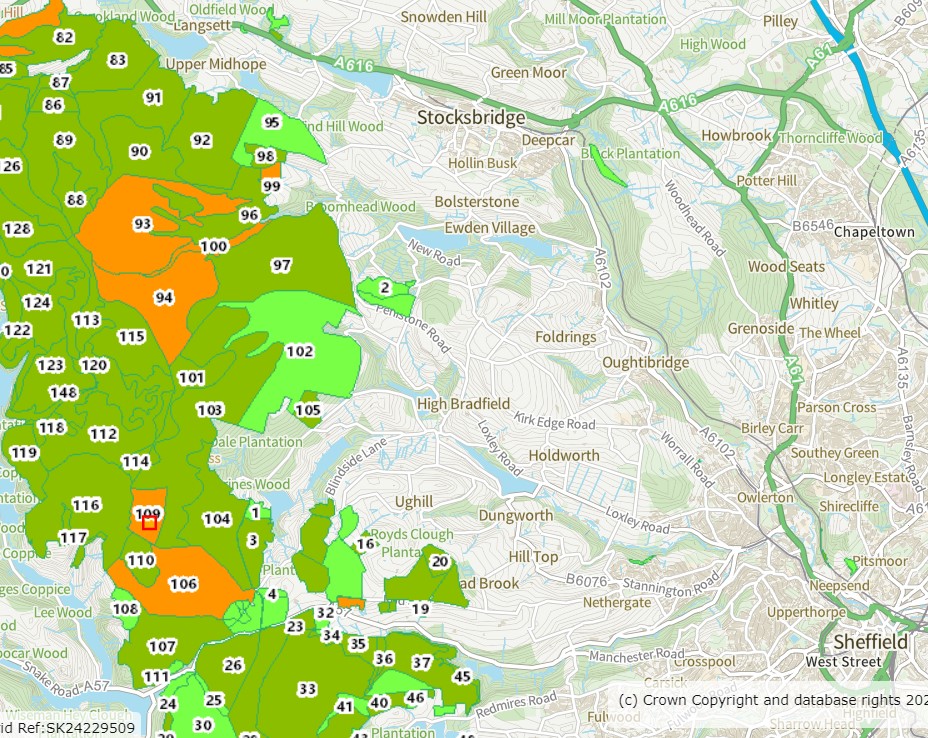
This is land with the highest conservation designations – Sites of Special Scientific Interest, Special Protection Areas for wildlife and Special Areas of Conservation for habitat. Light green means the SSSI has favourable condition. Dark green means unfavourable recovering and pale red means unfavourable no change. Many of the unfavourable recovering sites haven’t been surveyed since 2011 when austerity slashed Natural England’s budget and the few remaining staff rarely visited these sites. The units were given recovering status because of new stewardship agreements which were supposedly going to transform the land but this hasn’t happened. Very clearly these moors are failing.
If we look at the units in pale red which have been surveyed recently, Middle Moss (94) is on the Broomhead Estate and the site visit refers to restoration work – in 2016/17 Broomhead received £530,922 (source FOI) in capital grants for restoration of this unit and others as well as around £2 million over a ten year period in Stewardship funding, mainly to improve conservation.


Surely such expensive restoration work on Middle Moss would result in a huge improvement and we’d now be seeing the benefits? No, the assessment is ‘unfavourable no change’. This land has been in the same family for 200 years – two centuries of burning and drainage to dry the whole landscape and promote a monoculture of heather can’t be undone with a half million pound tranche of restoration money. It’s left to the taxpayer to provide a bottomless pit of money to repair this damage.
Is the atrocious state of Grouse Moors limited to the Peak District?
The Duke of Devonshire’s family have owned Bolton Abbey Estate since 1748. Located in the Yorkshire Dales National Park, it’s been largely assessed as ‘unfavourable declining’ condition (bright red) in the screen grab below:

The Barden Moor unit assessment in 2024 states, “activities relating to grouse management are impacting throughout”. And on Thorpe Fell, “Blanket bog in this unit appears relatively dry and there is a notable lack of sphagnum cover / species… Rewetting, re-vegetating exposed peat and reduction in the intensity of / location of grouse management activities would all likely see an improvement in the condition of both dry heath and blanket bog in this unit.”
In this area of the Yorkshire Dales, grouse management has resulted in dry moors which are unfavourable condition and declining. Managed to death, this huge area of moorland is failing under its current owners.
Grouse moor management is still a constant brake on improvement
Back in the Peak District, Moscar Estate also received huge sums for restoration – £348,800 in 2016/17 but Black Hole Moor unit 109 was assessed as ‘unfavourable no change’ in 2022 and previous “Hot Burns” are one of the contributing factors.
When burning was allowed on this blanket bog the management plan specified “Cool Burns” leaving much of the vegetation intact. Natural England issued the estate with a warning letter in 2016 after I complained about Hot Burns (removing all the vegetation) but that’s the limit of their monitoring.
This year I attended a public inquiry where a Natural England Manager said he’d been tasked with replying to my complaint about the Hot Burns on 9th October 2023 when Sheffield filled with smoke. He described me as a pain in the neck, but apparently at least I kept them honest.
Well I still haven’t had a reply and it seems that Natural England’s historical failure to monitor and act over illegal Hot Burns has led to the ‘unfavourable condition’ of this conservation unit. We all suffer as a result of that because an ‘unfavourable’ assessment means rainfall is flooding downstream and carbon is flooding into the atmosphere. Grouse moor managers know that dry, heather-dominated moors have provided ideal conditions for a huge number of grouse over the last 200 years and they’re not going to give that up.
Natural Flood Management

Sheffield suffered catastrophic flooding in June 2007. The moors are the highest part of the catchment – the area with highest rainfall. Seventeen years on there’s been some progress but nowhere near enough.
The Environment Agency and partners are starting to look at flood prevention measures. But crucially nobody has come up with a coherent plan of how to manage all moorland to provide the best mitigation against flooding. If blanket bog is still in ‘unfavourable’ condition that means the gully blocking has not transformed the landscape. The dams need to create mounds of sphagnum and a wider habitat where the water table is at the surface year round. And there’s still 50% of moorland on thinner peat soils – Dry Heath.

I’d say this is the worst possible management to prevent flooding yet this type of burning is usually described as essential by moorland owners. Under current arrangements there’s zero chance of seeing trees, scrub, more varied vegetation and measures to retain and increase peat coverage such as we’re seeing on blanket bog.

As well as the very obvious failure to prevent, police and prosecute raptor persecution, the same can be said of illegal burning on deep peat supposedly prohibited by The Heather and Grass Burning Regulations from October 2021.
We’ve had two token prosecutions (here) and (here) which did nothing to prevent alleged illegal burning on Fitzwilliam Estate over the last three seasons – all logged with Natural England and Defra. Another example of grouse moor managers desperately trying to maintain dry, heather dominated moors and apparently another example of our authorities looking the other way.
Conclusion
Two hundred years of grouse moor management is a major factor in the dire state of these uplands yet the taxpayer continues to fund practices which harm local and wider communities. We are paying for this land over and over, through subsidies and grants yet it remains the property of a handful of individuals. This is land which was wrenched away from the community and it needs to be taken back to provide benefits for us all.
Extending community ‘right to buy’ to moorlands is a start but we need more – a programme of moorlands coming under state ownership through compulsory purchase if necessary.
Who would manage this state owned land for the benefit of us all? Natural England is an obvious candidate but it would take a ban on grouse shooting for them to do the job effectively and honestly – the reach and influence of the grouse industry is simply too great at the moment.
If this seems like an impossibly high goal, land reform will be discussed and debated in Westminster and the impacts of climate change cannot be ignored forever. There has been probably five consecutive years of poor to non-existent grouse shooting in the Peak District the southernmost and warmest grouse area and extreme weather events and weather patterns are becoming normal. We need urgent, drastic action to put things right.
Please start by lobbying your MP over the English Devolution Bill. And if you want to hear more about all this Guy Shrubsole is doing a speaking tour with his new book.
ENDS
 Raptor Persecution UK
unfortunately my MP is a dyed in the wool Tory and supporter of hunting and fishing and I’d be wasting my time lobbying him. Let’s hope there’s enough opposition to this shocking status quo to make some significant changes.
Thank you. Great blog
“unfortunately my MP is a dyed in the wool Tory and supporter of hunting and fishing and I’d be wasting my time lobbying him.”
If I lobby a hostile MP I make sure my letter (email) is copied to the local press…
I have no doubt that Olivia Blake (olivia.blake.mp@parliament.uk), the Labour MP for Sheffield Hallam who is well versed in these matters, will take every opportunity to pursue this issue – especially now that Labour is back in office.
Thanks Bob for a very enlightening blog.
Excellent blog, excellent topic. The situation is a national scandal.
Yet another lot of mistruths by an urban based “class warrior”!
The suggestion that the National Trust,Sheffield District Council and the Peak District Park have managed better ,the land under their control better,fly’s in the face of the scientific evidence.No out of control moorland fires on any grouse moor around Sheffield!
I have lived at High Bradfield,adjacent to the grouse moors mentioned for 30 years.Previous to that I lived next to The Wildboarclough Estate for 20 years .I do not shoot but have been a regular visitor to all the estates mentioned.
I see raptors on a daily basis around my home.This includes Kestrels,Sparrow Hawks,Merlin’s,Buzzards,Kites,Little,Ling,Tawny and Barn Owls.I also see the occasional Hen Harrier and Osprey.We have a healthy population of curlews(two broods fledged on my farm alone).
The writer seems to be unaware of the existence of Article 17 of the European Convention of Human Rights:-
”Everyone has the right to own,use,dispose of and bequeath his or or law lawfully acquired possessions”
Hi Mark
While I agree with you that some people are overly negative about the state of the PDNP, and I too see the raptors you mention and though I’d broadly agree with you about the success of breeding waders on local grouse moors, I’m not so convinced about the breeding success of waders on the surrounding farmland. I’d like to know where your farm is as I’m one of the of the RSPB Peak District Farmland Waders group and I’m struggling to find any successful nests of Curlew on farmland in the Sheffield part of the Peak District. . Also, even if no wild fires have occurred near High Bradfield in recent years, there are undoubtedly very deleterious results from the intensive management of these moors which is in addition to the burning that takes place. And, we should always take account of the fact that, in addition to management for grouse shooting, there are other reasons for the degradation of local peatlands; pollution, overgrazing, peat and turf extraction etc.
It seems to me that the National Trust need to be given more time before you judge their performance, as they have only recently got onboard with addressing climate change and biodiversity on their land holdings. Fir instance they are doing good work with Moors for the Future on rewetting their High Peak estate. And, the Longshaw Estate has some delightful habitats, and no grouse moor management, but generally good, nature sympathetic, farming practice. As for SCC owned land, its a mixture. SCC own some of the land that is shown in Bob’s blog as SSSI, not all of this is grouse moor, these days anyway. Some is neglected dwarf shrub heath that appears not to have been managed in any way for many years. And, I know in one case (belonging to SCC) this is because of difficulties with access and it having no easy water supply for livestock. I know two of the other SSSIs on Bob’s map very well and some others less well, and I know some of the SSSIs are not grouse moors and never have been, well, not for many years anyway, it is overgrazing and nutrient enrichment that has damaged these. So Bob’s, I’d say, map isn’t a true reflection of the state of Sheffield grouse moors alone. I’m also aware that there are plans to improve other SCC land that is neither SSSI or grouse moor, but is dwarf shrub heath on SCC owned and tenanted farms. And, I suspect that, in the past SCC or it’s predecessor actively stopped some of their lands being designated as SSSIs, presumably because it would limit what they could do with it. I know of at least two of their farms that have good quality dwarf shrub heath, that would make good candidates to be notified, but they are not; but that occurred probably 20 or more years ago. I’d agree SCC’s Big Moor needs some more attention as some areas dominated by Molinia, which I think they’ve struggled to control. But again, this has had nothing to do with grouse shooting for many years.
Speaking as a dweller in the countryside, who works with and alongside a number of bloody good farmers on conservation projects, I find your attitude to someone who clearly has done his research, the typical sort of patronising rudeness that the Countryside Alliance comes out with on a regular basis to justify maintaining the status quo. There is a reason that they have fewer than 50k paying members: they and their attitudes and, by extension it would seem, your attitudes, are not reflected throughout the majority of country folk, like me.
I think that the point you miss in the blog, despite you highlighting it in your last sentence, is that these lands were corruptly acquired at a time when the ordinary people had no voice or representation in Parliament, i.e. before universal suffrage. What this country needs is a repeal of all of the Enclosures Acts. They were simply a mechanism for the rich and powerful to steal the land from the common folk. Just because those Acts have been in place for a long time does not legitimise them.
Brings to mind Barry Hines “The Gamekeeper” (page 82 in my 1988 reprint)
Altercation between the Duke and a miner he comes across who is trespassing/poaching on his land.
Duke (annoyed): “Do you know my ancestors had to fight for this land, my man?”
Miner: “Right then, get your coat off and I’ll fight you for it now.”
“Yet another lot of mistruths by an urban based “class warrior”!
The suggestion that the National Trust,Sheffield District Council and the Peak District Park have managed better ,the land under their control better,fly’s in the face of the scientific evidence.No out of control moorland fires on any grouse moor around Sheffield!”
Not ‘mistruths’ at all: you are simply in denial.
I notice that there is no such body as ‘Sheffield District Council’, so if you are wrong about that, why should anyone take anything else you ‘claim’ seriously?
“have managed better ,the land under their control better,fly’s in the face of the scientific evidence.”
Semi-illiterate rant, without supplying any necessary ‘scientific evidence’.
“The writer seems to be unaware of the existence of Article 17 of the European Convention of Human Rights:-
Everyone has the right to own,use,dispose of and bequeath his or or law lawfully acquired possessions”
No, it does not. You are bullshitting, again.
Article 1 of the Protocol to the Convention states that “No one shall be deprived of his possessions except in the public interest and subject to the conditions provided for by law and by the general principles of international law
The preceding provisions shall not, however, in any way impair the right of a State to enforce such laws as it deems necessary to control the use of property in accordance with the general interest or to secure the payment of taxes or other contributions or penalties.”
See https://www.echr.coe.int/documents/d/echr/convention_eng
I don’t know whether contemporary efforts at rewetting moors by blocking moorland drains – for which there are often grants available – is sincere or not, or truly effective or not. I do know that the reason most draining was done in the first place in many parts of the Pennines was to boost grouse stocks.
Here are the words of Sir Joseph Nickerson, a renowned grouse moor visionary and owner of the shooting at Wemmergill from 1952 to 1989. Writing in his book “A Shooting Man’s Creed’ he says-
“In the twenty years before I took over Wemmergill not a yard of burning or draining had been done. I introduced carefully controlled burning to ensure a regular supply of young heather and put in thousands of miles of drains. The result was an improvement in the grouse population and in the bags.”
The quotation is featured on-
http://www.lunedaleheritage.org.uk/wemmergill.htm
But this local history website have referred to his book as ‘A Shooting Man’s Greed’. Greed – instead of Creed! An apt typo as both terms apply, in my opinion 😆
Also I wonder if his moors were much of a wild-fire risk “In the twenty years before” he took over? In other words before he inaugurated the modern period of burning and draining. Or are they a greater risk today, after 50-60 plus years of modern management for grouse? After all, we are repeatedly told we must count our lucky stars that gamekeepers exist to burn it rotationally and keep it safe.
A well reasoned and argued blog. Thank you Bob.
It demonstrates that we are not all equal in the eyes of the law. All legislation can be repealed and in my naivity I wondered if individual enclosure acts could be repealed and the land returned to the community. Now that would be land reform.
….and the corruption continues.
Maybe our new Government can remove our “wild” places from those that abuse them so blatantly?